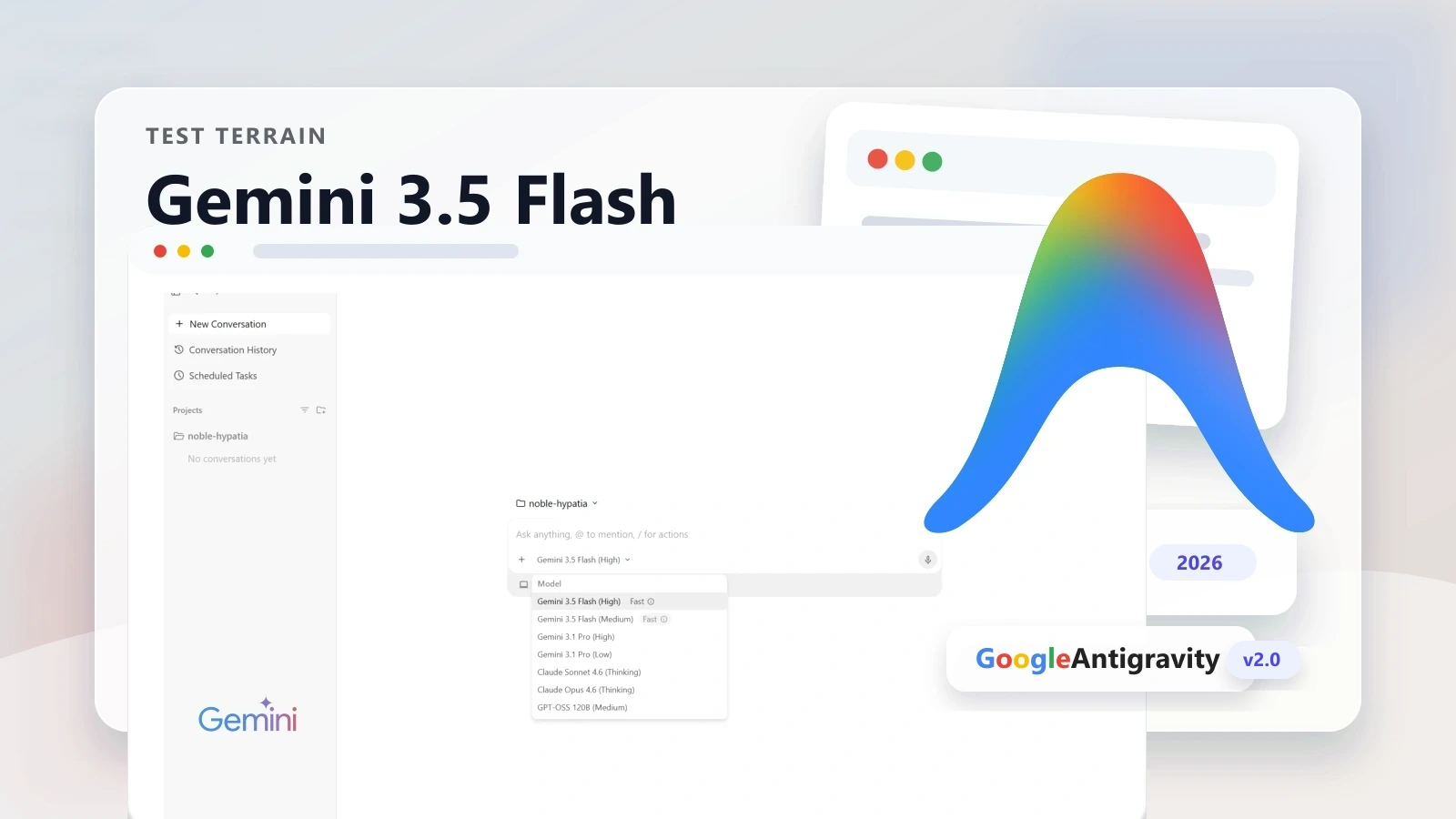
Google has put another coin in the machine. With Gemini 3.5 Flash, announced on May 19, 2026, the promise is clear: keep the speed of a Flash model while substantially improving reasoning, coding and long agentic workflows.
This time, the interesting test is not only in Google AI Studio. The real playground is Antigravity 2.0, Google's new agentic development tool. I tested it with a deliberately long prompt: generate a premium guest-house landing page in vanilla HTML/CSS/JavaScript, with a booking module, coherent art direction, responsive behavior, interactions and visual assets.
Two things happen at once: Gemini 3.5 Flash produces something genuinely clean, while Antigravity 2.0 feels like a step back for developer experience.
What Google announced
According to the official Google DeepMind model card, Gemini 3.5 Flash is the latest iteration of the Gemini 3 series. It is a multimodal model with text, image, audio, video and file input, up to 1 million tokens of context, and up to 64K tokens of text output.
Google distributes it through the Gemini app, Gemini API, Google AI Studio, Android Studio, Search AI Mode and Google Antigravity. The DeepMind page emphasizes agentic workflows, coding, multi-step tasks and long-running processes. This is not merely a faster chat model.
Google's benchmarks position Gemini 3.5 Flash very high on agentic tasks such as Terminal-bench 2.1, SWE-Bench Pro, MCP Atlas and OSWorld-Verified. I treat those numbers as context; the article focuses on a real session.
Antigravity 2.0: simpler, but less developer-first
Antigravity had already been introduced as Google's agent-first IDE. Its first incarnation had a clear VS Code lineage: developer environment, file exploration, extensions, terminal, in short a real technical workstation.
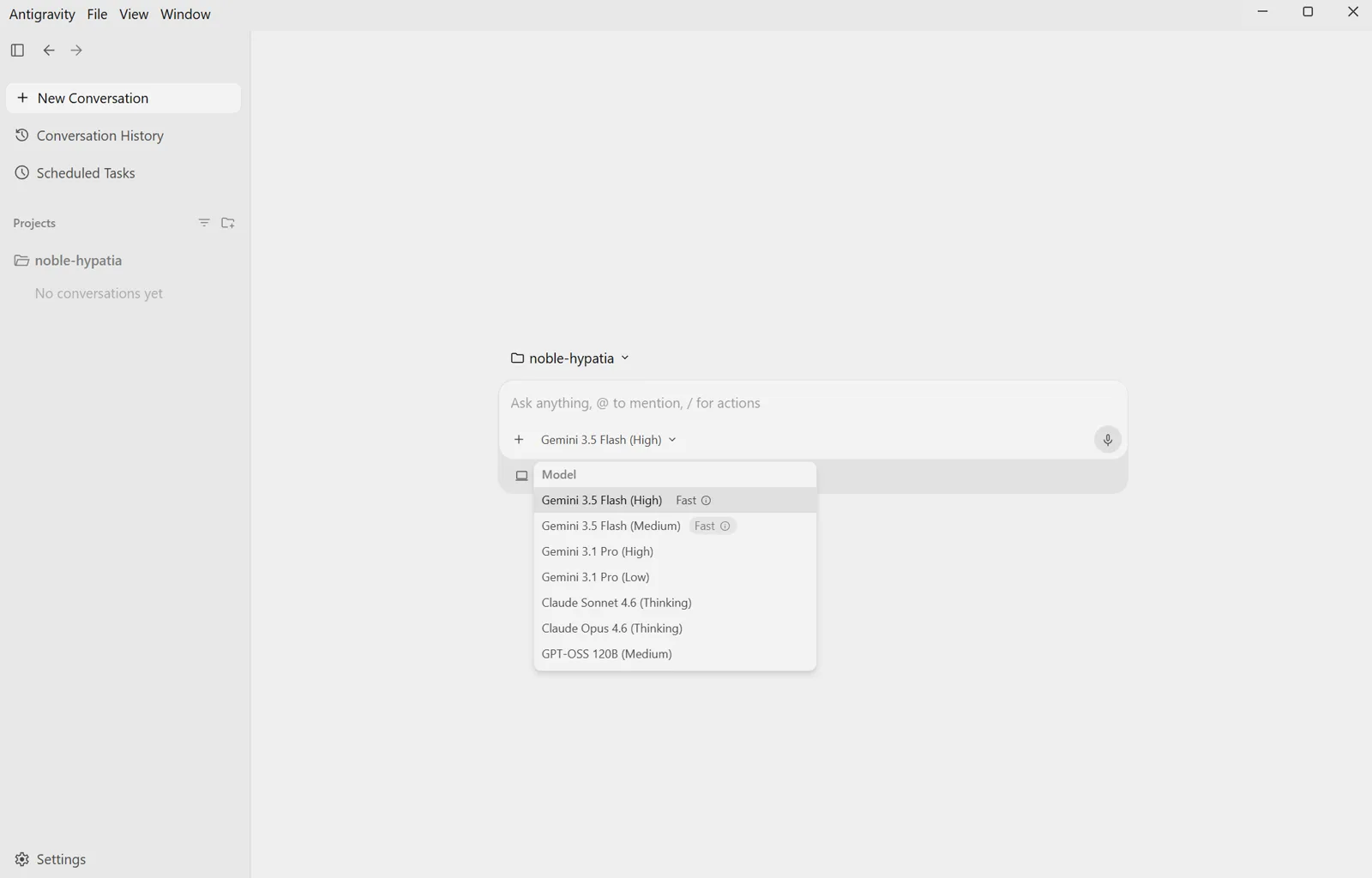
With Antigravity 2.0, my impression is more ambivalent. The interface is simpler, cleaner and less intimidating. But it is also poorer for developers. It feels like a lighter 1.0: more accessible, yes, but stripped of part of what made it valuable as a development environment.
The question is simple: can Google finally offer a credible alternative to Claude Code, Codex, Cursor and OpenCode, tightly integrated with its own model? On paper, the combo is strong: Gemini 3.5 Flash for speed and context, Antigravity 2.0 for agentic orchestration, and deep Google integration. I also place it in my 2026 LLM coding comparison, because the issue is no longer just model quality; it is model plus tool.
The test prompt
I wanted to avoid the toy "build me a todo app" test. I asked for a complete premium guest-house landing page: vanilla HTML/CSS/JavaScript, immersive hero, booking module with validation, presentation, rooms, experiences, gallery, reviews, final CTA and footer, with a warm premium art direction and responsive interactions.
The prompt was long and highly constrained, almost a mini product brief. It tests design, structure, multi-file generation and overall consistency.
First surprise: the visual result is solid
Antigravity first generated an implementation plan. That pattern is now common in agentic tools: you send a prompt, the agent proposes a plan, you approve it, it builds, and then you walk through the project to correct and iterate.
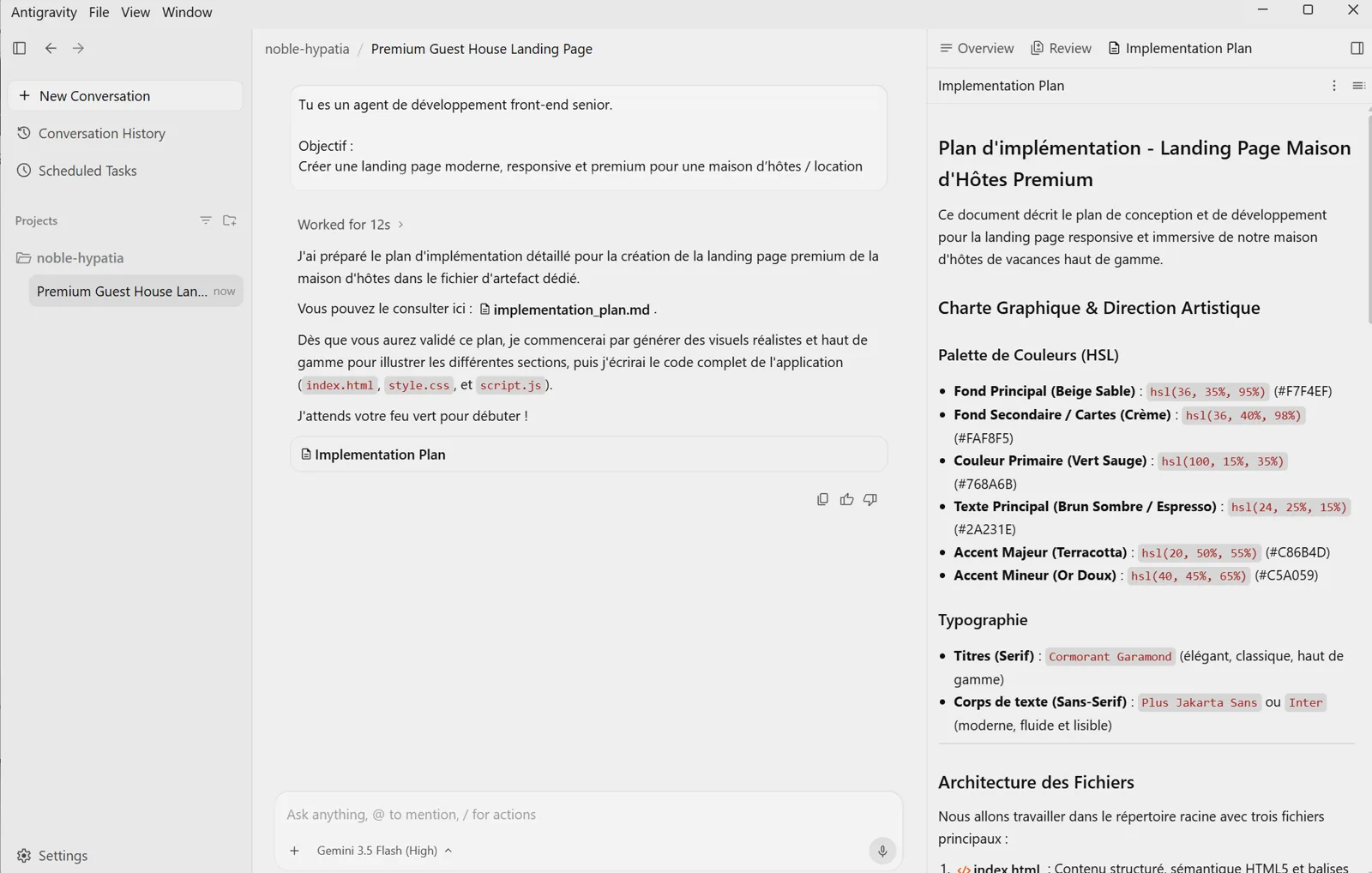
The resulting landing page is genuinely clean. The art direction is coherent: elegant serif, premium Provence atmosphere, warm palette, consistent visuals and a usable booking module. It is not perfect, but it is far above a basic wireframe.
Screenshots of the result




For non-technical or semi-technical users who want to move from intent to a credible first mockup, this is very interesting. You can immediately see where Google wants the product to go: describe, review, comment, iterate.
But Antigravity 2.0 frustrates developers
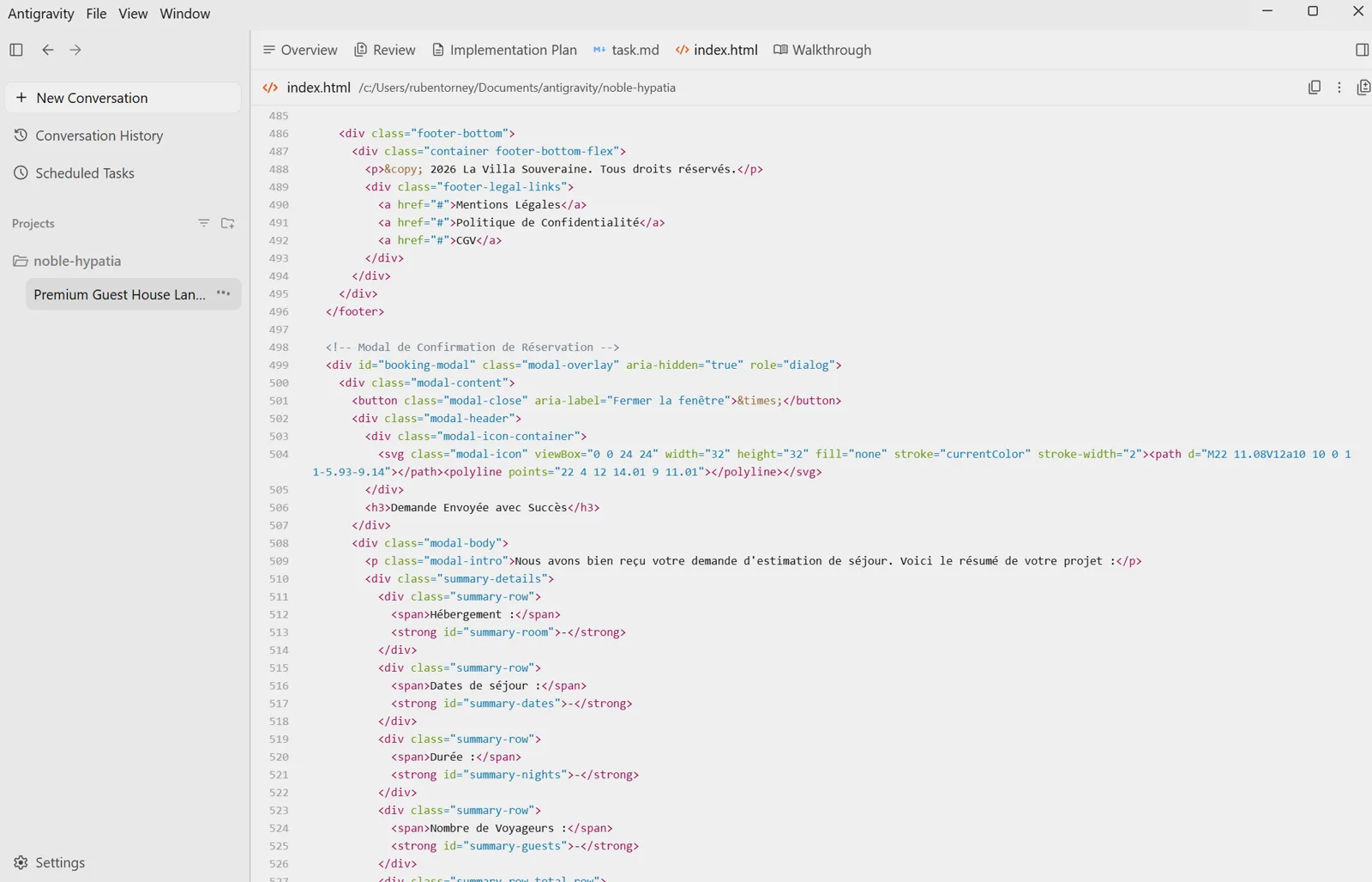
The less flattering part is the tool itself. Antigravity 2.0 feels like a simplified version of the first generation. Visually it is cleaner, but developers lose a lot: the terminal is no longer central, file exploration feels less natural, VS Code extensions are no longer the heart of the workflow, and the product pushes you toward guided agent supervision rather than direct development.
Who is Antigravity 2.0 really for?
My feeling after this test: Antigravity 2.0 is no longer primarily built for developers. It looks more like a simplified agentic environment, close in spirit to OpenCode or Hermes Agent, but with a more accessible visual layer and much stronger Google integration.
That choice can make sense if Google wants to push Gemini 3.5 Flash into more agentic usage. But for a developer who wants to keep control, the product is frustrating: too simplified for advanced developers, still too technical for a fully no-code audience.
First verdict
Gemini 3.5 Flash is credible. On an ambitious frontend prompt, it produces a premium, coherent and usable landing page. As a way to generate a first project base, it is very solid.
Antigravity 2.0 leaves me more skeptical. The interface is cleaner, but part of the developer experience is gone: less terminal, less IDE feel, fewer extension-centered workflows, less direct control.
For a developer, I would not replace Claude Code, Codex, Cursor or OpenCode with Antigravity 2.0 yet. For someone who wants to generate a clean interface quickly from a precise brief, it becomes much more interesting. On that more visual side, OpenCode + Open Design offers another answer: keep the agentic loop, but with more local control.
— Ruben