The Claude Design trigger
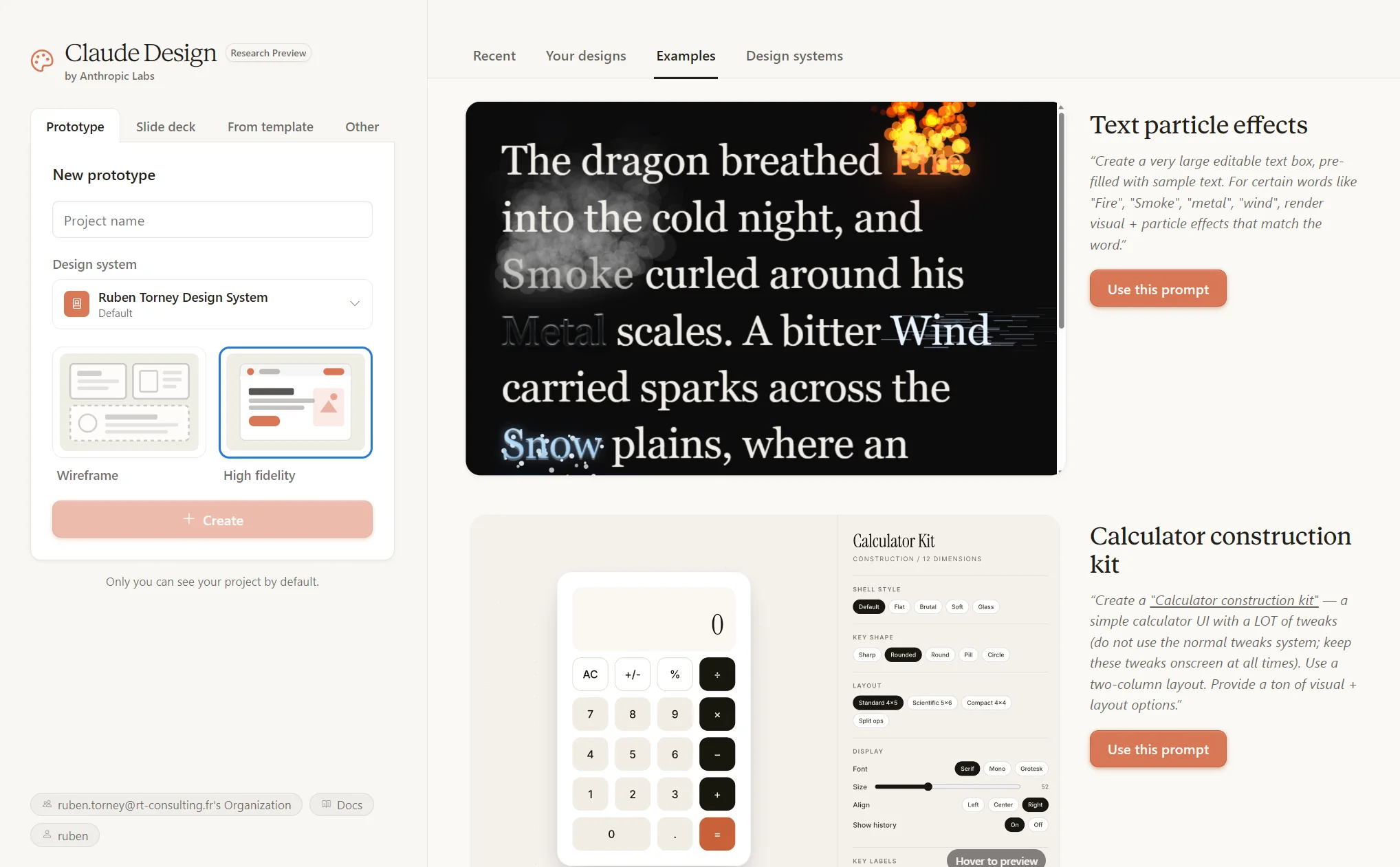
Claude Design introduced a simple but powerful idea: stop working blind with an LLM. Instead of asking the model to describe what we have in mind, ask it to produce a visual artifact directly, then iterate on it.
That is exactly what is often missing when doing design with AI. On one side, models are incredibly fast at generating, correcting and producing variations. On the other, you need to see something concrete, almost like in Figma: an interface, a mockup, components, a visual direction. Claude Design managed to bring these worlds closer together.
The problem is price, closed models and cloud-only workflows. For personal projects, confidential topics or simply a more sovereign approach, you quickly feel boxed in. The tool is excellent, but the workflow remains locked inside one platform.
The good news is that an open source alternative now exists: Open Design. Combined with OpenCode, it becomes a local-first agentic design studio that can use the models and API keys you choose.
The principle
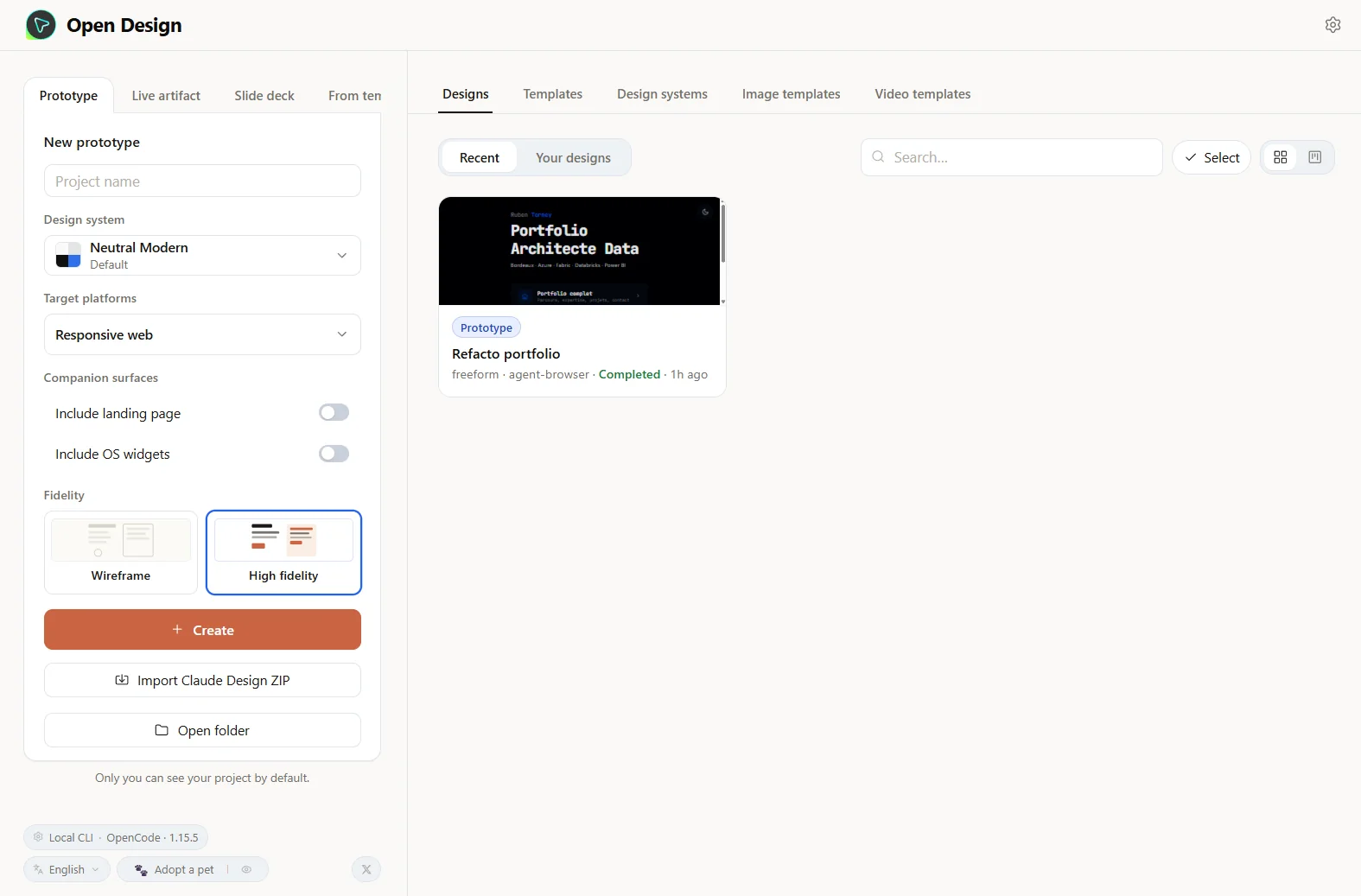
Open Design, the nexu-io/open-design project, does not replace your agent. It orchestrates the agents already available on your machine. That distinction matters: it does not necessarily change the engine, it adds a design production framework around it.
You can keep Codex CLI, OpenCode, Gemini CLI, DeepSeek, OpenRouter or another engine. Open Design adds the missing layer around code agents: briefs, visual directions, skills, design systems, sandboxed previews and exports. That kind of layer becomes especially useful once you start comparing coding LLMs and their real costs.
The result is a local-first, open source and versionable design studio. You no longer have to choose between an efficient visual interface and control over your workflow.
The real point is not only cloning Claude Design. It is reusing its excellent creation process without keeping the lock-in. We keep the visual loop and regain sovereignty.
— field notes
Why it matters with OpenCode
OpenCode is already very good at reading a project, modifying files, running commands and keeping a real terminal-centered workflow. Open Design adds a design framing layer: an interactive brief, prepared visual directions, skills for prototypes and dashboards, sandboxed preview, exports and a real project folder on disk.
The combination is healthy: OpenCode executes, Open Design frames. You keep the files, prompts, exports and model choice.
My portfolio test
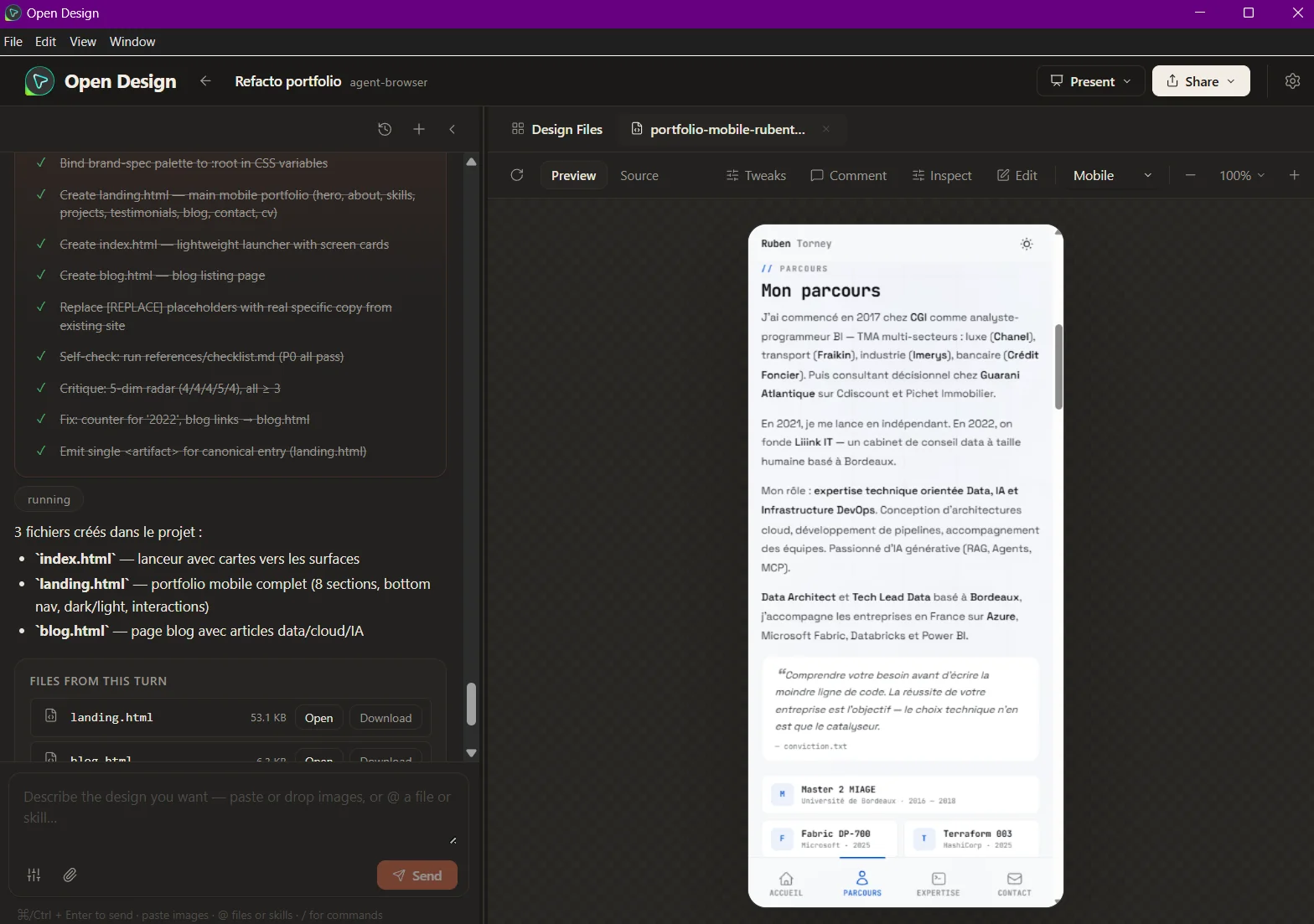
To test the workflow, I used a concrete case: ask Open Design to redesign my portfolio with a different visual direction. The engine behind it was OpenCode, connected to the free model of the moment, DeepSeek V4 Flash Free.
I was not trying to get a final publish-ready version in one prompt. I wanted to see whether the loop felt like Claude Design: brief, generation, preview, correction and recoverable files. On that point, the experience is close. You keep the agentic logic, but can change model, API key or even move to a local model.
Installing Open Design
If you want the fastest route, use the Desktop app. On Windows, download the installer from the releases page, install it as a normal application, then connect your agents and keys. If you do not want to start with a git clone, this is the most comfortable path.
git clone https://github.com/nexu-io/open-design.git
cd open-design
pnpm install
pnpm tools-dev
Open Design then detects the agents available on your PATH. If opencode is installed, it can become one of the generation engines. You can also go through a BYOK proxy compatible with multiple providers, or connect local models depending on your confidentiality needs.
My opinion
It is not magic. An open source tool requires a bit more setup, understanding and sometimes patience. But for a team that wants to understand, adapt, version or self-host its design workflow, it is the right compromise.
I would not sell it as a Figma killer. That is not the point. I see it more as a generation studio: produce a prototype, landing page, deck, poster or operational mockup quickly, then bring the result back into the right stack.
In my portfolio test, the most reassuring point was continuity. You can run OpenCode with DeepSeek V4 Flash Free, then tomorrow switch to OpenRouter, Gemini, Codex CLI or a local model. You do not have to rebuild the whole process because one provider changes pricing or rules. In the same spirit, the Qwen 3.6 Plus free in OpenCode test shows why model freedom becomes concrete.
Conclusion
If you are looking for an open source alternative to Claude Design, I would start with this trio:
- OpenCode for the open source coding agent.
- Open Design for the agentic design workflow.
- Your model, API key or local model to avoid lock-in and regain control.
Personally, Claude Design was the feature that still made me hesitate about keeping Anthropic Max. With Open Design, I can get out of that lock-in, reduce the bill, test other LLMs and regain control of part of my workflow.
It is not as polished as a closed product yet, but it is much freer. And for me, that is exactly the interesting direction for agents: producing real interfaces, real mockups and real artifacts without locking the whole workflow into a single platform.
— Ruben