What really changes with GPT-5.6
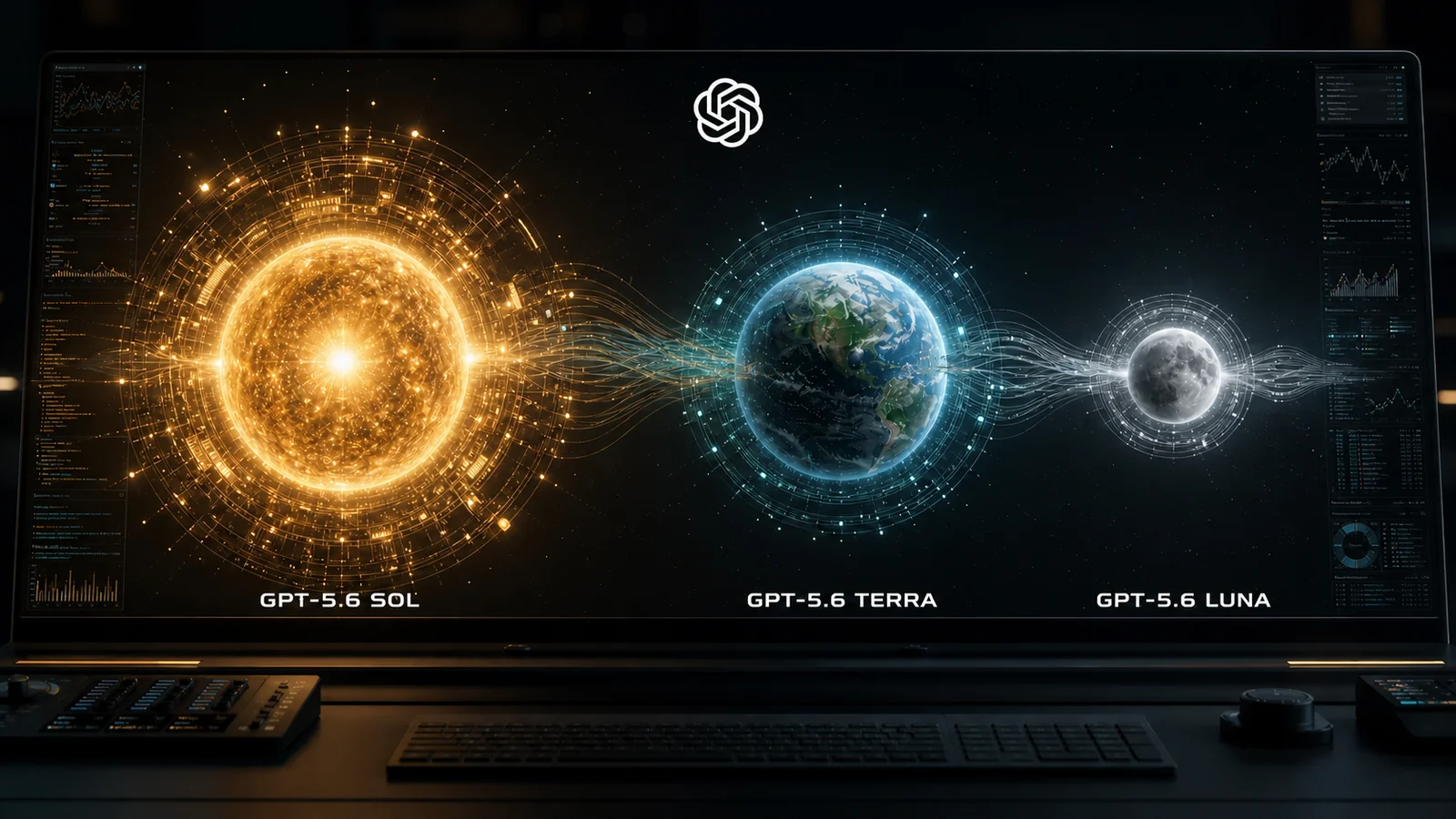
GPT-5.6 launched on July 9, 2026 after a limited preview. The important change is not one more benchmark: OpenAI now splits the family into three durable tiers. Sol is the flagship, Terra the everyday balance, and Luna the fast, cost-efficient model.
All three share a closely aligned technical base:
1.05M tokens of context, up to
128K output tokens, text and image input, reasoning
from none to max, tools, web search, file
search, computer use and MCP. The real difference is compute, speed,
price and the difficulty each tier can absorb reliably.
Do not default to Sol simply because it tops the range. Start with the fastest and cheapest model that can complete the job, then move up only when quality or reliability requires it.
Sol, Terra and Luna: the differences
| Model | Profile | In Codex | API input / output |
|---|---|---|---|
| GPT-5.6 Sol | Highest capability for complex reasoning, difficult coding, research and long workflows. | Architecture, migrations, deep debugging, critical review and multi-step planning. | $5 / $30 per million |
| GPT-5.6 Terra | The balance of intelligence, speed and cost. | Daily development, refactors, tests, documentation and normal agent tasks. | $2.50 / $15 per million |
| GPT-5.6 Luna | The fastest and cheapest tier for high-volume, latency-sensitive work. | Repo search, small fixes, classification, repeated generation and subagents. | $1 / $6 per million |
On paper, Sol wins the hardest tasks. But Terra and Luna are not weak models. OpenAI reports Terra slightly above Claude Fable 5 and Luna above Claude Opus 4.8 in its coding-agent comparison, using much less time, fewer output tokens and lower estimated cost. Vendor benchmarks deserve caution, but the signal is clear: the smaller tiers are designed for real work.
In ChatGPT: Sol is the real Plus upgrade
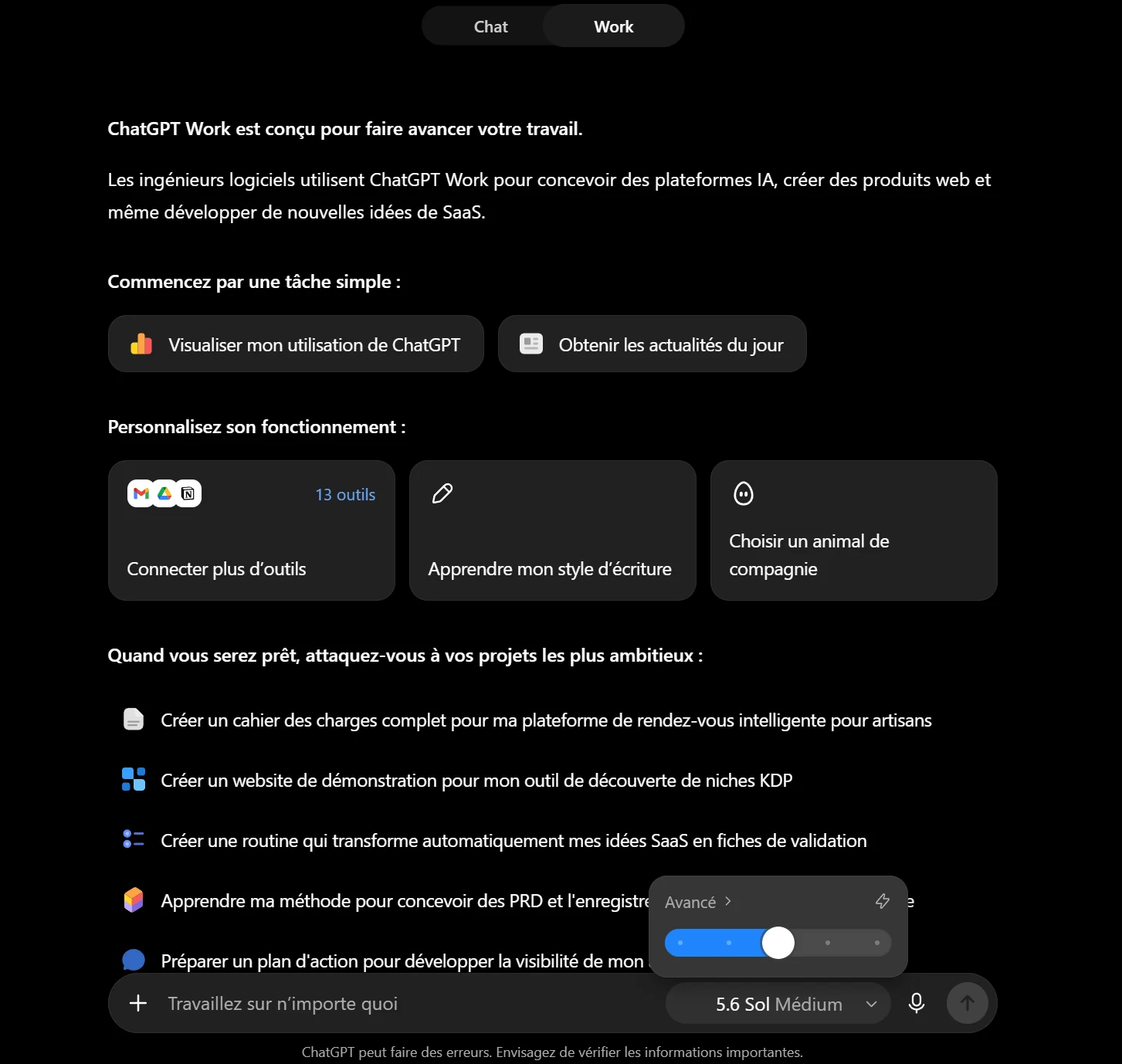
In standard ChatGPT conversations, the $20/month Plus plan does not expose three Sol, Terra and Luna buttons. GPT-5.5 Instant remains the fast default. Selecting Medium or High reasoning uses GPT-5.6 Sol. Extra High and Sol Pro remain available on higher plans.
Use Medium for serious analysis, a difficult document or a multi-step question. Move to High when challenging assumptions, comparing architectures, auditing a body of work or building a robust plan. For a simple request, Instant remains more sensible.
Terra and Luna are not selectable in standard chat. They are available in Work in ChatGPT and Codex for Plus, Pro, Business and Enterprise subscribers.

In Codex: all three models from the $20 plan
Codex is where the family becomes most useful. With ChatGPT Plus,
you can select Sol, Terra or Luna and tune
reasoning effort. max is available, and OpenAI says
ultra is available in Codex from Plus. Use desktop app
version 26.707.30751 or Codex CLI
0.144.0 at minimum.
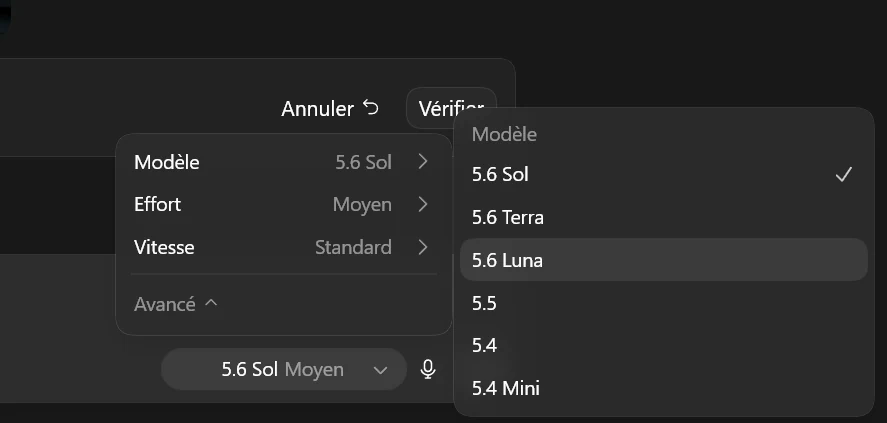
My routing would be simple: Terra for daily work, Luna for fast or parallel delegation, and Sol when the problem genuinely deserves more compute. On a new repo, Terra can inspect structure, run tests and propose a plan. Sol can take over architectural decisions or difficult bugs. Luna can handle mechanical searches, labels, straightforward tests and parallel checks.
How to get the most from each tier
Luna
Split, search and execute short or parallel tasks.
Terra
Build, test, document and run most everyday workflows.
Sol
Reason through architecture, migrations and high-risk decisions.
With Sol: provide a goal, constraints and a stopping condition
Sol is valuable when it can reason over a real problem. Provide the expected outcome, non-negotiable constraints, files or sources to inspect, and verification criteria. High or Max makes sense for migrations, security reviews, architecture and cross-module bugs.
With Terra: optimize for productive throughput
Terra should cover most daily work: features, refactors, tests, PR preparation, data analysis and document transformation. Precise instructions and clean context will often matter more than moving up to Sol.
With Luna: split and parallelize
Luna fits short, repeated and verifiable work. In Codex it is useful for subagents inspecting separate areas of a repo, listing API references, checking translations or proposing tests.
The model does not replace the harness. As models become more capable, context, tools, skills, tests and routing create more of the difference.
— field notes
Live benchmark: one prompt, three models
To move beyond model cards, I am reusing the exact hospitality prompt from my Antigravity, MiMo Code and ZCode tests: a complete guest-house landing page in vanilla HTML, CSS and JavaScript, with a booking flow, responsive layout and working interactions.
Tu es un agent de développement front-end senior.

Objectif :
Créer une landing page moderne, responsive et premium pour une maison d’hôtes / location de vacances, avec un module de réservation simple et une direction artistique chaleureuse, élégante et immersive.

Contexte :
Le site doit donner envie de réserver un séjour dans une maison d’hôtes haut de gamme, située dans un cadre naturel ou patrimonial. L’expérience doit rassurer, mettre en valeur le lieu, les chambres, les services et faciliter la réservation.

Stack souhaitée :
- HTML, CSS et JavaScript vanilla
- Code propre, structuré et maintenable
- Aucun framework obligatoire
- Compatible desktop, tablette et mobile
- Design responsive
- Animations légères et fluides

Pages / sections attendues :

1. Header
- Logo fictif de la maison d’hôtes
- Navigation claire : Accueil, Chambres, Expériences, Galerie, Avis, Réserver
- Bouton CTA visible : “Réserver maintenant”
- Header sticky avec léger effet au scroll

2. Hero dynamique
- Grande image immersive en arrière-plan
- Titre fort, par exemple : “Une parenthèse élégante au cœur de la nature”
- Sous-titre court et rassurant
- CTA principal : “Vérifier les disponibilités”
- CTA secondaire : “Découvrir la maison”
- Effet visuel moderne : overlay, léger mouvement, fade-in ou parallax doux
- Prévoir une image générée ou simulée représentant une belle maison d’hôtes moderne, chaleureuse, avec jardin, piscine ou terrasse

3. Module de réservation
Créer un vrai bloc de réservation visible dès le haut de page :
- Date d’arrivée
- Date de départ
- Nombre de voyageurs
- Type de chambre
- Bouton “Rechercher”
- Validation simple en JavaScript
- Afficher un message de confirmation ou d’erreur selon les champs remplis
- Design premium, clair et facile à utiliser

4. Section présentation
- Présenter la maison d’hôtes en quelques paragraphes courts
- Mettre en avant : calme, confort, charme local, petit-déjeuner, proximité des activités
- Ajouter 3 à 4 badges de confiance : Wi-Fi, Parking, Petit-déjeuner inclus, Piscine / Jardin

5. Section chambres
- Créer 3 cartes de chambres :
  - Chambre Jardin
  - Suite Terrasse
  - Chambre Familiale
- Chaque carte doit contenir :
  - Image
  - Nom
  - Description courte
  - Prix à partir de
  - Bouton “Voir la chambre”

6. Section expériences
- Mettre en avant les activités :
  - Petit-déjeuner maison
  - Balades et nature
  - Détente au jardin
  - Découverte du patrimoine local
- Utiliser des icônes simples ou illustrations légères

7. Galerie
- Grille d’images élégante
- Images représentant la maison, les chambres, le jardin, la terrasse et les petits-déjeuners
- Prévoir des placeholders propres ou générer des visuels cohérents
- Ajouter un effet hover moderne

8. Avis clients
- 3 témoignages clients
- Note moyenne affichée, par exemple 4.9/5
- Design rassurant et premium

9. CTA final
- Bandeau immersif avec fond image ou dégradé
- Texte : “Prêt à réserver votre prochaine escapade ?”
- Bouton : “Réserver mon séjour”

10. Footer
- Coordonnées fictives
- Liens utiles
- Réseaux sociaux
- Mentions légales
- Rappel du CTA de réservation

Direction artistique :
- Style moderne, premium, chaleureux, naturel
- Palette recommandée :
  - Beige clair / sable
  - Vert sauge
  - Blanc cassé
  - Brun doux
  - Accent doré ou terracotta
- Typographies élégantes :
  - Serif moderne pour les titres
  - Sans-serif lisible pour les textes
- UI avec cartes arrondies, ombres douces, espaces généreux
- Ne pas faire un design froid ou trop corporate

Images :
- Créer ou simuler des images cohérentes avec le thème :
  - Maison d’hôtes lumineuse
  - Chambre élégante
  - Terrasse au soleil
  - Petit-déjeuner artisanal
  - Jardin / piscine / nature
- Les images doivent être visuellement cohérentes entre elles
- Utiliser des prompts d’image intégrés dans le code sous forme de commentaires si la génération réelle n’est pas possible

Interactions JavaScript :
- Menu mobile
- Header qui change légèrement au scroll
- Validation du formulaire de réservation
- Message de confirmation après recherche
- Animation légère d’apparition des sections au scroll
- Option bonus : mini-calcul approximatif du prix selon les nuits et le type de chambre

Exigences techniques :
- Fournir tous les fichiers nécessaires :
  - index.html
  - style.css
  - script.js
- Code bien commenté
- Structure claire
- Aucun bug console
- Accessibilité de base :
  - boutons explicites
  - contrastes corrects
  - alt sur les images
  - navigation clavier correcte
- Performance correcte :
  - images optimisées ou placeholders propres
  - animations légères

Critères d’acceptation :
- La landing page doit être visuellement professionnelle dès le premier écran
- Le module de réservation doit être utilisable
- Le rendu mobile doit être propre
- Le hero doit avoir un impact visuel fort
- Le design doit donner envie de réserver
- Le code doit être prêt à être repris par un développeur
- Le résultat doit pouvoir servir de base à un vrai site vitrine de maison d’hôtes

Livrable attendu :
Génère directement le code complet des 3 fichiers :
1. index.html
2. style.css
3. script.js

Ne te contente pas d’une maquette statique : crée une vraie landing page fonctionnelle avec interactions.
The comparison page renders all three results in the same frame, with no editorial fixes before comparison. GPT-5.6 Sol Medium, GPT-5.6 Terra Medium and GPT-5.6 Luna Medium use the same prompt and protocol.
Open the benchmark to compare all three interpretations, then test navigation, booking validation, price estimation and responsive behavior directly in the browser.
My take on the three results
The page produced with GPT-5.6 Sol is the strongest in my view. Its scroll effects are more sophisticated, the composition feels more deliberate, and the overall result has a slightly more premium quality. Terra and Luna deliver fairly similar results: they are a little less elaborate, but remain refined, elegant and professional enough for a real-world project.
These are probably the most accomplished pages I have obtained since I started testing this prompt, including against Gemini 3.5 Flash, MiMo 2.5 Pro and GLM-5.2. You can feel how much the Codex harness has improved at producing increasingly polished interfaces from the very first prompt.
Across all three Codex tests, multimodality and the use of ImageGen work extremely well. The models' reasoning also feels a step above GPT-5.5: they were able to correct themselves, improve their output and test responsiveness across several screen sizes. That applies to Sol, Terra and Luna alike. There is no low-end model here; all three are already highly capable and can deliver a genuinely usable result.
Pricing, caching and limits
ChatGPT Plus costs $20 per month, but API calls are
separate. Using gpt-5.6-sol,
gpt-5.6-terra or gpt-5.6-luna from your
own application is billed independently. Inputs over 272K tokens
also trigger higher long-context pricing for the full request.
Prompt caching now has a 30-minute minimum life. Cache reads receive a 90% discount, while cache writes cost 1.25 times the normal input rate. This can matter for agents that repeatedly reuse a large project context.
Finally, included in Plus does not mean unlimited. Limits vary by plan and system conditions. Codex usage depends heavily on repo size, task duration and reasoning effort.
My pick: Terra by default, Sol when it matters, Luna for volume
With Plus, I would not use Sol High for everything. In chat, I would keep Instant for simple requests and Sol Medium for serious analysis. In Codex, Terra would be my default because it has enough capability for most work while remaining faster and more efficient.
Sol is the right choice when mistakes are expensive: architecture, migrations, security, major refactors and difficult decisions. Luna should accelerate the system around the model: searches, parallel tasks, checks and repeated generation.
This family reinforces what I observed in my coding LLM comparison and with Hermes Agent: finding a magic model matters less than building an environment that chooses the right compute level, provides the right context and verifies the outcome. At $20 per month, GPT-5.6 is compelling not only because of Sol, but because Codex gives you three levers and lets you decide when to use each one.
Sources
- OpenAI — GPT-5.6: Frontier intelligence that scales with your ambition, July 9 launch, availability, benchmarks and pricing.
- OpenAI Help — GPT-5.6 in ChatGPT, plan access and product differences.
- OpenAI API — Models, context, output limits, tools and reasoning levels.
- OpenAI API — GPT-5.6 Sol, technical details and long-context pricing.
- OpenAI API — GPT-5.6 Terra, positioning, context and pricing.
- OpenAI — ChatGPT pricing, Plus plan price.
- OpenAI Help — Using Codex with your ChatGPT plan, inclusion and variable limits.