
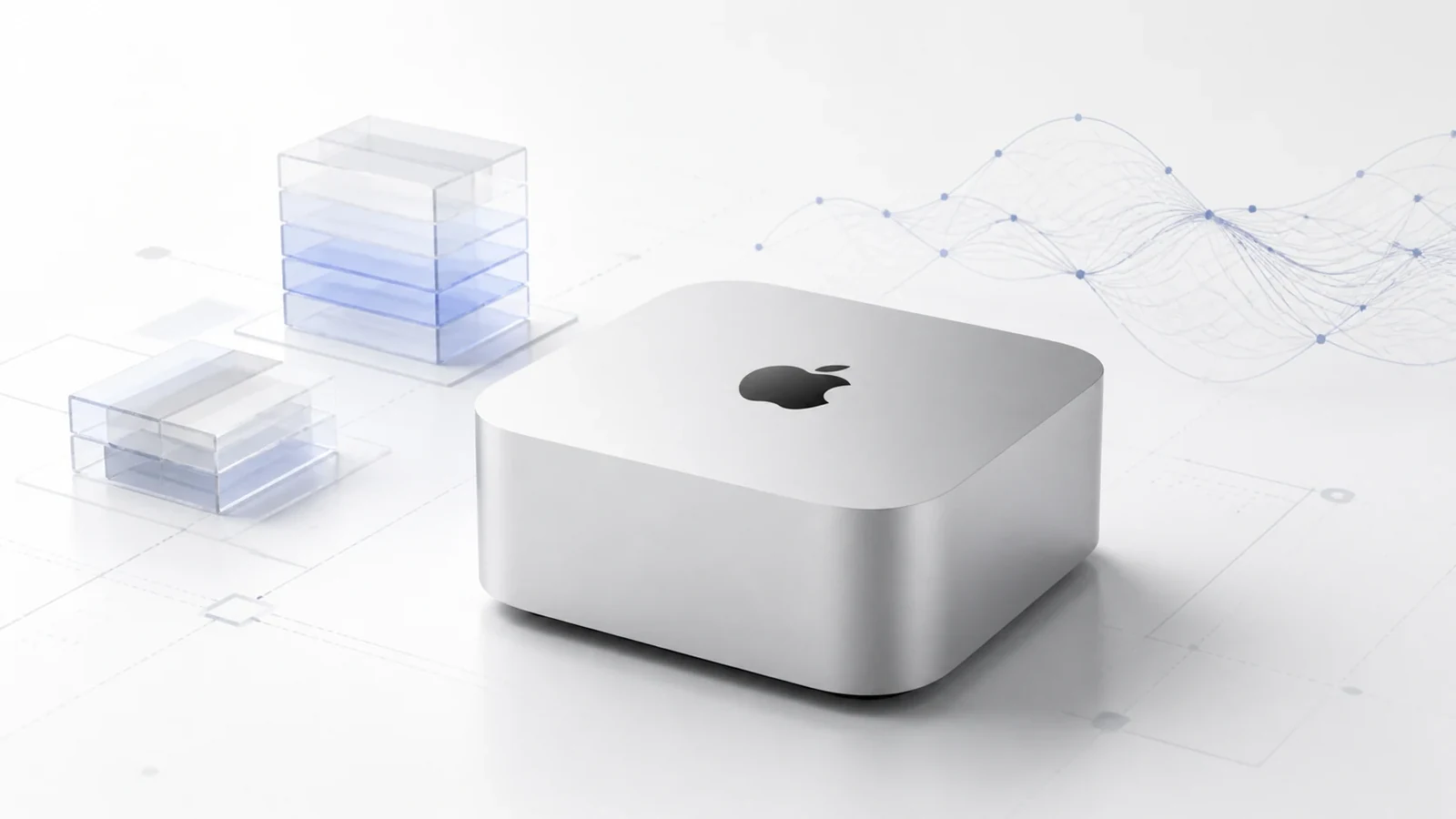
The 128GB M5 Max is already a strong entry point for dense 27B to 70B models and compact MoEs. The 256GB M5 Ultra moves into another category. It can host suitable quantizations of Qwen3.8-Flash-Next, DeepSeek V4 Flash or GLM-5.3 Flash, preserve room for context and serve an agent such as Hermes from one machine.
The purchase does not quickly pay for itself against an occasional cloud subscription. The case becomes convincing when privacy, guaranteed capacity, freedom from token billing, offline work and control over the stack have real value.
What Apple actually launched
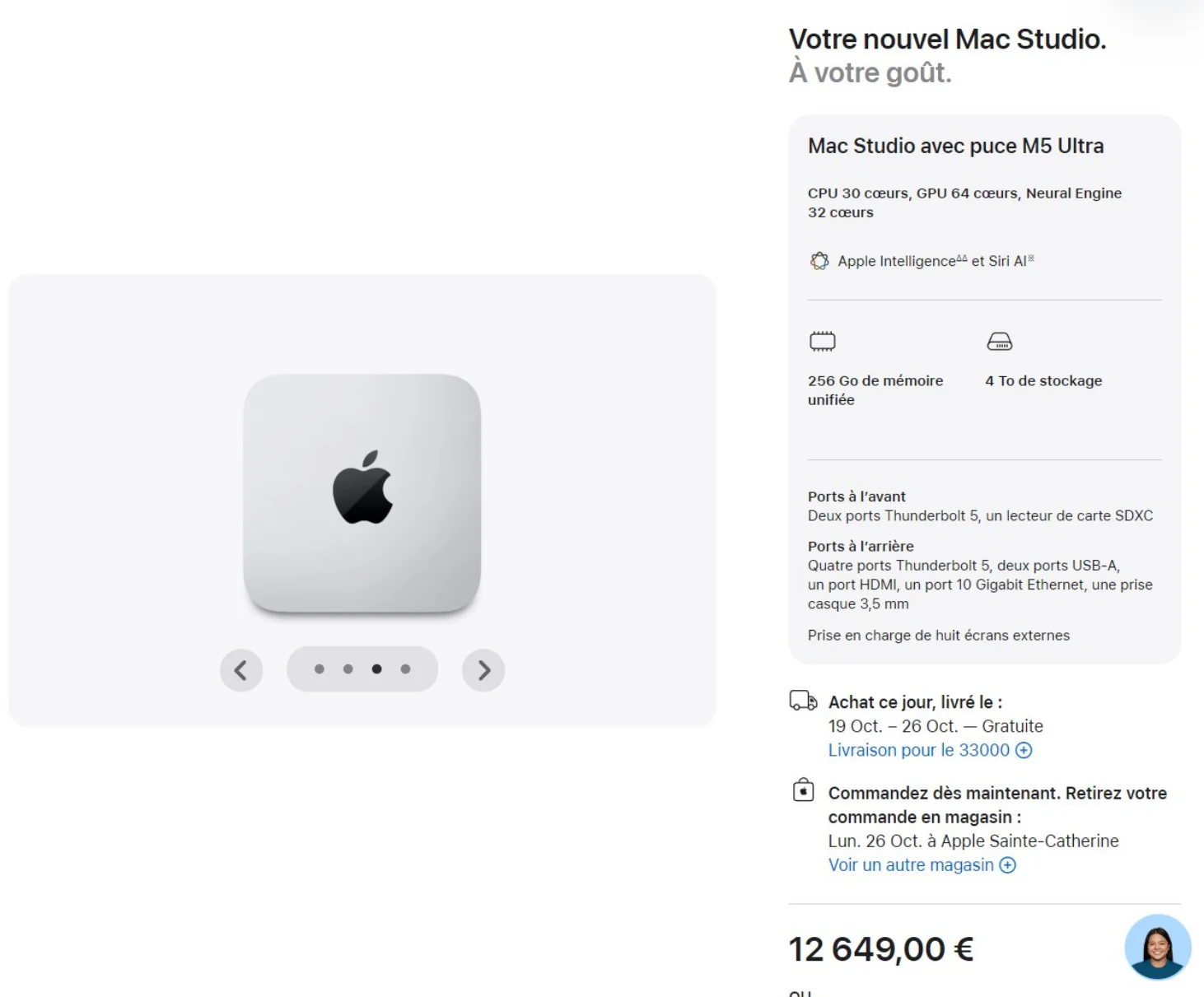
Apple opened pre-orders on August 25, 2026. Deliveries begin on September 22, while the 512GB option is due in late October. The configuration observed on September 2 combined a 30-core CPU, 64-core GPU, 256GB of unified memory and 4TB of storage for €12,649 including VAT. Apple then showed an October 19 to October 26 delivery window for Bordeaux.
M5 Max scales to 128GB and 614GB/s. M5 Ultra offers 256GB or 512GB at 1.2TB/s. Moving from 256GB to 512GB adds capacity, not bandwidth. The decision therefore depends mainly on model weights, KV cache and how many models must remain resident.
| Configuration | Maximum memory | Memory bandwidth | Local AI position |
|---|---|---|---|
| Mac Studio M5 Max | 128GB | up to 614GB/s | 27B to 70B, small and medium MoEs |
| Mac Studio M5 Ultra | 256GB or 512GB | 1.2TB/s | large MoEs, multiple models, long context |
| Mac Studio M3 Ultra | 256GB or 512GB | over 800GB/s | still a very powerful reference for the largest models |
| NVIDIA DGX Spark | 128GB | 273GB/s | CUDA, models up to 200B according to NVIDIA |
Apple claims up to four times faster prompt processing in LM Studio than M3 Ultra. That result comes from Apple's own test and should not be read as four times faster generation. Decode speed still depends heavily on model architecture, quantization, context length and runtime.
Why 128GB is already serious
Discrete GPU VRAM is a hard boundary. A 24GB or 32GB card cannot treat hundreds of gigabytes of system RAM as local VRAM. Offloading and transfers quickly reduce throughput.
Apple Silicon uses unified memory accessible to both CPU and GPU. MLX is designed around that model and avoids unnecessary copies. Memory is not infinite, but a very large share of 128GB can be allocated to weights and cache.
A 128GB system supports several durable workloads.
- Dense 27B or 32B models can run at comfortable quantizations and high speed.
- A 70B model at 4 bits fits with room for context and tools.
- Compact MoEs such as Qwen3.8-Flash-Next can be very fast because only a few billion parameters are active per token.
- Two smaller models can stay loaded, such as a main model and a fast router or vision model.
The boundary appears when resident weights approach 100GB to 120GB. macOS, the runtime, context and buffers need memory too. Buying 128GB for a 125GB model file means operating without headroom.
That does not make the 128GB version useless. Far from it. DeepSeek V4 Flash is a good example. The model has 284B total parameters but only 13B active per token. Very compact quantizations can fit within 128GB with a compatible runtime, reasonable context and carefully managed headroom. More quality or cache compromises are required than on 256GB, but the result can still be a strong local coding and agentic model.
Keep 128GB local and rent the peaks
The machine does not have to be sized for the rarest workload. A 128GB workstation can handle everyday local inference, then rent a European GPU for a heavier quantization, unusually long context or batch job.
Scaleway lists an L40S in its Paris region from €1.46 per GPU hour before tax and an H100 PCIe around €2.86. Nebius publishes an L40S in its European region at $1.35 per hour plus CPU and RAM, and an H100 at $2.95. Depending on the exact instance and supporting resources, roughly €2 per hour is therefore a reasonable order of magnitude for occasional capacity. H100 and multi-GPU configurations cost more.
This hybrid approach avoids locking several thousand euros into memory used only a few hours each month. Scaleway operates GPU capacity in Paris and Warsaw. Nebius offers European capacity in Finland and is also developing infrastructure in France. Genuine European sovereignty still requires selecting an EU region, keeping storage and logs there, governing access and checking the contractual framework. European rental reduces dependency, but it does not provide exactly the same control as a machine disconnected from the cloud.
Why 256GB changes the category
At 256GB, Apple is not merely doubling a specification. It opens access to models that do not fit cleanly on a 128GB system.
After macOS, MLX or llama.cpp, buffers and KV cache, keeping resident weights below roughly 220GB to 240GB is prudent. The exact headroom depends on runtime and context. That still leaves enough capacity for 3-bit or 4-bit quantizations of several leading MoE models.
| Model | Published architecture | Realistic reading on 256GB |
|---|---|---|
| Qwen3.8-Flash-Next | 125B, 6B active, plus embeddings and MTP | Strong candidate with a suitable quantization |
| DeepSeek V4 Flash | 284B, 13B active | Community Q4 builds can fit with measured headroom |
| GLM-5.3 Flash | 320B, 18B active | Q3 or Q4 is plausible, 8-bit is better suited to 512GB |
| Dense 70B model | 70B active | Can run at high precision depending on format |
| DeepSeek V3/R1 671B | 671B total | 256GB requires aggressive quantization, 512GB is more sensible |
In 2025 Apple demonstrated a 670B DeepSeek model quantized to 4.5 bits on a 512GB M3 Ultra. The weights alone used about 380GB. The lesson is simple. The 256GB tier targets modern 125B to 320B MoEs and smaller dense models. The 512GB tier targets 670B-class families with healthier quantization.
MoE makes this machine much more relevant
A Mixture-of-Experts has many total parameters but activates only a fraction for each token. All weights must remain addressable, which makes capacity important. The heaviest compute and memory reads focus on selected experts, which makes bandwidth and runtime layout equally important.
Qwen3.8-Flash-Next publishes 125B parameters with 6B active. DeepSeek V4 Flash publishes 284B with 13B active. GLM-5.3 Flash publishes 320B with 18B active. These are precisely the architectures that turn 256GB of unified memory into a practical tool instead of a theoretical luxury.
There is a catch. A low active parameter count does not guarantee high speed. Expert routing, weight layout, prefill, attention, KV cache and Metal kernel maturity all matter. A specific model, quantization and context should be benchmarked before a professional purchase.
Can it really deliver 30 to 50 tokens per second
Early community reports reviewed for this article already place DeepSeek V4 Flash around 30 to 40 tokens per second on some M5 Max 128GB recipes. Lower numbers appear with stock llama.cpp and long contexts, while specialized engines can dramatically improve prefill.
The 30 to 50+ tok/s mentioned in my initial take should therefore be read as a range that can be achieved with suitable models and quantizations, not a universal M5 Ultra guarantee. There is not yet a broad, reproducible public benchmark set for this new machine.
The more useful point is that 20 to 40 tok/s from a strong agentic model is already comfortable for code, research and tool use. End-to-end time often depends more on shell commands, tests, browsers and APIs than on decode speed alone.
An alternative to multiple DGX Spark systems

One DGX Spark provides 128GB at 273GB/s, 4TB of storage, a 140W GB10 SoC and, crucially, CUDA. NVIDIA documents support for models up to 200B on one machine and 405B on two connected systems. Two Sparks therefore offer 256GB in aggregate, the same raw capacity as the Mac Studio reviewed here, but not a memory pool as simple as one host. Weight placement, communication and runtime support become operational concerns.
Pricing makes the comparison much more interesting. On September 2, LDLC listed the 4TB DGX Spark at €6,099.95 with availability beyond fifteen days. Other European offers approached €6,999. A realistic current range is therefore roughly €6,100 to €7,000 per unit, with uneven availability.
| Solution | Memory capacity | Published bandwidth | Storage | Observed or estimated price |
|---|---|---|---|---|
| Mac Studio M5 Ultra 256GB | 256GB on one node | 1.2TB/s | 4TB | €12,649 |
| Two DGX Spark systems | 2 × 128GB aggregate | 273GB/s per node | 2 × 4TB | roughly €12,200 to €14,000 |
| Mac Studio M5 Ultra 512GB | 512GB on one node | 1.2TB/s | 4TB in this projection | unannounced, around €20,000 in my estimate |
| Four DGX Spark systems | 4 × 128GB aggregate | 273GB/s per node | 4 × 4TB | roughly €24,400 to €28,000 |
This equivalence is about memory capacity, not performance. Two or four Spark systems do not magically become one unified 256GB or 512GB memory pool. The model and traffic must be distributed across machines. The Mac, by contrast, keeps weights, cache and runtimes in one memory space. That makes it particularly practical for personal inference, development and local agents.
The 256GB Mac Studio M5 Ultra keeps the capacity inside one system. Its published bandwidth is more than four times that of one Spark. That does not make it four times faster. Tensor Cores, CUDA, TensorRT-LLM, batching and NVIDIA kernels can give Spark the advantage in many workloads.
NVIDIA still has a major software advantage. Its drivers, DGX OS, CUDA, cuDNN, TensorRT-LLM and NIM form an exceptionally optimized and widely adopted stack. Fifth-generation Blackwell Tensor Cores support NVFP4. NVIDIA advertises up to one petaFLOP of sparse FP4 performance on Spark and provides first-party tooling to quantize and deploy models in that format. This integration remains hard to beat when a project already depends on CUDA or needs highly optimized serving throughput.
The Mac nevertheless has less and less to envy for the workloads discussed here. MLX keeps improving, unified memory avoids part of the transfer overhead, and 1.2TB/s can feed very large models inside one machine. Spark retains the more mature ecosystem. Mac gains single-node capacity, simplicity and, in this price comparison, usable value.
The 512GB version is therefore worth watching closely. Apple confirms late-October availability but has not published its French price. My estimate places a comparable 4TB configuration around €20,000. That is not an official price. Even there, it would provide the raw memory capacity of four current DGX Spark systems on one node, while those four machines would currently cost roughly €24,400 to €28,000. For large MoEs, the Mac value proposition could become stronger still.
The Mac is rational when fitting a large model with minimal complexity is the primary problem. Spark remains preferable when software depends on CUDA, must serve many concurrent users or already relies on a validated NVIDIA stack.
What about an eight-GPU rig
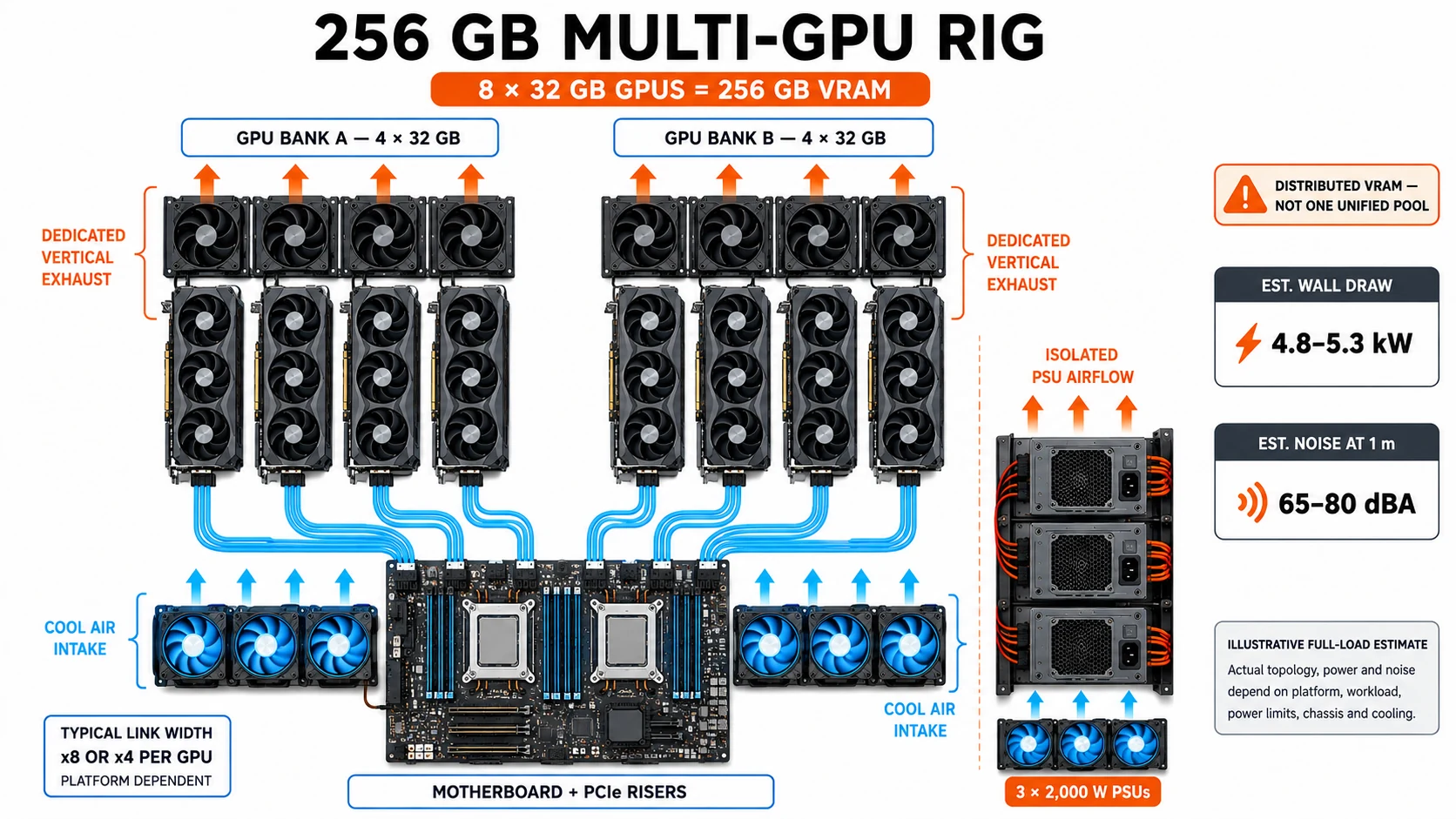
Eight 24GB or 32GB cards provide 192GB to 256GB of aggregate VRAM and much more raw compute. They also require a suitable motherboard, large power delivery, cooling, physical space, interconnects and real software discipline.
This remains a conceptual layout. Depending on the platform, all eight links will not necessarily run at PCIe x16; x8 or x4 per card is common. Cooling should also separate the two GPU banks and isolate PSU airflow so neither the GPUs nor the power supplies ingest air already heated by another component.
Mac Studio does not replace that rig for heavy training, large batches or CUDA-only kernels. It can avoid building one for personal inference, a RAG lab, a private coding server or a handful of internal agents.
Apple also supports clustering over Thunderbolt 5 and claims up to three times faster distributed inference across multiple Mac Studio systems. I would still start with one. Anything that fits on a single node avoids synchronization and another failure mode.
MLX makes the hardware useful
Memory capacity is irrelevant without a capable software stack. Apple designed MLX for Apple Silicon. MLX-LM can load, quantize, fine-tune and serve LLMs from Python or the command line. Its benchmark tools report prefill, generation speed and peak memory separately instead of reducing a system to one flattering number.
“In my view, Apple is preparing its own local AI models, deeply optimized for Apple Silicon. The hardware, unified memory and MLX are already in place. If the company completes that foundation with a truly mature software stack, it could control almost the entire chain and offer one of the most coherent all-in-one platforms for local AI.”
— Ruben Torney
The ecosystem moves quickly but remains less universal than CUDA. Some architectures arrive later, many quants are community builds and regressions still appear with hybrid models or very long generations. That immaturity belongs in the purchasing decision.
For OpenAI-compatible software, a local MLX server can still expose a standard endpoint. That is enough to connect an interface, RAG pipeline or agent without rewriting the whole application.
Hermes on Mac Studio is a real use case
Hermes Agent supports OpenAI-compatible endpoints and documents local Mac models through MLX and omlx. A 256GB Mac Studio can therefore become an always-on agent brain available across the local network.
The main model can code, browse, analyse documents and call tools. A smaller second model can handle fast tasks. A multimodal option such as DeepSeek V4 Flash Vision or GLM-5.3 Flash can read screenshots and attachments without sending data to another provider.
This architecture brings three concrete gains.
- Code, documents and conversations stay on the machine.
- The marginal cost of a long task is close to zero beyond electricity.
- The agent does not stop because a quota changes or a provider downgrades a model.
In return, the owner must manage updates, backups, network security and observability. Sovereignty is never a magic switch.
€12,649 new versus €19,999 refurbished
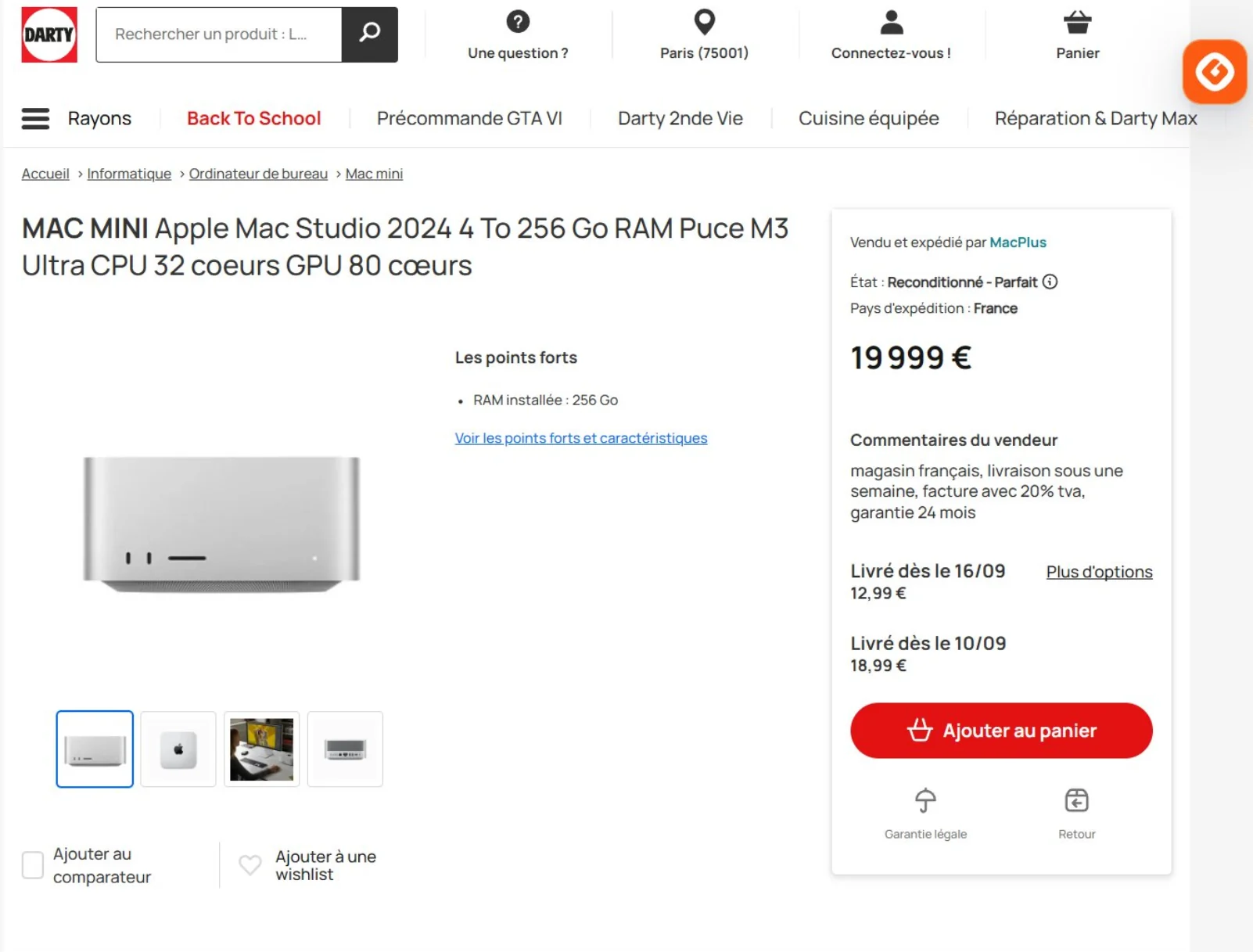
The secondary market makes this launch unexpectedly competitive. On September 2, a marketplace listing on Darty showed a refurbished M3 Ultra with 256GB, 4TB, a 32-core CPU and an 80-core GPU at €19,999. The new M5 Ultra configuration observed on Apple with the same memory and storage was €12,649.
The gap is €7,350. The new model adds 1.2TB/s of bandwidth versus over 800GB/s on M3 Ultra, a new-product warranty and newer AI hardware.
Precision matters. The Darty figure is one third-party seller's asking price, not evidence that units transact at that level. It is not a market average. It does show the scarcity and rigidity of high-memory M3 Ultra inventory. In this snapshot, buying new is much more rational than paying the previous generation's scarcity premium.
The calculation against a cloud subscription
Compared with a $200 monthly subscription, €12,649 represents more than five years before electricity, maintenance and cost of capital. For occasional Claude, ChatGPT or Grok use, the Mac does not win on price.
The calculation changes with constant use, multiple users, long-running workloads or sensitive data. Local hardware provides fixed capacity at any hour without per-token billing. It also retains resale value and can be used for development, video, data work or compilation.
The real purchase is still about something else. Code and documents remain under your control. Exposure to model changes, quotas, commercial policies and extraterritorial laws is reduced. It is not the cheapest answer for everyone. It is the price of sovereignty for teams that need it.
Reasons to hesitate
- Memory is fixed at purchase, so a sizing mistake cannot be fixed with two DIMMs.
- CUDA remains essential for many tools, training workloads and specialized kernels.
- Real gains from the new Neural Accelerators depend on MLX and runtime adoption.
- Very long contexts consume substantial memory and slow down prefill.
- Apple's 480W figure is maximum continuous power, not typical inference draw.
- Local privacy still depends on the operating system, installed software, remote access and backups.
Which configuration should you choose
M5 Max 128GB. The best balance for developers running 27B to 70B models, compact MoEs and a quiet workstation. Avoid buying it for a quant that already fills almost all memory.
M5 Ultra 256GB. The sweet spot for current large MoEs, multiple resident models, local vision and a serious Hermes deployment. This is the configuration I find most rational for professional sovereign AI.
M5 Ultra 512GB. The choice for 670B-class models, higher-bit quants, several large services or research. It arrives in late October and costs substantially more.
My verdict
€12,649 remains a very large amount of money. Yet compared with a €19,999 asking price for an equivalent refurbished M3 Ultra, the bandwidth gain and the ability to host genuinely useful MoEs make the 256GB M5 Ultra look like a strong value inside its niche.
I would not recommend it to someone merely looking for a cheaper Claude subscription. I would seriously consider it for private code, RAG, document research, local vision and autonomous agents working for several hours each day.
It is compact, quiet and much easier to operate than an eight-GPU rig. The trade-off is a narrower ecosystem than CUDA and a high upfront investment. Everyone has to decide where to place the slider between cost, speed, simplicity and sovereignty.
Quick questions
Can a 256GB Mac Studio M5 Ultra replace two DGX Spark systems?
It can replace them for some inference workloads where single-node capacity, simplicity and MLX matter more than CUDA. It is not a universal replacement for batching, training or NVIDIA-optimized applications.
Which models fit in 256GB?
Suitable quantizations of Qwen3.8-Flash-Next, DeepSeek V4 Flash and GLM-5.3 Flash can fit with varying context headroom. A 4-bit 671B DeepSeek model is better suited to 512GB.
Can it really reach 30 to 50 tokens per second?
Yes for some combinations of model, quantization, context and runtime. It is not a general guarantee. Reproducible M5 Ultra benchmarks are still needed for precise expectations.
Is Mac Studio more sovereign than a cloud API?
It can keep weights, prompts and data on premises. Sovereignty remains partial unless the operating system, updates, models and network access are governed as well.
Sources
- Apple, Mac Studio M5 Max and M5 Ultra technical specifications.
- Apple Newsroom, Mac Studio M5 announcement and pre-order schedule.
- Apple Developer WWDC25, large language models with MLX.
- Apple Developer WWDC26, local agentic AI with MLX.
- MLX-LM, runtime and benchmark tools.
- NVIDIA, official DGX Spark specifications.
- NVIDIA, NVFP4 quantization with Model Optimizer on DGX Spark.
- LDLC, DGX Spark 128GB / 4TB price and availability viewed September 2, 2026.
- DeepSeek, official DeepSeek V4 Flash model card.
- Qwen, official Qwen3.8-Flash-Next model card.
- Z.ai, official GLM-5.3 Flash model card.
- Nous Research, running local models on Mac with Hermes Agent.
- Scaleway, official European GPU instance pricing.
- Nebius AI Cloud, official GPU resource pricing.
- Nebius, AI infrastructure expansion in Finland and France.
- Darty Marketplace, M3 Ultra 256GB / 4TB listing viewed September 2, 2026.