The short version
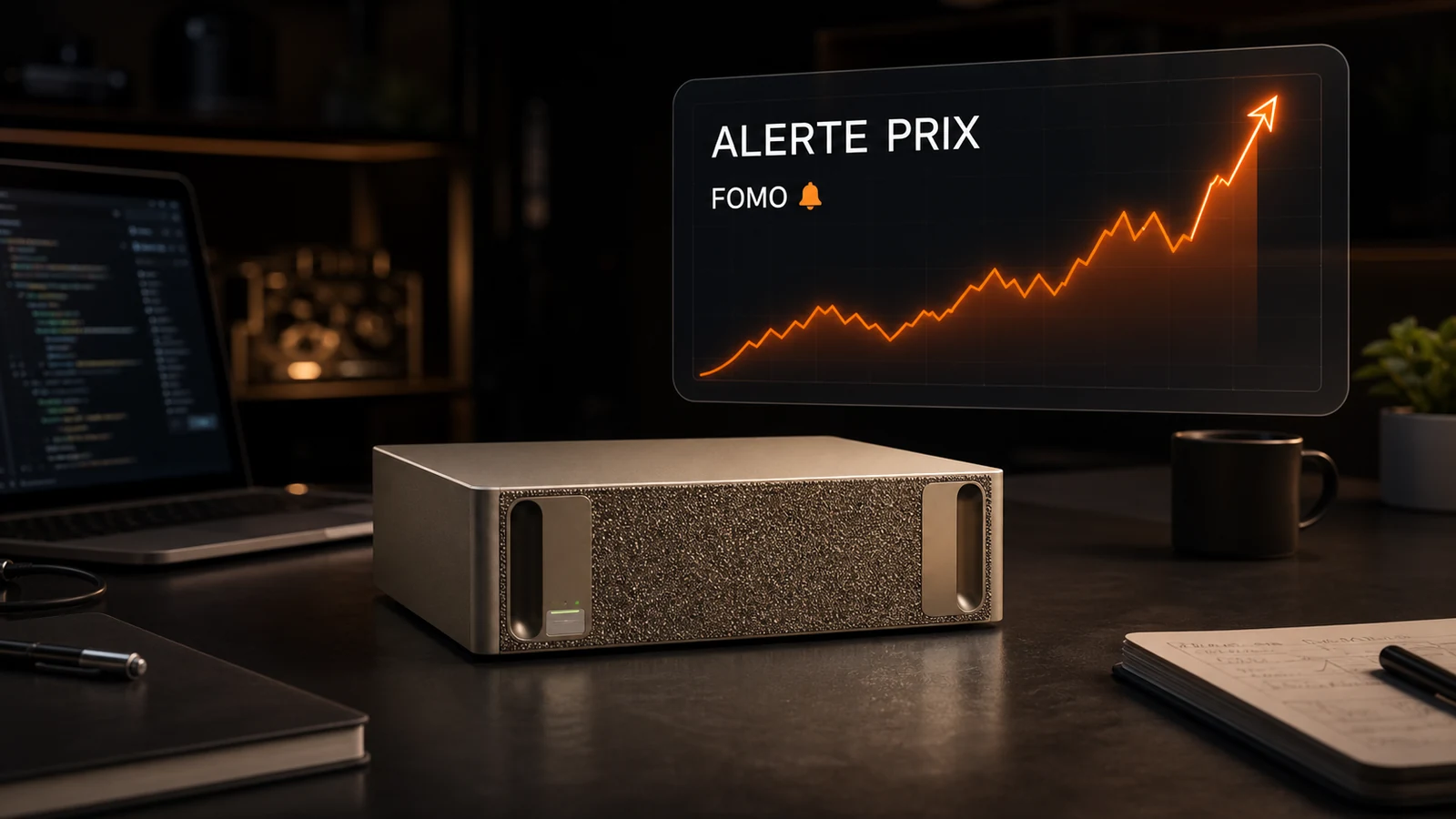
NVIDIA GB10 AI mini PCs are getting a lot of attention. This time, the hype is not completely detached from reality. DGX Spark, Asus Ascent GX10, HP ZGX Nano, Lenovo ThinkStation PGX and Dell Pro Max with GB10 all point to the same new category: compact local AI workstations with enough memory to run meaningful experiments.
The promise is attractive: up to 200B-parameter optimized models on one system, and up to 405B with two linked systems. For a box that fits on a desk, that is wild. But the price curve matters. These are not impulse purchases.
Prices were checked on July 3, 2026. Some merchant links in this article are Amazon affiliate links: it does not change the price for you, and it can help fund this work. The Idealo screenshots are used here to illustrate the price signal, not to promise a stable price.
What NVIDIA GB10 is
The shared foundation is the NVIDIA GB10 Grace Blackwell Superchip. NVIDIA describes DGX Spark as a compact system with a 20-core Arm CPU, integrated Blackwell GPU, 128 GB of unified memory, Wi-Fi 7, 10 GbE, ConnectX-7 and an AI-ready software stack. The hardware guide also mentions support for models up to 200B parameters, or 405B in a dual-Spark configuration.
This is not a gaming PC, and not a regular mini PC with a louder spec sheet. The point is unified memory, the NVIDIA stack, compact operation and a developer environment that makes local AI workflows more realistic: RAG, agents, PyTorch/Jupyter prototyping, open-model inference and sovereignty tests.
The sovereign use case: hosting your own LLM agents
This may be the most interesting scenario for a company or an independent expert: using a DGX Spark as a local LLM node. You can host one or several agents, connect open models, keep sensitive data on site and avoid sending every prompt, document or business trace to an external API. In the same spirit as my article on Hermes Agent on Windows, DGX Spark becomes the hardware layer that makes local reasoning much more credible.
That does not mean everything should move back on premises. The right decision is still to choose what must remain sovereign, what can run in the cloud and what deserves a specialized model. That is the point of my article on AI governance and sovereignty in business. But for running several inference services, exposing internal agents and testing concurrent local LLM workloads without renting cloud GPU for every iteration, DGX Spark has a real role: it provides a compact, coherent and solid enough base to get good results under concurrency when the use case is well framed.
GB10 machines to watch
The market is forming around several variants. They share a technical family, but not the same storage, support story or price.
| Model | Typical storage | Positioning | My quick take | Link |
|---|---|---|---|---|
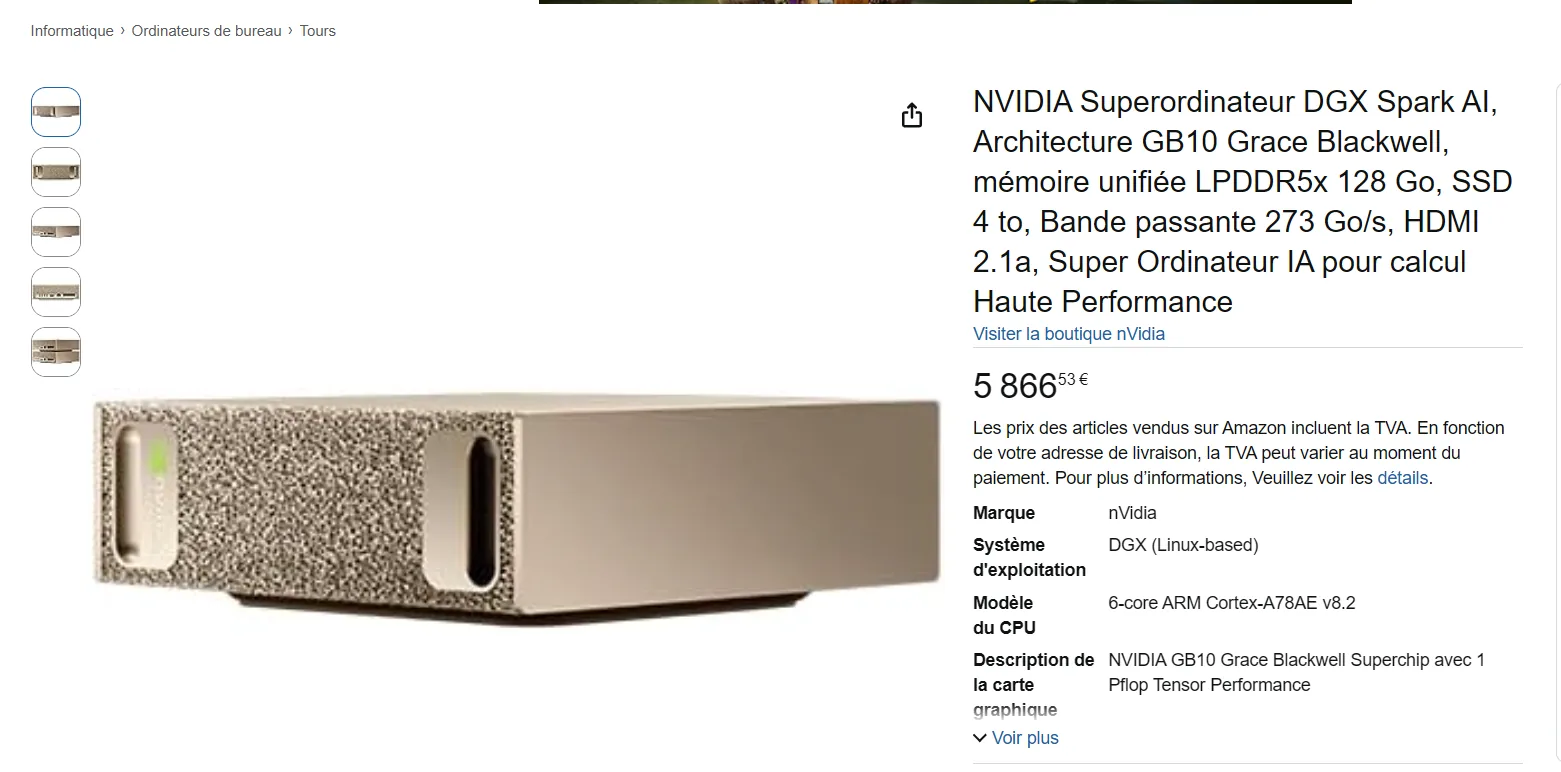
| NVIDIA DGX Spark Founders Edition €5,866 · 4 TB | 4 TB NVMe | NVIDIA reference design | Clean reference machine, but expensive. Worth it if the 4 TB and NVIDIA baseline matter. | see on Amazon |
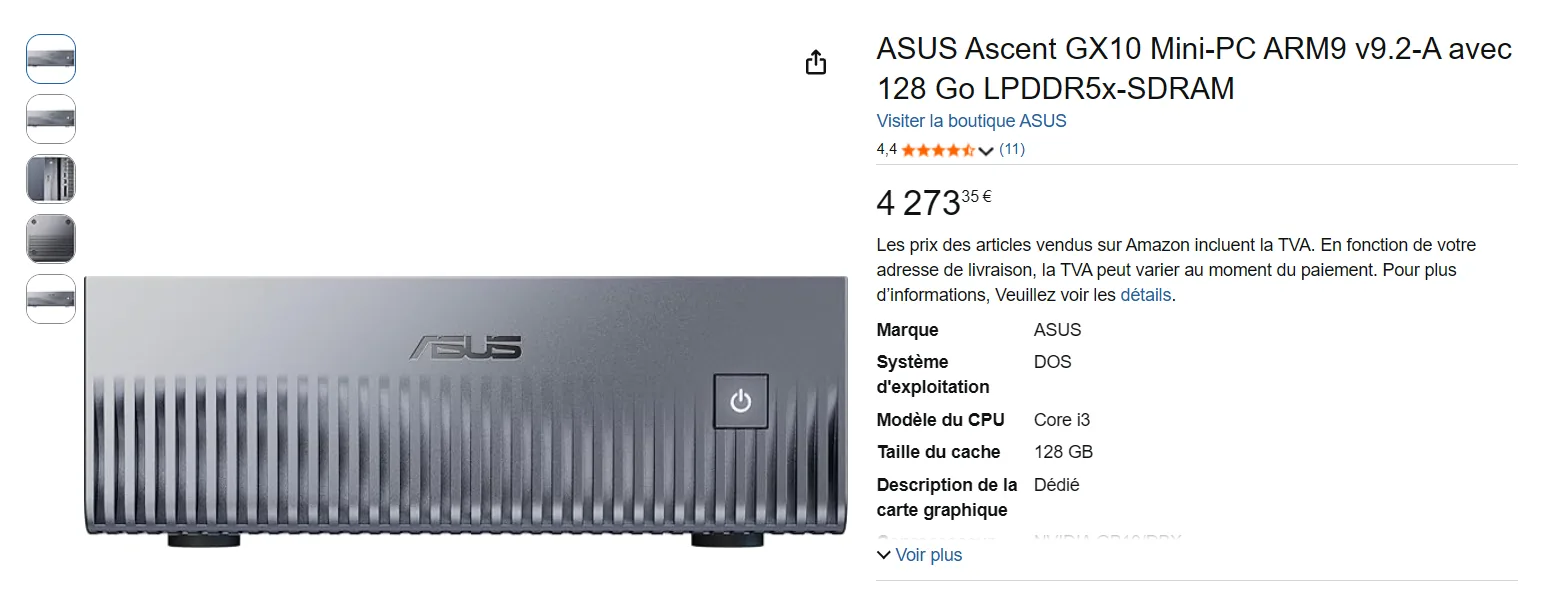
| Asus Ascent GX10 €4,273 · 1 TB | 1 to 4 TB depending on SKU | GB10 entry point | The most interesting independent-user option if the price comes back down. | see on Amazon |
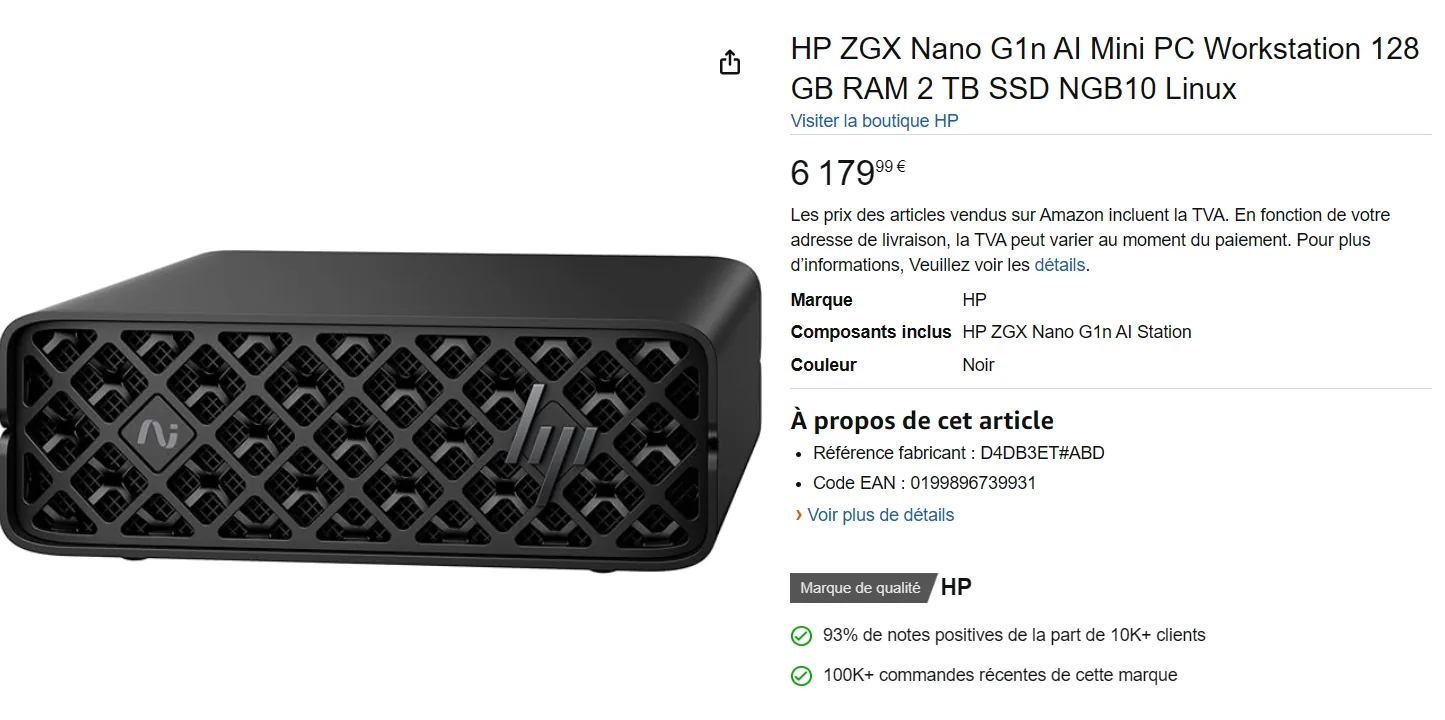
| HP ZGX Nano G1n €6,179 · 2 TB | 2 to 4 TB depending on configuration | Enterprise / pro support | Interesting when HP support and workstation framing matter more than raw price. | see on Amazon |
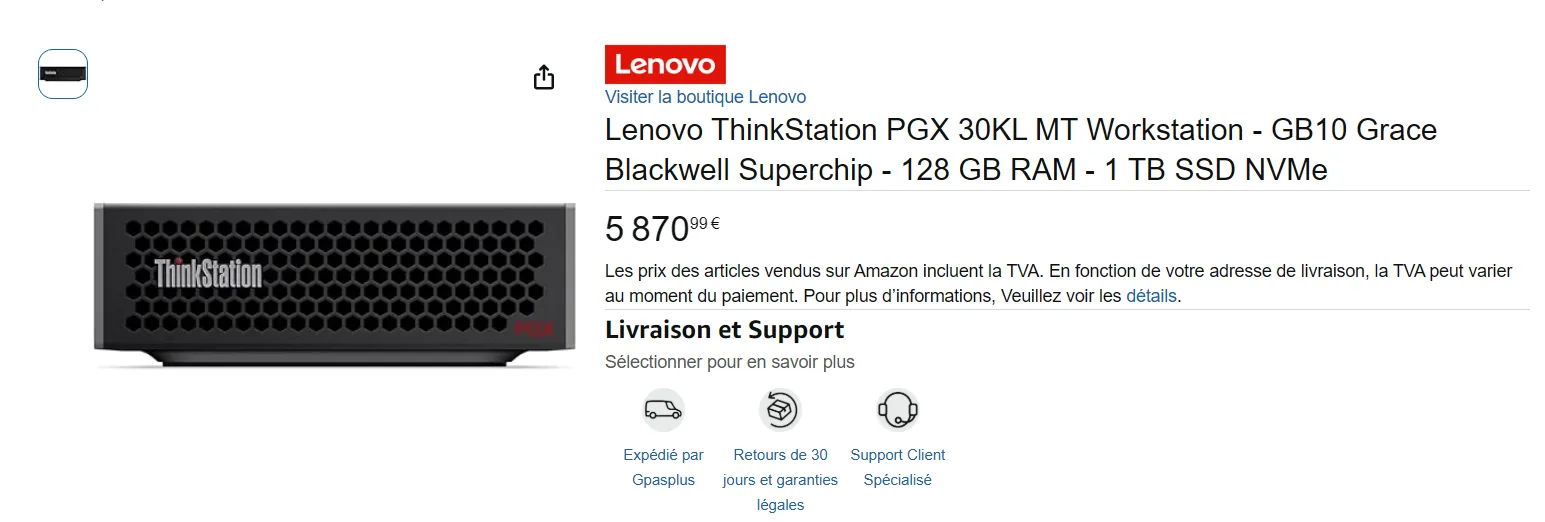
| Lenovo ThinkStation PGX €5,870 · 1 TB | 1 TB on the supplied screenshot | Lenovo workstation | Logical in a Lenovo-standardized workstation environment, but expensive for 1 TB. | see on Amazon |
| Dell Pro Max with GB10 | 2 TB on the consulted configuration | Enterprise / AI Factory | Strong Dell coherence, especially for teams moving between local development and cloud. | no reliable Amazon FR link |
| Acer Veriton GN100 | 4 TB announced | GB10 alternative | Worth watching depending on regional availability and real street price. | watch availability |
The price signal
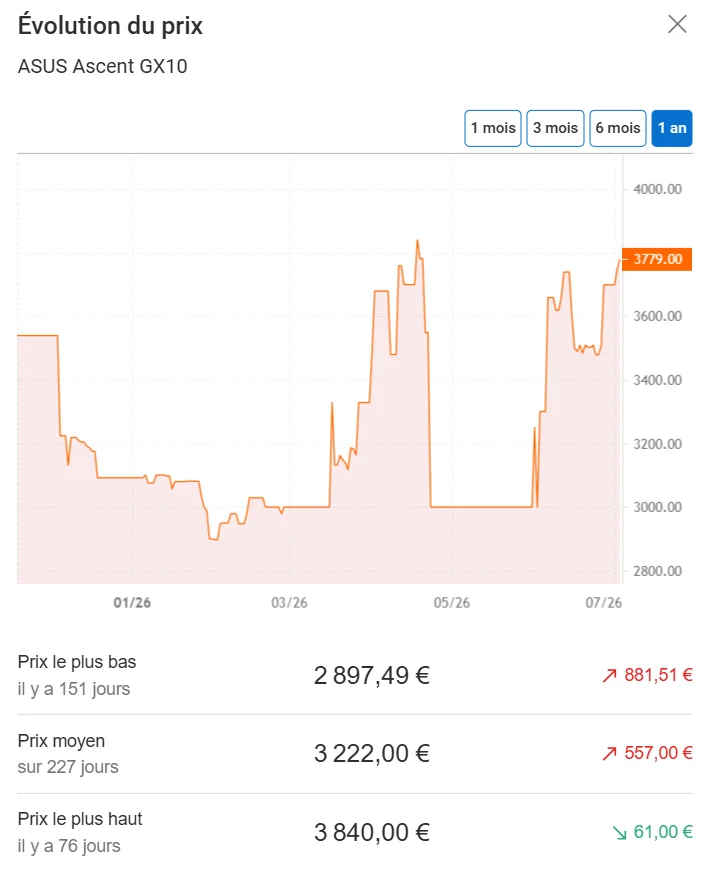
The Asus Ascent GX10 is the clearest example. In the supplied screenshot, the current price is €3,779. The lowest observed price is €2,897.49, the average is €3,222 and the high is €3,840. In plain English: the checked price is very close to the top of the curve.
The DGX Spark Founders Edition is higher in absolute terms: €5,640 in the supplied screenshot, with a displayed average at €4,816.10 and a low at €4,309. Again, this is not a casual purchase.

1 TB, 2 TB or 4 TB
Storage is the quiet trap. 1 TB can be fine if you test a few quantized models, run local agents and keep your environment clean. But models, datasets, checkpoints, Docker images and inference engines fill a drive quickly.
My rule of thumb: 1 TB is acceptable if the price is excellent and you are disciplined. 2 TB is comfortable. 4 TB makes sense for advanced local AI work, especially if you do not want to delete models every week.
Can these boxes really run very large models?
Yes, but read the promise carefully. NVIDIA's 200B and 405B claims refer to optimized and quantized models. That is not the same thing as running a massive model at full precision, and throughput is not magic. Tokens per second depend on the inference engine, format, context length, parallelism and networking between systems.
I like these machines because they solve a real problem: working locally without turning your office into a server room. But they do not replace an H100 or GB200 cluster. They are better understood as compact R&D nodes, local prototyping systems, or personal AI workstations for people who already know what they want to test.
Should you buy now or wait?
If you have an immediate professional need — sensitive data, local agents, reducing cloud GPU spend, regular prototyping, open-model testing — the purchase can make sense. Then it is a work tool, not a toy.
If you mostly want the premium AI gadget of the moment, breathe. At €3,779, the Asus GX10 is expensive. Around €3,000 it becomes much more tempting. DGX Spark 4 TB is a beautiful reference system, but it is for people who already know why they need it.
There is also another signal to watch: NVIDIA and Microsoft have announced RTX Spark, a new Windows PC family for personal agents, with up to 128 GB of unified memory, a claimed 1 petaFLOP at FP4, 14- to 16-inch laptops and compact desktops expected this fall from ASUS, Dell, HP, Lenovo, Microsoft Surface and MSI. It will not automatically be better than DGX Spark for every workload, but it can shift some buyer intent toward more versatile machines.
That is why waiting can be rational. If RTX Spark systems arrive with good pricing, decent mobility and enough memory for local agents, some buyers currently looking at DGX Spark / GX10 may move to those portable formats. DGX Spark does not become old generation technically — it is still in the same Grace Blackwell / GB10 family — but the market may treat it as less new once RTX Spark laptops are visible. For mobile or hybrid use, an RTX Spark laptop could offer the better compromise: local AI compute plus portability that a desk-bound box cannot provide.
My take: the FOMO is real, but not absurd. These machines answer a concrete need. The right move is to watch the price curve before paying. If your need is clear, go. If it is just the pull of the shiny local-AI box, wait for calmer pricing.
Sources
- NVIDIA DGX Spark product page.
- NVIDIA DGX Spark hardware overview.
- NVIDIA Newsroom, DGX Spark arrival.
- NVIDIA Newsroom, RTX Spark and Windows PCs for personal agents.
- Microsoft Windows Blog, RTX Spark and Windows optimizations.
- ASUS Ascent GX10.
- HP ZGX Nano AI Station.
- Lenovo ThinkStation PGX Product Guide.
- Dell Pro Max with GB10.
- Acer Veriton GN100.