The AI market is extremely noisy. Claude ships new capabilities, OpenAI pushes Codex, Mistral strengthens its enterprise offers, Microsoft embeds Copilot into the work ecosystem, Chinese model families such as Qwen and DeepSeek move quickly, and every week brings new benchmarks, LinkedIn posts and productivity promises.
For executives, this creates a dangerous illusion: that the priority is to pick the best model of the moment. The real topic is different. A company does not need to marry a model. It needs an AI strategy that creates business value, protects data, controls cost and stays mobile when the market changes.
This is also the approach I describe on my AI support from Bordeaux page: start from the business need, frame the architecture, then choose the AI, RAG, automation or Azure OpenAI components that actually make sense.
The question is not: "which AI model should we choose?" The better question is: "which processes do we want to transform, with which data, risks, costs and exit options?"
AI noise is not a strategy
The market has become hard to follow by design. OpenAI presents Codex as an agent that helps write, review and ship code. Mistral highlights Le Chat Enterprise with administration, governance and security for organizations. Microsoft documents governance mechanisms in Copilot Studio. GitHub Copilot, Claude Code, Gemini, Qwen and open source alternatives add even more options.
This abundance is good news: it creates competition, accelerates innovation and gives businesses more choice. But it also makes decision-making harder. An executive committee should not build its AI transformation on the latest viral demo or a single benchmark score.
Benchmarks are useful, but they do not answer the questions that matter in business: integration with existing tools, confidentiality, workflow cost, logging quality, human supervision, operations, reversibility and the ability to audit a decision.
The real cost comes later
At an individual level, AI can feel almost free. A monthly subscription lets people run long agent sessions, generate code, process documents or automate part of their work. But the visible price does not tell the whole story.
The International Energy Agency notes that AI data centres are becoming a major electricity load: AI-oriented hyperscale centres can exceed 100 MW, and data centre electricity demand grew sharply in 2025. In other words, the physical cost already exists. It is not always fully visible in today's subscriptions.
Inside a company, this quickly becomes AI FinOps. If an internal assistant is used by 20 people, the risk is limited. If it becomes central to support, sales, reporting, compliance or document production, every API call, output token, RAG reindexing job and automation can become recurring cost.
AI vendor lock-in
Vendor lock-in already exists in data: cloud platforms, warehouses, BI tools, orchestrators and proprietary formats. With AI, it can happen even faster because models enter business processes directly.
If your workflows, prompts, agents, connectors and evaluations depend too much on a single vendor, you lose negotiation power. If prices rise, usage limits change, latency worsens or a regulatory constraint appears, the business must be able to pivot.
Anthropic's documented rate limits, for example, are a reminder that capacity is managed. This is not specific to one vendor: every AI provider must balance demand, infrastructure, abuse prevention, cost and service quality.
Start from the business need, not the desire to use AI
AI transformation rarely starts with a model. It starts with a simple sentence: "which problem are we solving?" In many cases, a good UX, a clear business rule, classic automation or a better data pipeline is enough. AI is not needed everywhere.
OCR may work with a small specialized model. Email classification may combine a lightweight model with confidence rules. A document RAG assistant needs strong document governance before it needs the biggest model available. A development or analysis agent may justify a premium model, but only where the value created offsets the cost.
This is also the message in my 2026 LLM coding comparison: the best choice depends on context, output cost, stability and real usage, not only model prestige.
| Executive question | Why it matters | Possible decision |
|---|---|---|
| Does the process deserve AI? | Avoid gimmick automation. | AI, business rules, UX, RPA or redesign. |
| Is the data sensitive? | GDPR, trade secrets, health, finance, HR. | Public API, Azure, EU cloud, local model. |
| What performance level is needed? | Avoid paying a large model for a simple task. | Routing between small, medium and large models. |
| Who validates the output? | Limit hallucinations and business errors. | Human-in-the-loop, confidence threshold, logs. |
| How do we exit the vendor? | Preserve negotiation power. | API abstraction, versioned prompts, shared tests. |
Define an MVP and measurable goals
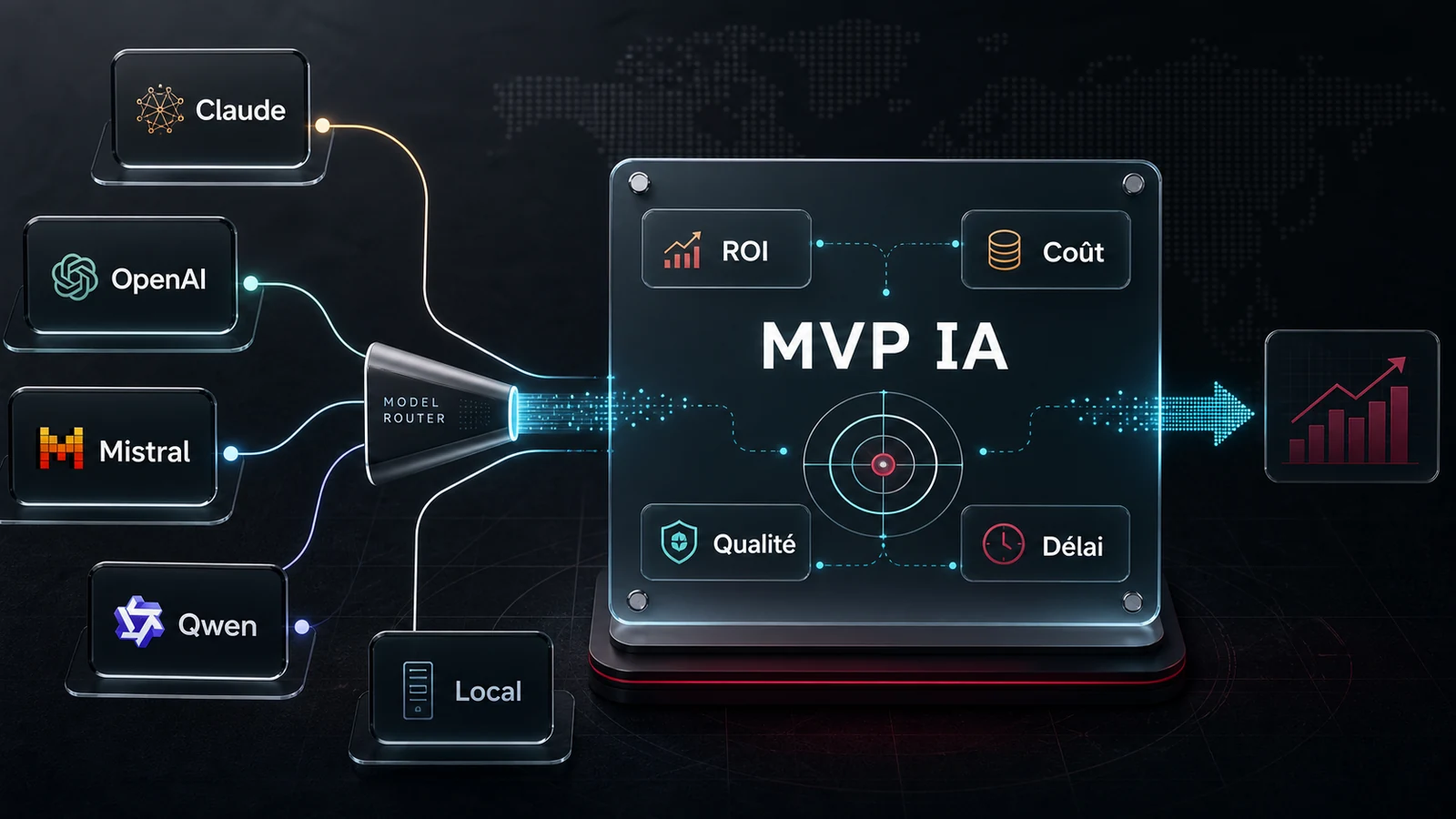
An AI project should not start with a vague ambition such as "transform the company with AI". It should start with an MVP target: the smallest useful version that proves real business value. Not a flashy demo. Not a prototype that only works in front of the steering committee. A tool simple enough to be shipped quickly, used by real users and evaluated with numbers.
This is where many projects drift. RAND notes that, by some estimates, more than 80% of AI projects fail, around twice the failure rate of traditional IT projects. The widely cited 2025 MIT NANDA report on enterprise GenAI also states that about 95% of the pilots studied do not generate measurable P&L impact. This does not mean AI is useless. It means that a project with no target, no business integration and no value measurement quickly becomes wasted budget.
Before funding an AI agent, a document RAG system or an automation workflow, the target should be written in measurable terms. For example: reduce request handling time by 30%, reduce support cost by 15% on a defined scope, move from a two-day response time to two hours, reach 90% sourced answers on a validated document corpus, or keep cost below X euros per processed case.
The MVP also needs stop criteria. If the tool is not used, if cost per action explodes, if users spend more time correcting than saving time, or if quality does not pass a defined threshold, the company must be able to stop, pivot or return to a simpler automation. A good AI project is not the one that goes furthest into hype. It is the one that can quickly prove it deserves to be industrialized.
Use case: internal support AI assistant. Target: handle 40% of recurring requests with sourced answers, reduce average first-response time by 50%, keep cost below EUR 0.80 per ticket and reach a user score above 4/5 after four weeks.
Governance, data and compliance
AI governance is not paperwork. It is what allows a company to move from experiments to production. The NIST AI Risk Management Framework offers a useful logic: govern, map, measure and manage risk. In Europe, the AI Act adds a risk-based approach. The CNIL also reminds organizations that AI projects must be designed with GDPR in mind from the beginning.
In practice, AI governance must answer very operational questions: which data can be sent to an external model? which data must stay local? who approves an agent before production? how are answers traced? how are access rights handled in a document RAG system? how do we audit an automation acting inside a CRM or business tool?
Without those rules, the company accumulates AI debt: scattered prompts, copied data in unmanaged tools, ownerless agents, invisible costs and untraceable decisions. With those rules, AI becomes an enterprise capability, not a collection of isolated tests.
Model-agnostic architecture: the LLM should become a commodity
A good AI architecture should be able to change models without rewriting the whole application. That does not mean all models are equal. It means the company must control its critical layers: data, prompts, evaluation, security, observability and workflows.
In practice, I often recommend a routing or abstraction layer: a fast model for simple tasks, a premium model for complex reasoning, a European or local model for sensitive data, and shared evaluations to compare quality. RAG, connectors and logs should remain under the company's control.
This also opens sovereignty options. Depending on constraints, you can use Azure OpenAI, a European provider, Mistral, an open source model hosted in France, or a rented GPU for a sensitive batch. The point is not to discover this question on the day your main provider changes its rules.
A 30 / 60 / 90 day AI roadmap for executives
For an SME, a mid-market company or a business unit, I prefer a short and concrete path over a large abstract programme.
| Period | Goal | Deliverables |
|---|---|---|
| 30 days | Identify useful use cases. | Process map, ROI / risk / complexity scoring, first data rules. |
| 60 days | Build a governed POC. | RAG or AI agent prototype, test sets, quality metrics, FinOps estimate. |
| 90 days | Prepare industrialization. | Target architecture, monitoring, security, reversibility plan, automation backlog. |
From Bordeaux, I help companies of all sizes frame this work: AI audits, AI agents, document RAG, business automation, data governance, Azure OpenAI, Microsoft Fabric and more sovereign cloud paths when the context requires it.
A good AI transformation is not about chasing every model. It is about making the company faster, more reliable and more lucid without losing control of its data, costs and future choices.
Choose your frame first: need, data, risks, cost, governance, reversibility. Model selection then becomes an architecture decision, not an existential bet.
Sources
Sources used: IEA on energy and AI, IEA on data centre electricity demand, NIST AI RMF, EU AI Act, CNIL AI and GDPR, RAND on AI project failure causes, MIT NANDA GenAI Divide, OpenAI Codex, Mistral Le Chat Enterprise, Microsoft Copilot Studio governance and Anthropic rate limits.