The timing strengthens the IPO narrative
Opus 5.5 arrived on September 22, followed by Sonnet 5.5 on September 28. Two launches in quick succession put Anthropic back at the centre of the conversation. Is the timing purely coincidental? I doubt it, but that is my strategic interpretation rather than proof that the releases were scheduled for the stock market.
The IPO process is real, since Anthropic announced on June 1 that it had confidentially submitted a draft registration statement on Form S-1 to the SEC, and the press reported on the contents of that prospectus in late September. Preparing an offering does not mean a listing has happened or that its date is guaranteed. According to reporting picked up on September 29 by El País, drawing on Reuters and the Financial Times, the listing could even be pushed back until after the US midterm elections in November, and the funding needs remain considerable.
In that setting, convincing new models help sell a straightforward proposition to investors. Anthropic can keep improving, attract developers and turn that advantage into paid usage. That could support demand and the valuation it hopes to achieve. It cannot guarantee an offer price or the amount ultimately raised.
A striking demonstration makes the progress tangible
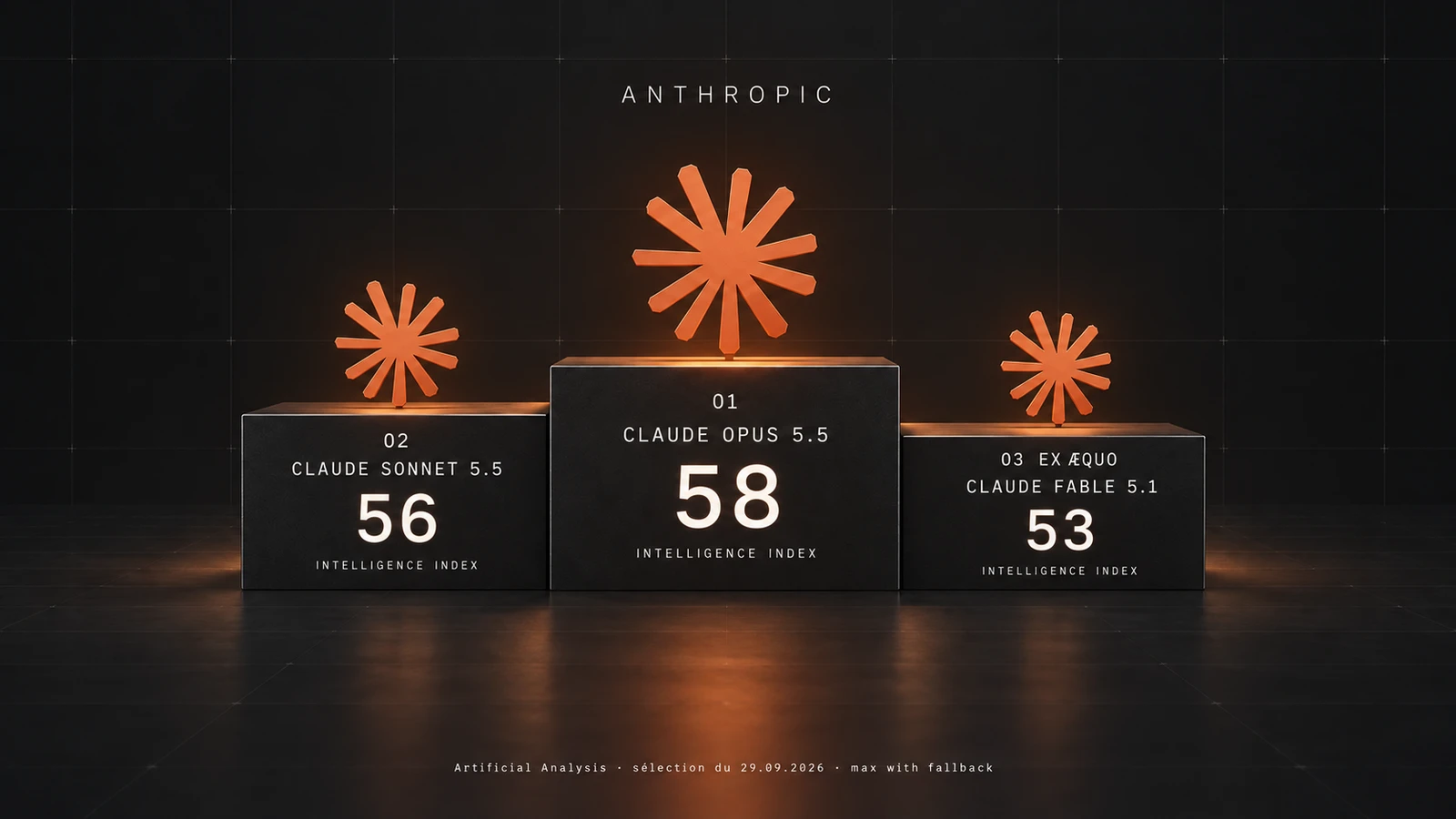
Anthropic now leads the Artificial Analysis Intelligence Index on its own, after sharing first place with OpenAI while Fable 5.1 and GPT-6 Astra were tied at 53 points. On the full leaderboard, Opus 5.5 ranks first with 58 points and Sonnet 5.5 is the second model with 56. Both are evaluated in the configuration Artificial Analysis labels “max with fallback”. That sends a clear signal to the market beyond Anthropic’s own published results.
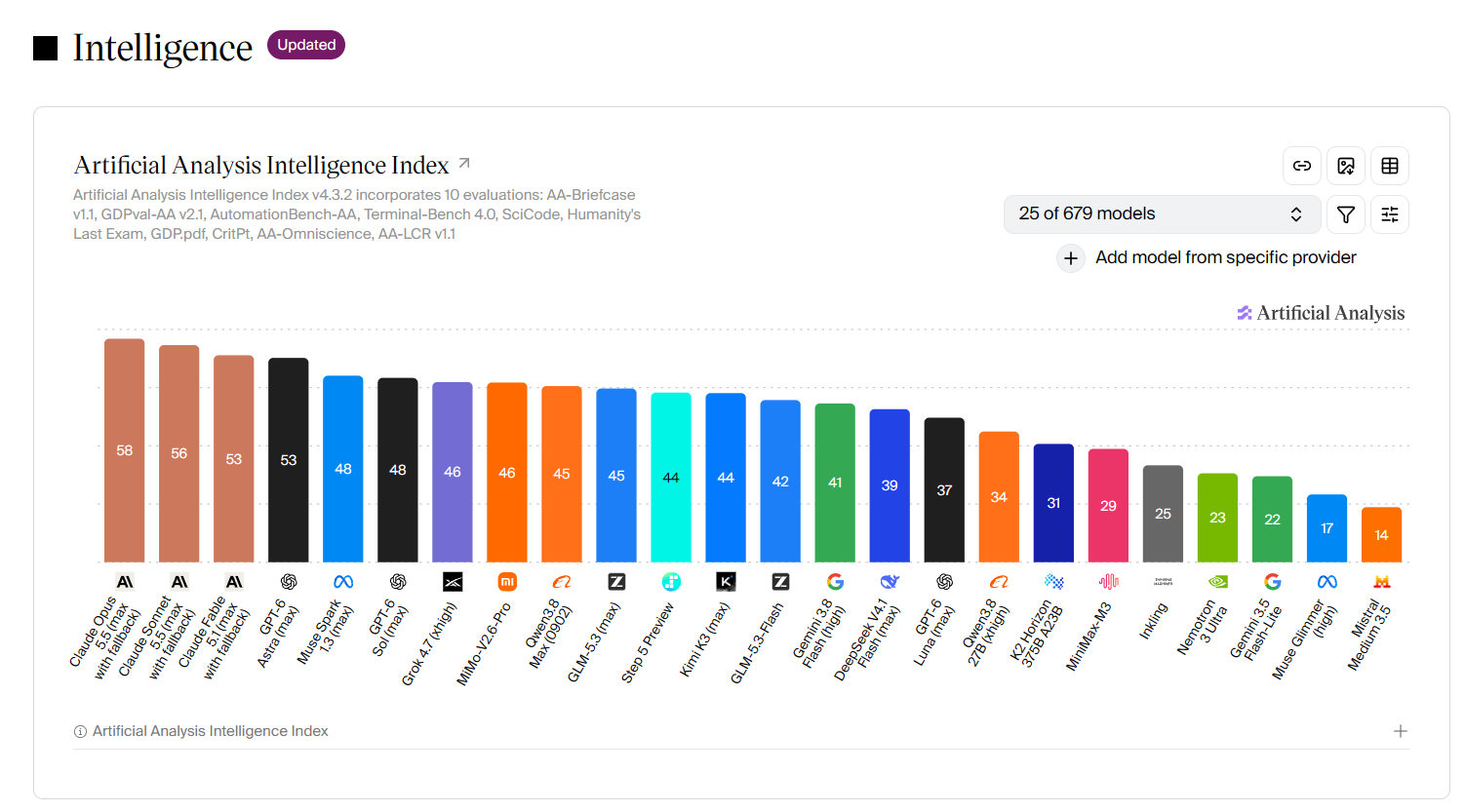
The score combines several evaluations. It does not mean every task will be completed better, and effort settings matter. The full leaderboard also includes multiple configurations of the same model. Still, this comparison delivers a strong message. Anthropic places both new models ahead of every model evaluated, precisely when it needs to convince people that it can remain a leader.
What also strikes me is the work I see on X and LinkedIn, ranging from software development to 3D scenes, motion design and animations with effects and synchronised sound. A fluid sequence makes progress immediately visible. People understand the result before they understand the model.
In my view, a few seconds of demonstration can leave a stronger impression than hundreds of pages of research. Research remains essential to understanding limitations. But visual work is exceptionally effective at capturing attention.
We should also describe what we are watching accurately. An agent can write code, operate tools and assemble a rendered output. That does not automatically make Claude a native video or audio generator. A shared result does not always reveal the iterations, tools or manual edits behind it.
My test, two animations built by Claude 5.5
To see what these demonstrations are worth from the inside, I handed two animations to Claude Code sub-agents (model instances that work autonomously on a task), running in parallel. Opus 5.5 had to present its own characteristics and its Intelligence Index score as a motion design piece with visual and sound effects. Sonnet 5.5 had to make 3D bricks fly in and snap together to spell “Ruben T.”. Each animation went through the same three stages, a first version, an independent review by the same model, then a round of fixes.
The Opus 5.5 animation lasts 30 seconds. It covers the figures Anthropic published against Opus 5 (cost, pricing, speed, benchmarks and behavioural audit), then builds the top 10 of the September 29 Intelligence Index, where Opus 5.5 takes first place with 58 points.
The Sonnet 5.5 animation lasts 26 seconds. Eighty procedurally generated bricks fly in, tumble and snap together to synthesised clicks until they spell “Ruben T.”. Midway through, I asked for the colours of Lo Mahavéli, the popular flag of La Réunion (blue field, red volcano triangle and yellow rays), and that revision is included in the figures below. The pattern reads across the letters rather than as a complete flag.
In both cases this is HTML and JavaScript running live in your browser, with Three.js for the 3D and sound synthesised on the fly by the Web Audio API. No video or audio file was generated, which illustrates the distinction made above between an agent coding a render and a native video generator.
| Claude Opus 5.5 | Claude Sonnet 5.5 | |
|---|---|---|
| Subject | Motion design on its own specs and score | 3D bricks spelling “Ruben T.” |
| Reasoning effort requested | xhigh | xhigh |
| Time taken | 2 h 16 min | 1 h 58 min |
| Tokens processed | 81.8 million | 67.7 million |
| of which cache reads | 78.9 million (96%) | 65.9 million (97%) |
| Output tokens generated | 640,000 | 515,000 |
| API calls | 245 | 266 |
| API-equivalent cost | $39.82 | $21.63 |
These figures were measured from the agents’ transcripts. The cost applies Anthropic’s public API pricing as of September 29, 2026, namely $4 and $20 per million input and output tokens for Opus 5.5, $2 and $10 for Sonnet 5.5, $0.20 for cache reads and 1.25 times the input price for cache writes. I use a Max 20x subscription, so these amounts were not billed as such, and they show the order of magnitude of the same work done through the API.
The catch is that this setup is not for anyone in a hurry. I deliberately pushed the slider all the way, with xhigh reasoning effort (how much thinking the model puts into each step), an independent review and a round of fixes for each animation, to measure the highest cost and the best result I could get. Less reasoning might well have been enough to follow my instructions at an acceptable quality, in far less time and for far less money. A good part of those two hours also went into automated checks, with frame-by-frame screenshots and software 3D rendering without a graphics card.
Two lessons stand out. Sonnet 5.5 costs about 45% less than Opus 5.5 for a similar volume of tokens, because its price is half as high. More importantly, over 96% of the tokens are cache reads, meaning the context the agent re-reads at every step of its work. Billed at $0.20 per million, that line accounts for 40% of the Opus 5.5 bill and 61% of the Sonnet 5.5 bill, which explains why Anthropic highlights the 60% cut in cache read pricing on Opus 5.5.
The independent review also earned its place. On the Opus 5.5 animation, the reviewer blocked the first version because its animated ranking briefly passed through a wrong order, and the fix round replaced it with a build that stays true to the scores. The Sonnet 5.5 reviewer asked for only one significant fix, to the smoothness of the animation clock. I will let you judge the results by playing both animations above.
Efficiency makes a real difference on my long tasks
I have used Opus 5.5 extensively for agentic work lasting several hours, and for projects spanning several days. What stands out is the quality, the convincing precision and its ability to pursue complex work coherently.
Consumption also feels relatively reasonable compared with Fable 5.1 or the previous Opus. This is my everyday experience, without a controlled comparison or a measured savings percentage. Still, the improvement in efficiency feels substantial enough to change how I use the model.
That experience points in the same direction as Anthropic’s Opus 5.5 announcement, which says its own tests show it costs 40% less than Opus 5 on typical workloads at default settings. Artificial Analysis, for its part, measures the same cost per task as Opus 5 at maximum effort, despite 1.6 times as many output tokens. Those figures come from their tests rather than a guaranteed saving on my subscription, because API prices, token consumption and subscription limits measure different things.
As in my experience with GitHub Copilot’s everyday costs, the useful question is the cost of a completed, checked piece of work. A better initial answer is not enough if it still needs too much correction.
Claim up to $250 in cloud credits
The September 23 ClaudeDevs announcement offers eligible existing subscribers a one-time credit of $100 on Pro and $250 on Max. It does not distinguish Max 5x from Max 20x. Check the amount offered in your account.
Enter the following command inside Claude Code, noting that it uses the singular form.
/claim-creditAlternatively, open the official claim link shared in the announcement, which requires you to be signed in to your Claude account. The official instructions ask you to claim the credit by 11:59 PM Pacific Time on October 7. The announcement image adds that it expires at 11:59 PM Pacific Time on November 4 and that terms apply.
On the Claude website, you can also open Settings → Usage and select the credit claim button in the banner. Here is the offer displayed on my Max 20x account. The French interface labels that button Obtenir le crédit.
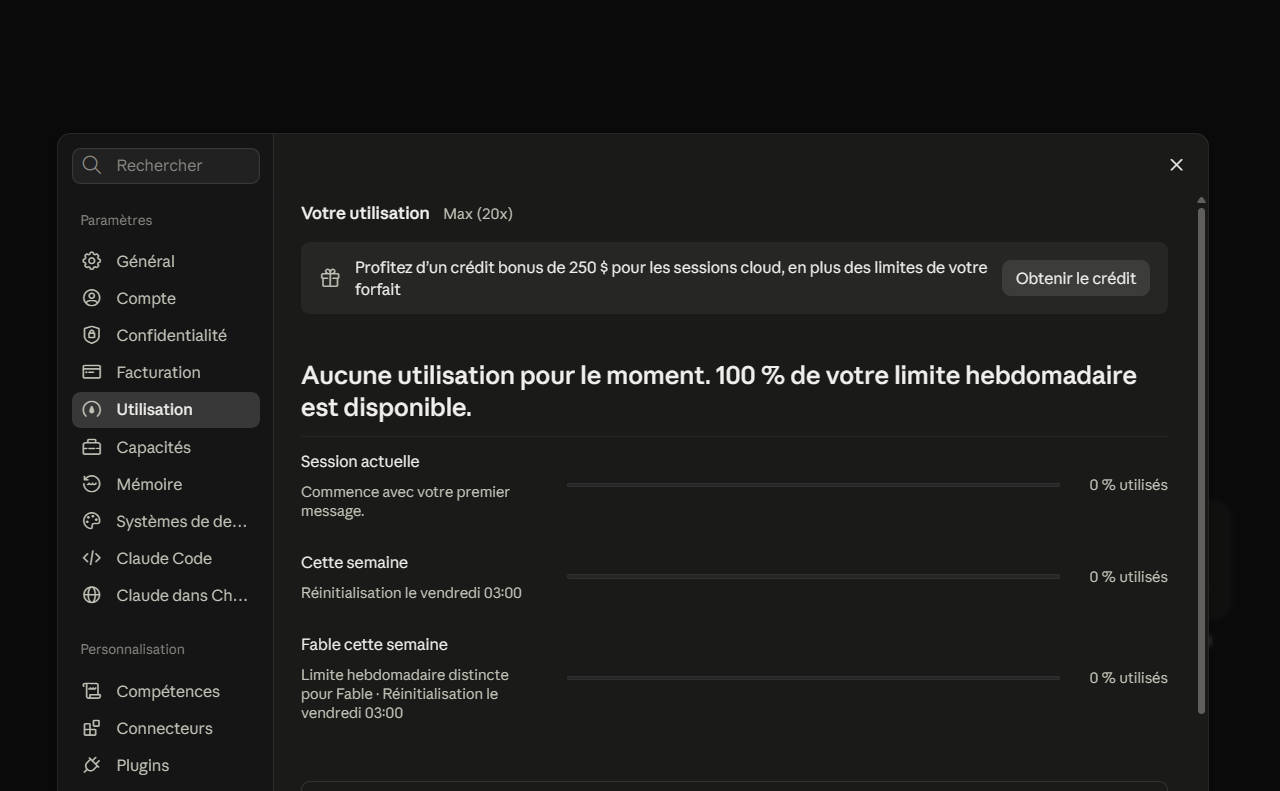
This credit is for cloud sessions only, with one credit per account, and it is neither general API credit nor a bonus for local conversations. As the rest of the announcement explains, it is separate from your usage limits and applies automatically once you start a cloud session. Normal plan limits apply after it is spent or expires. It should not be confused with the usage-limit reset offered elsewhere.
For the web onboarding flow, connect GitHub and choose your repository. The cloud-session documentation explains how work can continue after you close your computer. It is a useful way to evaluate an agent on a substantial task rather than a single impressive response.
Winning developers before winning investors
I see a coherent sequence here, which is to show improvements, make their benefits visible, then give subscribers a way to try them. Credits can encourage adoption, practical feedback and more demonstrations. All of this supports a favourable narrative ahead of an IPO, without proving a stock-market motive behind every announcement.
My analysis of Mistral’s positioning already highlighted the value of efficiency and distribution. Anthropic can use those strengths while also competing at the performance frontier. That combination is what looks compelling to me today.
A beautiful demonstration gets attention, whereas a tool people keep using for months builds a business. The real challenge, in my view, is converting visible progress into durable revenue with manageable costs. The excitement around Claude 5.5 helps communicate that ambition without fulfilling it on its own.
Sources and methodology
References consulted on September 29, 2026. Vendor announcements, independent evaluations and my personal experience are distinguished throughout the article.
- Anthropic’s confidential SEC filing announcement, June 1, 2026. It confirms the proposed IPO without setting its price or date.
- Official Opus 5.5 announcement, September 22, 2026, and Sonnet 5.5 announcement, September 28. These document the releases and Anthropic’s performance claims.
- Artificial Analysis Intelligence Index leaderboard and its independent Opus 5.5 analysis from September 22. These support the scores and cost-per-task comparison. Rankings may change after publication.
- ClaudeDevs’ September 23 announcement, cloud-credit scope and claim instructions. This official thread details the amounts, usage and offer conditions.
- Claude Code cloud-session documentation. It describes how sessions work and how to connect a repository.
- El País reporting from September 29, 2026, drawing on Reuters and the Financial Times for the prospectus and potential timeline. This is press reporting rather than a confirmed listing date.
The screenshots show the selected ranking and the offer displayed in my account. The podium illustration is AI-generated editorial artwork, not an official chart. Both animations were produced on September 29, 2026 by Claude Code sub-agents, and their tokens, costs and durations come from those agents’ transcripts. My efficiency assessment reflects my own usage without a controlled comparative protocol. The connection between the launches and the IPO strategy remains my interpretation, and the social-media demonstrations mentioned here are not a reproducible benchmark.