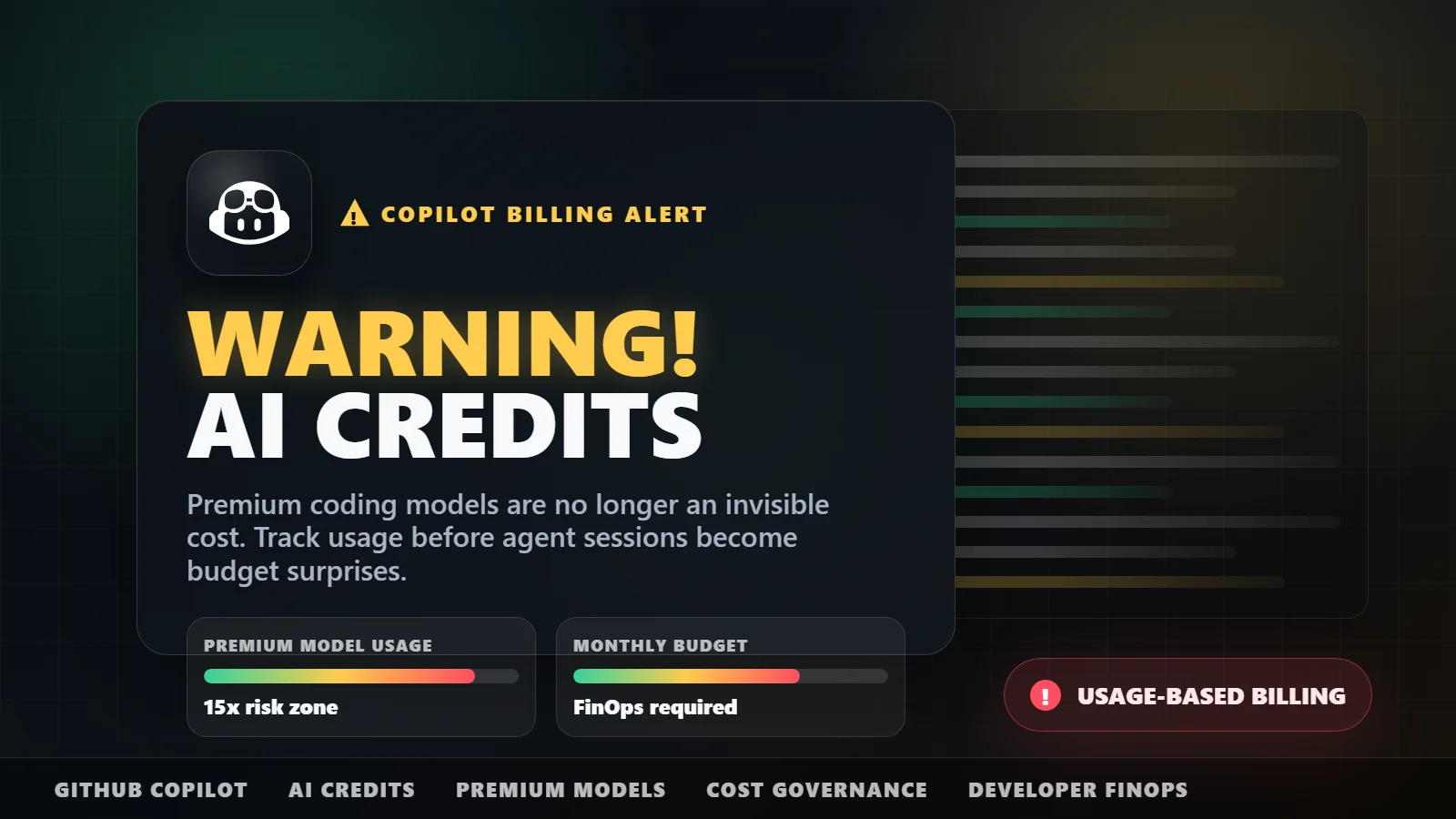
Autocomplete remains a strong argument. Chat and agents now make me hesitate before a routine task, because the real cost only shows up afterwards.
A product I believed in
I found the positioning excellent. An assistant sitting in VS Code, next to the code, with all the value that has in a Microsoft, Azure and data environment. Autocomplete remains, in my view, one of its best arguments. Chat and agents had extended that promise.
I am not criticising a product I do not use. I am criticising a tool I liked, and whose economics now make me hesitate before starting a task.
Since 1 June 2026, GitHub has replaced premium requests with AI Credits, billed from tokens and the chosen model. The subscription has not disappeared. It includes an allowance, then overage can be charged depending on account settings. Completions and next edit suggestions still do not consume those credits on paid plans. I laid out that framework in GitHub Copilot billing, the end of open bar AI.
What I see on my SQL work
These are observed consumptions, not an average of every prompt I send.
| Observed use | Credits consumed | Equivalent at the credit rate |
|---|---|---|
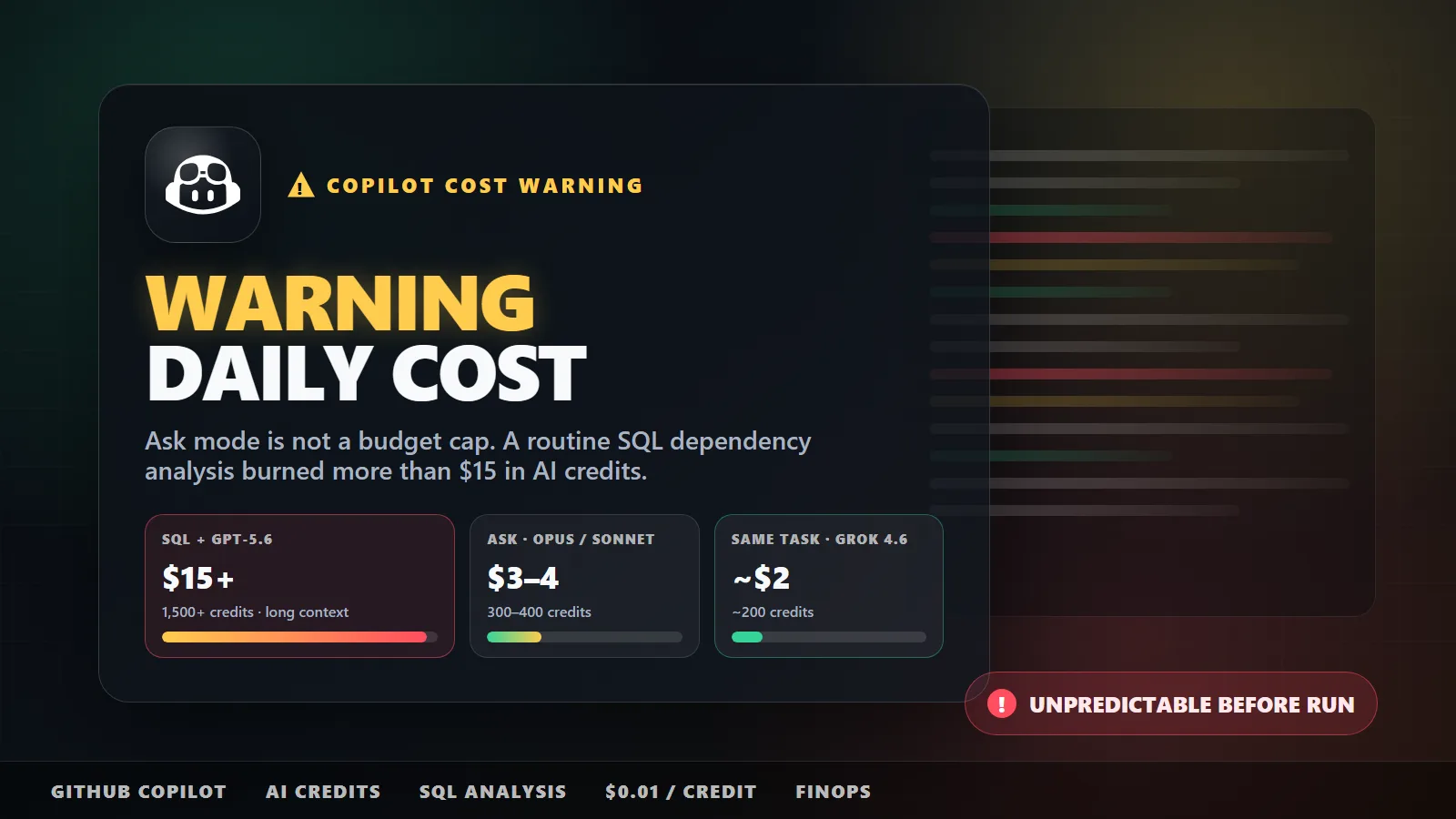
| Ask-mode questions with Claude Opus or Sonnet at medium reasoning | 300 to 400 | $3 to $4 |
| SQL dependency analysis with GPT-5.6, in a very loaded conversation above 500,000 tokens | More than 1,500 | More than $15 |
| A new attempt at the same analysis with Grok 4.6 | About 200 | About $2 |
One credit is worth $0.01. This is a consumption value, not necessarily an overage on the invoice. Credits can come from the included allowance. These runs are also not a benchmark with identical context, cache and call count.
That does not remove the problem. Burning the equivalent of more than $15 to analyse the dependencies of a SQL table is excessive on this use case. Dropping to $2 with Grok 4.6 is better. It still does not make repeating those costs in everyday work automatically acceptable.
I do have a comfortable allowance in my current setup. A generous quota hides the problem for longer. It does not change the cost of the task.
A small question and a large context
I know the objection. A short question does not mean a small model call.
History, files, instructions and tools can weigh far more than the sentence typed in the chat. An agentic turn can also fire several successive calls. The VS Code team documents those costs, and the work to reduce them, including prompt-prefix caching and on-demand tool definitions.
Long context adds another difficulty. For GPT-5.6 Sol, the Copilot grid consulted on 15 September doubles input beyond 272,000 input tokens ($4 then $8 per million) and multiplies output by 1.5 ($20 then $30). That is not a universal rule for every model.
I am not claiming my SQL analysis technically used only three small files. I am saying the functional scope of my request does not let me anticipate its real cost.
That is the product problem. Ask mode is not a guarantee of low consumption. A medium reasoning setting is not a budget ceiling.
September looks worse, but I separate the observation from the cause
I thought I had recovered some comfort during the summer. In September I again see consumption I find disproportionate.
There is a documented change that should not be confused with a rise in prompt prices. Promotional Business and Enterprise credits were planned for June, July and August. Standard allowances are 1,900 and 3,900 credits per seat, against 3,000 and 7,000 during the promotion. That can empty a concerned budget faster. It cannot, on its own, explain why the same task consumes more credits.
Recent public comments show comparable frustration. On 9 September, one user explained giving up on a rollout to colleagues. On 11 September, another reported burning 1,500 credits in six hours. These are individual reports, not proof of a hidden price change.
At this stage I have not found, in the announcements I checked, a general September increase in per-token rates that would explain my readings. Without detailed session traces, I cannot attribute this shift to a precise cause.
A cap protects the budget, not productivity
GitHub offers user and organisation budgets, plus other spend controls. Claiming there is no FinOps lever would be false. Soft credit limits also exist in Copilot CLI, in preview. They can be exceeded by a response already in flight.
Blocking consumption is not the same as knowing how much useful work a team can finish with its budget.
A CIO needs to judge cost per completed, validated task, not only the amount at which developers will be interrupted. A $15 task can be profitable if it saves several hours. My problem is the repetition of high consumption on routine requests, without enough visibility before I start them.
Compacting context is not enough
Opening a new conversation, limiting files or compacting history are useful levers. GitHub also recommends preserving the cache and avoiding unnecessary configuration changes.
Starting from scratch and compacting are not equivalent. A summary can drop a fact the analysis still needs. You then re-explain, re-read or correct. Savings on one call can be cancelled by the next ones. That is not systematic. It is the trade-off to measure.
The right metric remains the cost of a usable result, including corrections. I already made that case on cost per finished agent task with DeepSeek V4 Flash.
On 14 September GitHub announced three Auto model-selection tiers, efficiency, balance and intelligence, with a 10% discount for paid subscribers using Auto. That is an extra lever, not a guarantee of the final cost of a task. Usage is still billed on the model Auto actually selects.
Taking the invoice back
You need to test these paths in your own usage. Watching the meter does not tell you where a task should actually run.
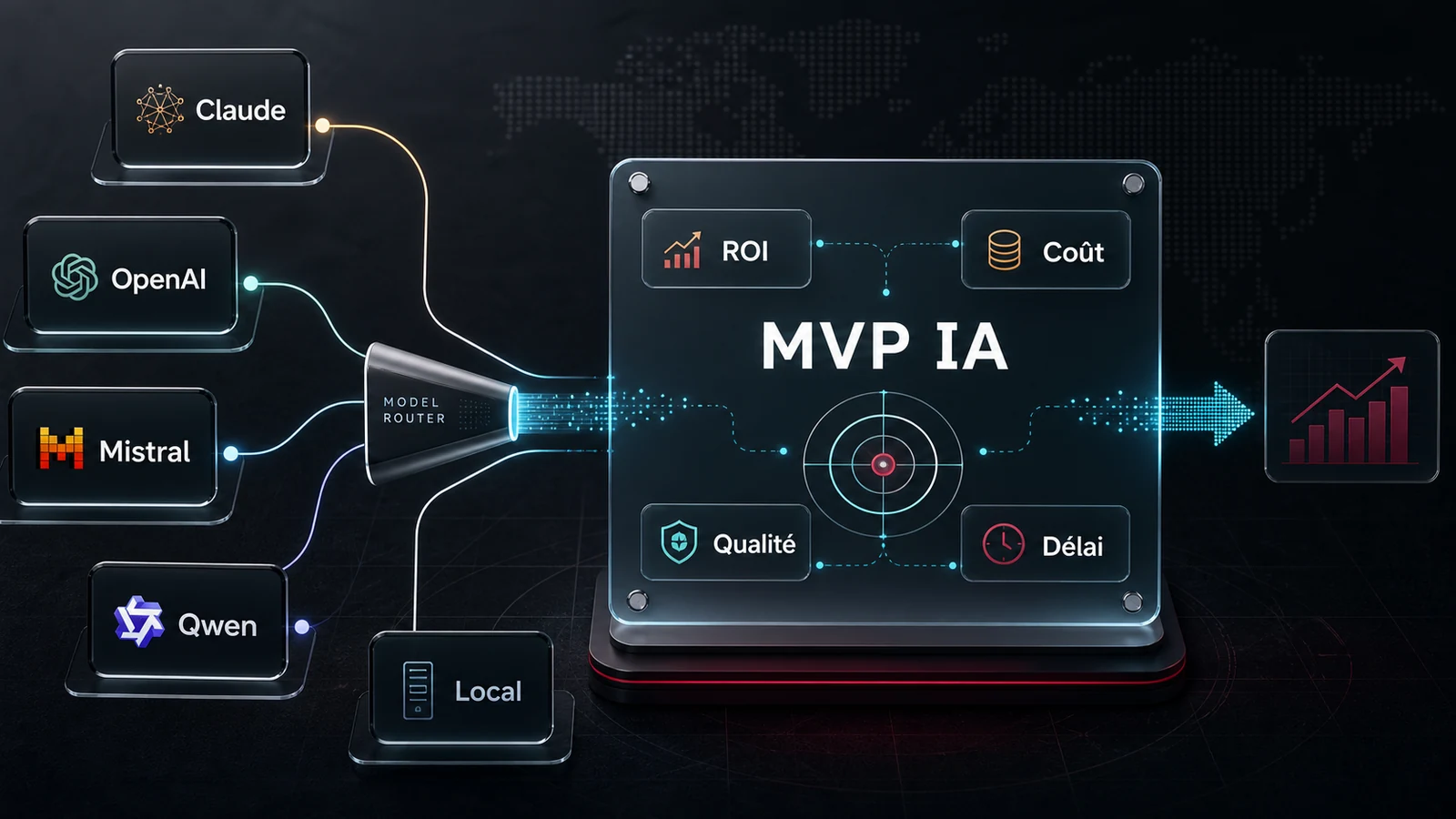
BYOK (Bring Your Own Key). Use your own API key in VS Code and compare the provider invoice with Copilot credits burned on the same routine tasks. Savings are not guaranteed. You still have to count included credits and any retries.
Rented GPUs. Nebius, Scaleway, Runpod. Rent capacity to host open-weight models, with a defined duration and budget, and a commitment if the offer requires one. The goal is to budget compute rather than every prompt, including extra fees.
Local GPUs, with an endpoint from Copilot. Keep Copilot as the interface in VS Code, and point some of the calls to a machine you control. A Mac Studio M5 Ultra, a DGX Spark or GB10 AI mini PC, or a cluster, can serve as a local endpoint for routine work and limit the credit shock. This is not automatic profitability. Electricity, operations and the fact that not every task fits remain. It is a lever for daily volume, not a universal replacement for frontier models.
These paths do not replace a strategy. They belong to one. I already set that frame in AI in business, do not choose a model, choose a strategy, and the cost of staying too long in a single ecosystem in the Astra, Fable, Grok triptych.
The through-line stays the same. Choose where each task runs, and compare the cost of the validated result, not only the token price.
The risk is to discourage use
In my other tools I do not feel the same excessive consumption. I am not turning that feeling into a universal price comparison.
My complaint sits elsewhere. I want to delegate a routine analysis without watching the meter as if it were an exceptional operation.
What I expect are estimates before execution, an alert before an expensive run, and a clear view of spend per task. Not only a counter that later explains why the budget melted.
Microsoft had, in my view, an excellent product in hand. The risk is not that Copilot disappears tomorrow. It is that users restrict chat and agents, keep only autocomplete, and do their important work somewhere else.
An assistant you hesitate to ask because of its cost has already lost part of its value.
Sources
The three trial amounts come from my field notes, without an external audit of the sessions. The sources below document billing, technical mechanisms and public reports. Checked on 15 September 2026.
- GitHub Changelog, 1 June 2026. Usage-based billing goes live
- GitHub Docs. Organisation billing, credit value and current allowances
- VS Code, 17 June 2026. Token-efficiency work
- GitHub Docs. Copilot model grid, including GPT-5.6 Sol long context
- OpenAI. GPT-5.6 Sol model page
- GitHub Docs. Usage, context and cache optimisation
- GitHub Blog, 27 April 2026. Announcement and June–August promotional period
- GitHub Community discussion, including a 9 September report
- Community discussion, Donny1717 comment on 11 September
- GitHub Docs. Soft session limits in Copilot CLI
- GitHub Changelog, 14 September 2026. Auto selection tiers
- VS Code Docs. External-key model billing
- Nebius. On-demand GPU pricing
- Scaleway. GPU instances
- Runpod. Pod pricing
- FinOps Foundation. Full cost of owned infrastructure