
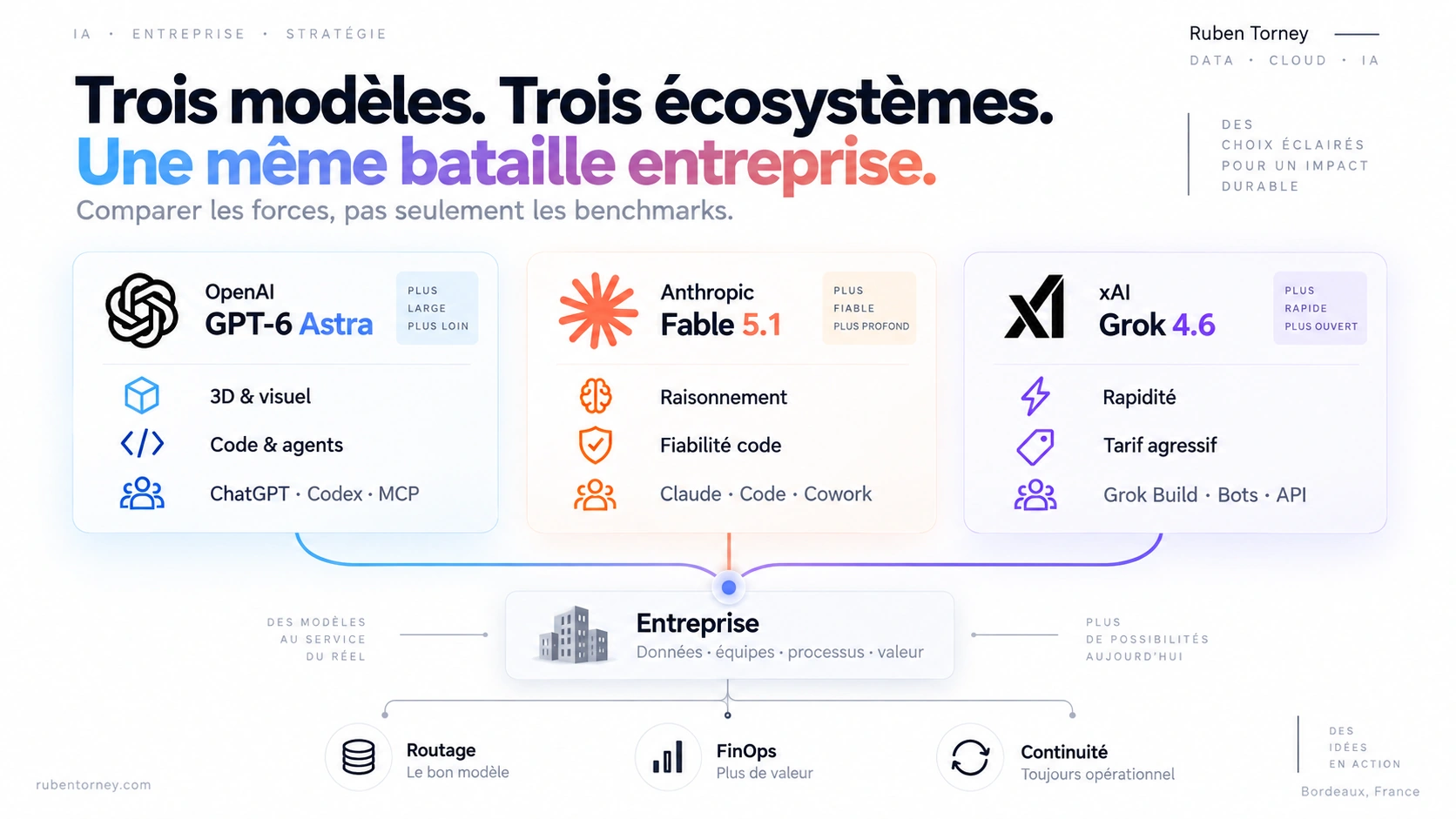
Anthropic ships Claude Fable 5.1. OpenAI follows with GPT-6 Astra. xAI has held Grok 4.6 since mid-August, with Grok 4.7 signaled for mid-September. Benchmarks make noise. What matters for a CIO or an executive is something else. Agent ecosystems sink into the work, the bill shifts to the enterprise, and switching cost rises with every connector you plug in.
The question is no longer only “which model to pick”. It is which processes you transform, with which data, which risks, which cost, and which exit door.
In one week, three camps, one shared logic
You could read this sequence as a leaderboard war. Fable 5.1 pushes agentic coding (software development delegated to agents) and knowledge work. Astra presents itself as OpenAI’s flagship for hard reasoning, software engineering and computer use (the model driving a computer). Grok 4.6, already in Cursor and via API, bets on long agents and aggressive pricing.
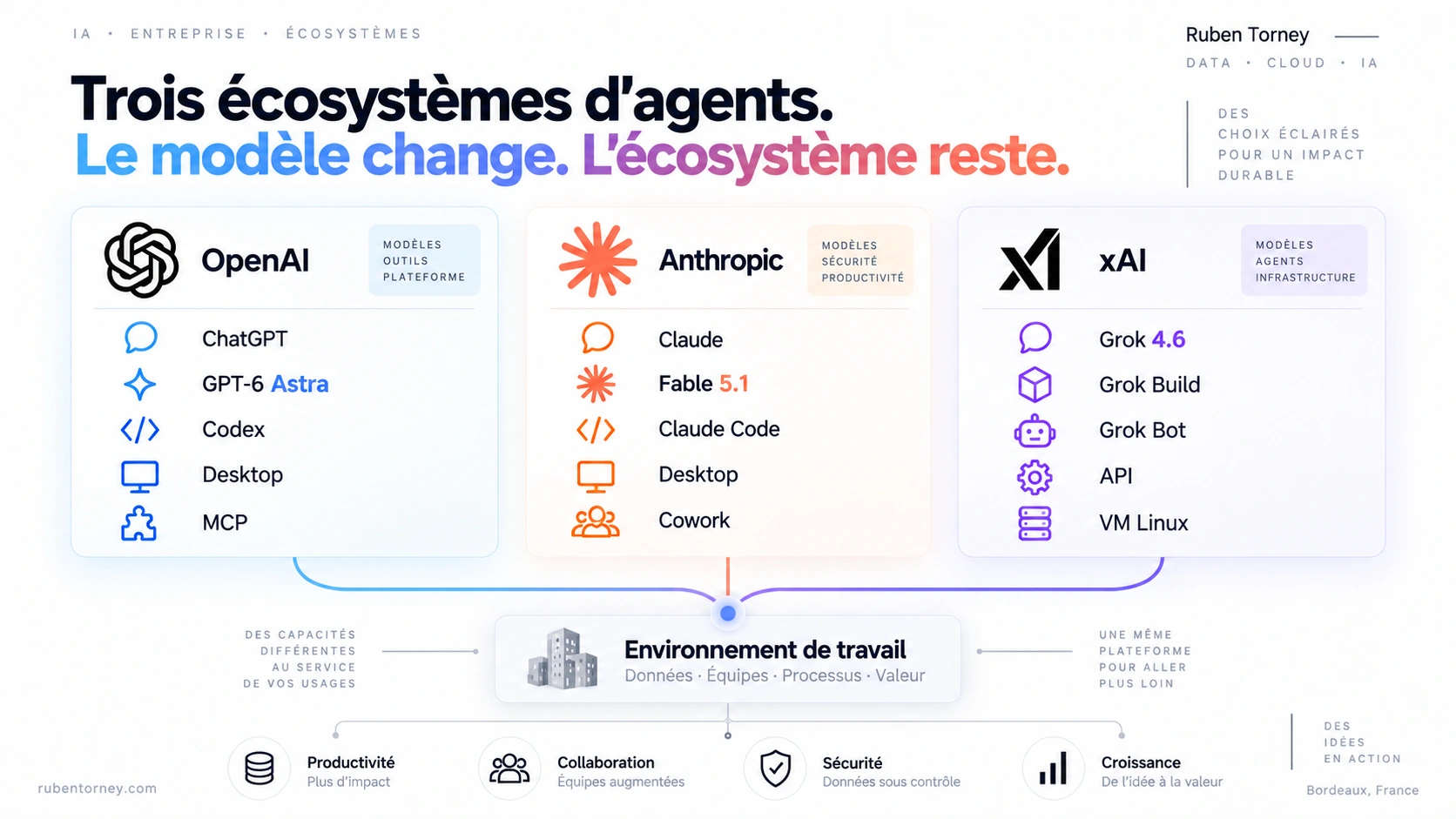
That frame is too narrow. What OpenAI, Anthropic and xAI sell today is no longer only a model. It is an environment to work in, with a chat wired to tools, agents that chain steps, an IDE, a desktop, sometimes a light VM. Once tickets, code, CRM and docs flow through that stack, changing camps is no longer a model choice. It is a migration project.
After nine years on data and cloud platforms, and a recent specialization in agents, RAG (retrieval-augmented generation) and AI FinOps, my field angle stays simple. The model looks interchangeable on paper. The ecosystem does not. And the day the API returns 503, you learn very fast whether you had a continuity strategy, or a subscription and crossed fingers.
The triptych, laid flat
| Anthropic Fable 5.1 | OpenAI GPT-6 Astra | xAI Grok 4.6 | xAI Grok 4.7 | |
|---|---|---|---|---|
| Avail. (9 Sep 2026) | Yes (Sep 1) | Yes (API since Sep 4) | Yes (Aug 12) | No, signal ~Sep 12 |
| API price (short) | $10 / $50 MTok · cache $0.25 | $10 / $50 MTok · cache $1 | $2 / $6 MTok (<200k) | Not published |
| Context | 1M | 1.05M | 500k | Not published |
| Positioning | Coding / knowledge / agents | Frontier + computer use | Agents + cheap coding | Hypothesis, competitive ticket |
| Sensitive access | Mythos 5.1 (trusted) | Daybreak (Blue / Red) | n/a | n/a |
Grok 4.7 cells stay empty on purpose. Without a product page and an API id, it is not an offer. It is an expectation, based on a Musk timing signal (“in 10 days” in early September), not an xAI release note.
On price, the gap is already political. Astra and Fable 5.1 sit on the same frontier ticket. Grok 4.6 is several times cheaper on output. Anthropic cut real agent-session cost via cache reads. On Astra, prompts beyond 272k tokens move to long-context pricing.
My hypothesis, clearly labeled as such, is that Grok 4.7 will land with another aggressive stance. I will only write it as fact after a repeatable test. I already covered the price/performance story of Grok 4.6 in mid-August.
Three ecosystems getting thicker
OpenAI, from chat to workflow
ChatGPT is no longer an isolated dialogue box. Codex, paid plans, tools and MCP (Model Context Protocol) push the model into the middle of processes. OpenAI docs are explicit. ChatGPT desktop, Codex CLI and the IDE extension can share the same MCP config. Codex Skills (SKILL.md) freeze reusable workflows. For a company, this looks less like an AI subscription and more like an execution layer.
Astra also arrives with cyber gating via Daybreak (Trusted Access). Useful nuance. Astra is Critical under the Preparedness Framework, but Daybreak “reduced refusals” are not available on Astra for most Daybreak customers. The public flagship and the permitted cyber flagship are not the same commercial product.
Anthropic, agentic for non-technical users too
Claude Cowork, inside the Desktop app, targets knowledge work without a terminal. You pick local folders, delegate multi-step tasks, and computer use stays in preview. As long as AI stays with power users, volume stays limited. The moment business teams can delegate without coding, organizational footprint explodes.
On the enterprise side, Fable 5.1 arrives with EFS (Enterprise Frontier Safeguards) and Mythos 5.1 for cyber and life-science uses under trusted access, in the Project Glasswing lineage.
xAI, agents, dedicated machine, multi-bots
Grok Bot launched on August 11, 2026, with persistent agents, routines, handoffs and multi-bots. Enterprise docs describe a managed Linux VM per member, shared across that member’s bots. Isolation is between users, not between bots on the same account. Less one giant chat for everyone, more a team of agents in a toolbox.
In all three cases, the direction is the same. Push AI agents everywhere. Fewer and fewer companies can do without them. And that is fair, because when it works, the product is impressive.
Three CLIs in the terminal
Under the desktop and the chat, each camp also ships a terminal agent. Same surface, three ecosystems.
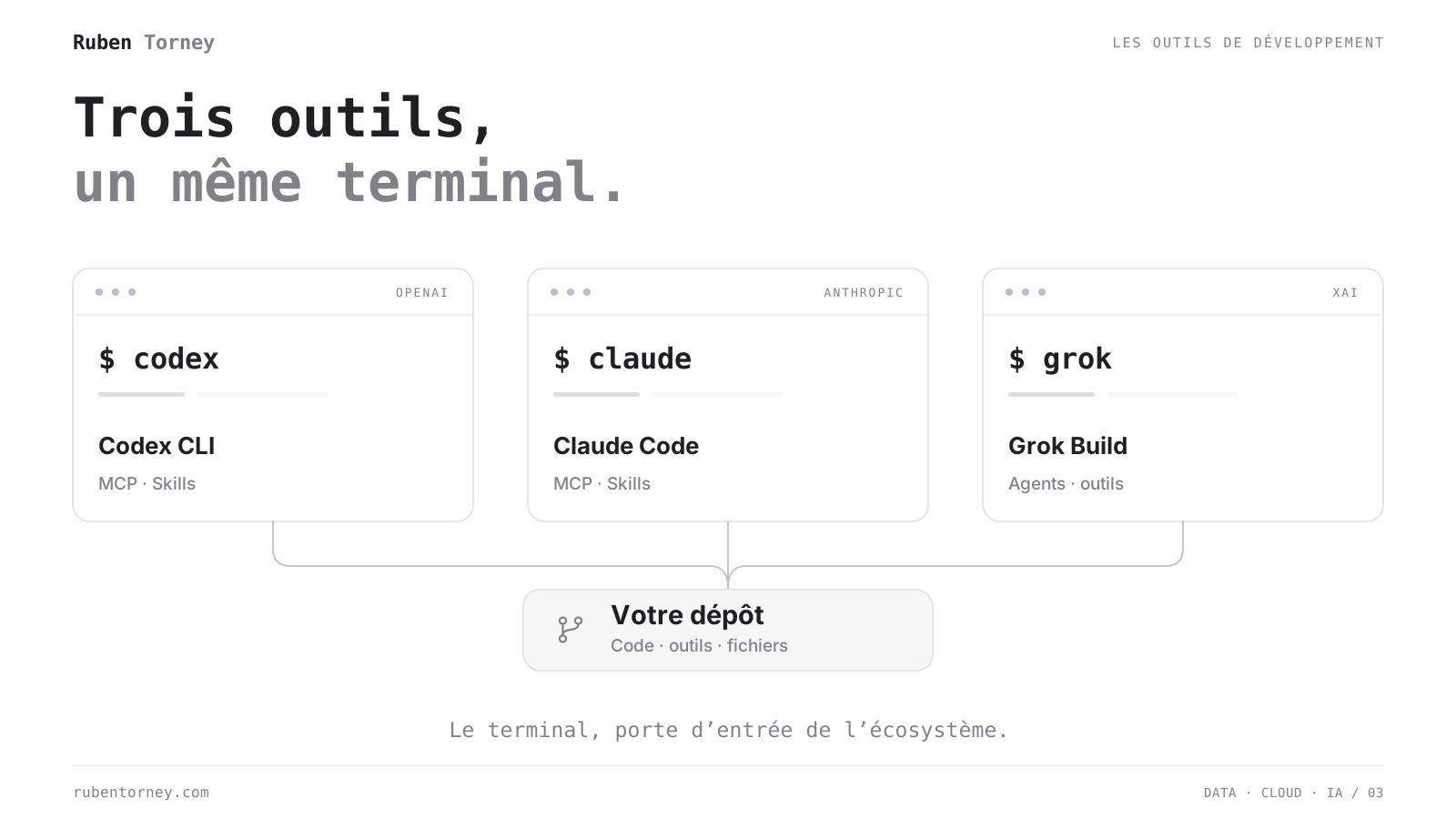
- Codex CLI (OpenAI). Included in ChatGPT plans. Cloud sandbox, MCP and Skills shared with desktop. Natural if the team already lives in ChatGPT.
- Claude Code (Anthropic). The terminal agent wired to the Claude family. Skills / MCP, strong on multi-file refactors. Often the default for teams already on Claude Pro or Max.
- Grok Build (xAI). xAI CLI / TUI, with parallel agents and an aggressive model ticket. Useful for volume and mechanical migrations, especially if SuperGrok is already paid. See also how to launch Grok Build.
The right criterion is not “which CLI is best”. It is which camp already owns your workflows, configs and billing.
Why enterprise, not (only) B2C
Three ideas get mixed too often.
- B2C flat rate is not inference economics. In January 2025, Sam Altman admitted losing money on ChatGPT Pro at $200/month. A subscriber who blows through limits can cost far more to serve than the plan. I see it at home. Some weeks I burn more than 30 billion tokens.
- OpenAI is clearly shifting to enterprise. On August 14, 2026, CFO Sarah Friar said enterprise was now the majority of revenue (CNBC). Companies move from “tokenmaxxing” to “cost per unit of intelligence”.
- Anthropic has played the API and enterprise card for longer. Enterprise, Bedrock, Azure, Foundry, EFS, Claude Code. The product signal is clear, even without a stable audited public percentage.
For a French decision-maker, labs want access certainty, seats, volume commitments and deep integration. That is where value sits. That is also where sovereignty and dependency play out. I framed this earlier in AI in business, choose a strategy.
FDEs, the arm that stitches the stack into the business
Behind the models and the CLIs (command-line interfaces), there is a human strike force. FDEs (Forward Deployed Engineers) do not stop at opening a support ticket. They embed in your organization, learn your data and processes, then build the AI software suite that actually works inside your IT landscape.
The playbook is not new. Palantir popularized it. Frontier labs (leading-edge model labs) reuse it because an API key deploys nothing by itself. At OpenAI, the FDE role is public. Engineers run end-to-end deployments for strategic customers, from technical scoping to production, with a strong Go-to-Market anchor. In May 2026, OpenAI went further with the OpenAI Deployment Company and the acquisition of Tomoro. The stated goal is to put FDEs on the ground to connect models to data, tools, controls and business processes. About 150 FDEs and deployment specialists from day one, plus more than $4 billion in initial investment to industrialize that motion.
Anthropic follows the same logic under the Applied AI label. FDE postings describe work inside customer systems, with concrete deliverables (MCP servers, sub-agents, skills) and white-glove support (premium hands-on onboarding) for Claude in the enterprise. Also in May 2026, Anthropic announced an enterprise AI services company with Blackstone, Hellman & Friedman and Goldman Sachs. Anthropic Applied AI engineers work alongside that firm’s team to fit Claude into operations, including at mid-market companies that do not keep an army of integrators in-house.
At xAI, the “FDE” branding is less omnipresent in public job posts. The direction is still clear. Grok Build pushes an enterprise footprint (private networks, SSO, fleet policies, compliance controls). In other words, the same problem family. Bring the agent and the CLI close to the work, not only sell tokens.
Officially, they are “lending a hand”. In practice, the more the stack is stitched into your workflows, the higher the switching cost climbs. Rewriting prompts, skills, MCP configs, permissions, runbooks and team training is no longer a subscription change. It is a transformation project. In 12 to 18 months, switching can become painful, even unthinkable for a CIO under pressure. That is exactly where today’s ridiculous price turns into tomorrow’s costly dependency.
The trap, and the outage that makes it visible
We get used to these offers. They are good. They become the heart of the work. Then terms tighten. We saw it on tokens and quotas. We saw it when Copilot’s open bar shifted to credits, and I already covered that in Copilot FinOps.
Once agents sit in the value chain, switching cost is no longer a subscription price. It is the time to rewrite prompts, skills, MCP configs, AGENTS.md, CLAUDE.md or .cursorrules, permissions, runbooks and training.
Lock-in moved. The model is increasingly swappable. The harness (tools, memory, agent definitions and ops around the model) is not.
The risk is not only financial. If a service drops after an outage, an access restriction or a gated model, and there is no exit door, the company is stuck. Digital sovereignty is not a slogan. It is business continuity.
The exit path, including local
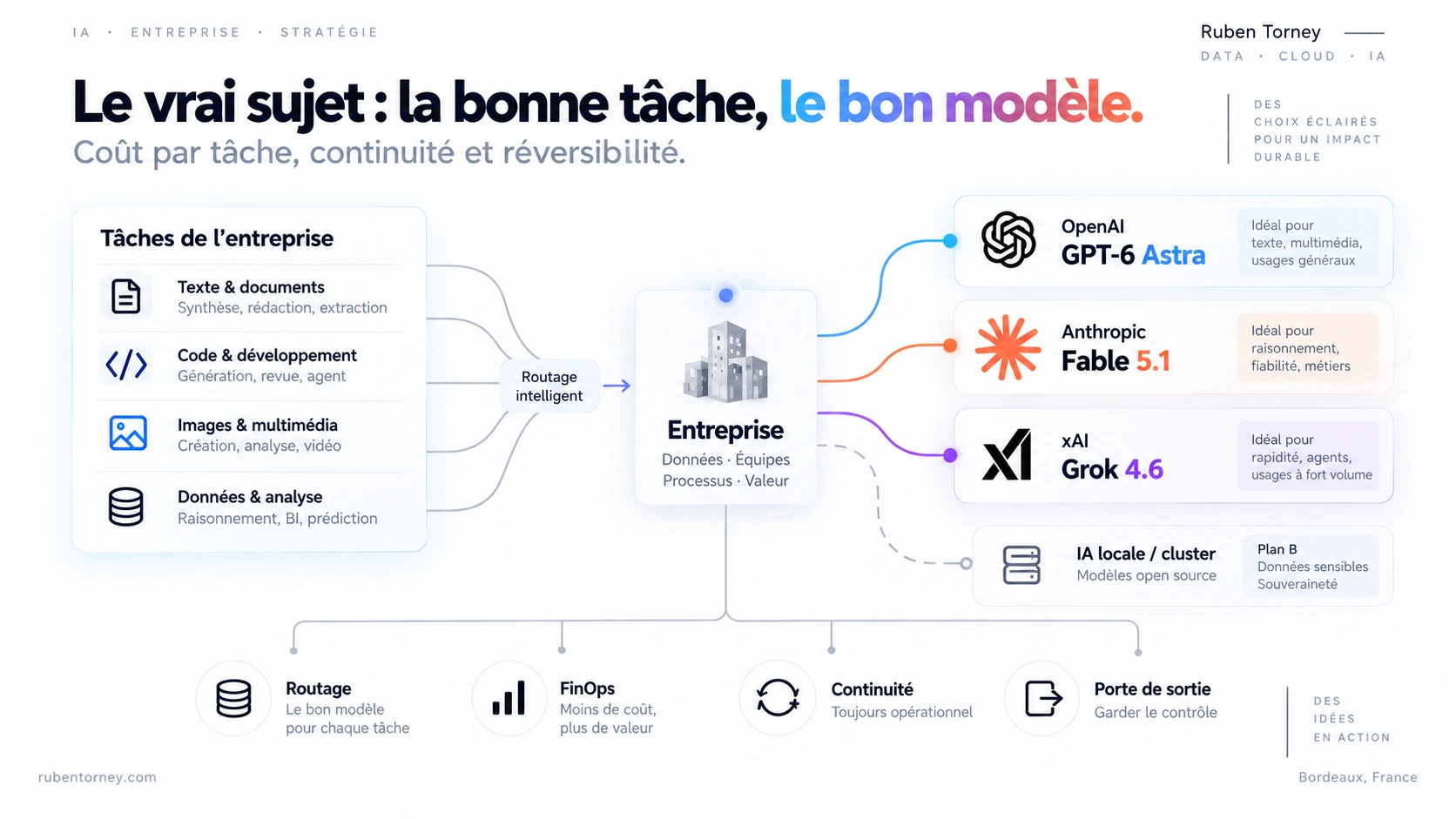
That exit path must be prepared now. It can be a second cloud camp, an abstraction layer, versioned prompts and data you own. It can also be local AI, the plan B that becomes plan A the day the API returns 503.
On one side, desk boxes. Mac Studio, DGX Spark, ASUS GX10, Xiaomi AI Cube. One plug, one machine, and a way to run part of the work without sending data to an external API. I already covered several of these boxes, including the Mac Studio M5 Ultra.
On the other side, enterprise GPU clusters. As a field order of magnitude, roughly 8 to 10 active sessions per large GPU, depending on model, context and accepted latency. On those stacks you can serve strong open-weight models, up to Kimi K3-class targets when you accept the matching infra. Full frontier open is clearly cluster territory, not Mac Studio territory.
The real brake is CapEx and cash lock-up, plus power, maintenance and ops skills. My view, clearly labeled as such. API prices are unlikely to evolve in the most comfortable direction for heavy consumers.
What I would do tomorrow morning
- Measure cost per outcome, not token volume.
- Map dependencies. Which processes die if ChatGPT, Claude or Grok falls tomorrow?
- Require an exit path. Swappable LLM, versioned data and prompts at home, a second camp for critical work, a local option for what cannot wait.
- Test Grok 4.6 now on real tickets. When 4.7 ships, judge on artifacts, not a timing tweet.
- Separate frontier and daily volume. Astra or Fable for hard and gated work. A cheaper model, cloud or local, for volume.
- Keep a plan B (other lab, owned open weights, box or GPU cluster, human degraded mode) for regulated or vital flows.
Conclusion
Astra, Fable 5.1 and Grok 4.6 are not three isolated announcements. It is the same story written by three camps. Put agents at the center of work, make the ecosystem indispensable, monetize the enterprise that cannot walk back.
Grok 4.7 may still shake price/performance. Good. The strategic question will not move with one benchmark point. Who owns your agent workflows? What will it really cost to leave in eighteen months? And what is a minimum autonomy worth the next time DownDetector lights up?
Models will keep changing. Integration depth will stay, with the bill that follows. I will be back soon, if the servers hold until then.
Glossary
| English | Short meaning |
|---|---|
| Agent / agentic | System that chains actions toward a goal |
| API | Programmatic interface (often billed per token) |
| Applied AI | Applied AI (customer-side business deployment) |
| ARR | Annualized recurring revenue |
| B2C / flat rate | Consumer / fixed-price subscription |
| Benchmark | Performance ranking or test |
| Cache read | Reread of already processed context |
| CapEx | Upfront capital investment |
| Computer use | Model driving a computer |
| Enterprise | Offer aimed at companies |
| FDE | Forward Deployed Engineer embedded with the customer |
| Frontier | Top tier of most capable models |
| Gating / Trusted Access | Controlled / trusted access |
| GPU | Graphics processor for inference |
| Harness | Tools, memory and ops around the model |
| Inference | Running the model to produce an answer |
| Lock-in / switching cost | Vendor lock / cost of leaving |
| MCP | Protocol to attach tools and data |
| Open weights | Downloadable model you can run yourself |
| RAG | Document retrieval + generation |
| Rate limit | API throughput ceiling |
| Tokenmaxxing | Maxing tokens without caring about useful output |
| White glove | Premium hands-on onboarding and support |
Sources
- OpenAI Docs · GPT-6 Astra / Codex / MCP
- Anthropic · Fable 5.1 / Cowork / EFS
- xAI · Grok 4.6 announcement
- xAI Docs · Grok Build / Grok Bot
- CNBC · Sarah Friar, OpenAI enterprise mix (Aug 2026)
- TechCrunch / Fortune · Altman on ChatGPT Pro (Jan 2025)
- OpenAI Careers · Forward Deployed Engineer (FDE)
- OpenAI · OpenAI Deployment Company
- Anthropic Greenhouse · Forward Deployed Engineer
- Anthropic · Enterprise AI services company
- xAI Docs · Grok Build enterprise