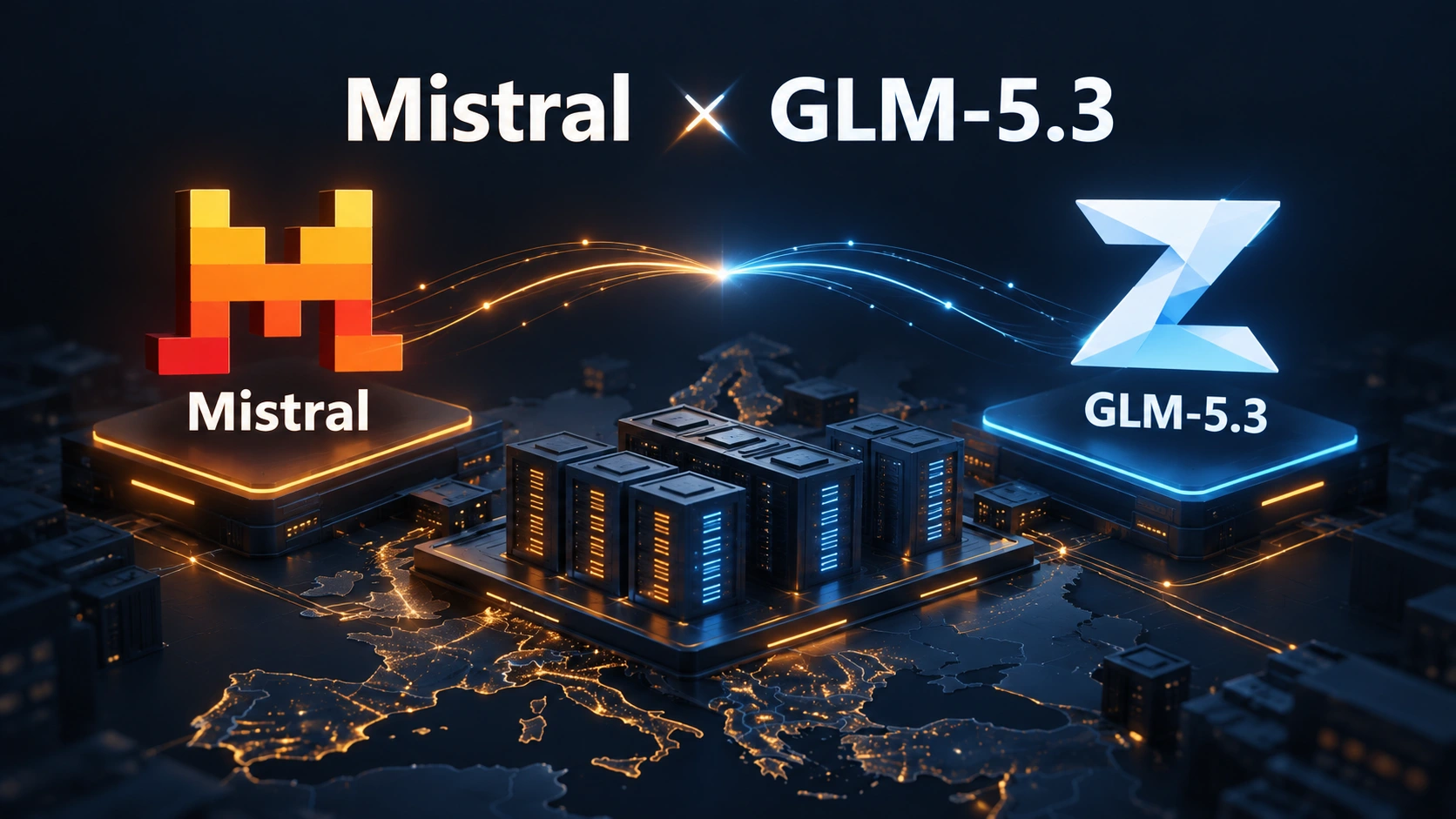
Hosting GLM‑5.3 is a commercial acknowledgement that the best answer to a customer’s problem may come from another lab. I see an admission of a capability gap in some workloads, but also a sensible adaptation. Capturing value through inference and trust can matter as much as producing model weights.
Another step in a strategy that predates yesterday
The announcement shared on 21 September 2026 presents GLM‑5.3 in Vibe Code for Pro, Team and Enterprise users, with hosting advertised in the EU. The chronology matters. Mistral’s model card is dated 15 September and labels it Public Preview. Third-party model hosting was already announced on 11 August, starting with GLM‑5.2.
What interests me goes beyond another entry in a model picker. Mistral is becoming a place to consume intelligence developed elsewhere. Customers can separate the choice of model from the choice of operator. For a European lab, that creates another way to retain a share of the value.
The capability gap is hard to ignore
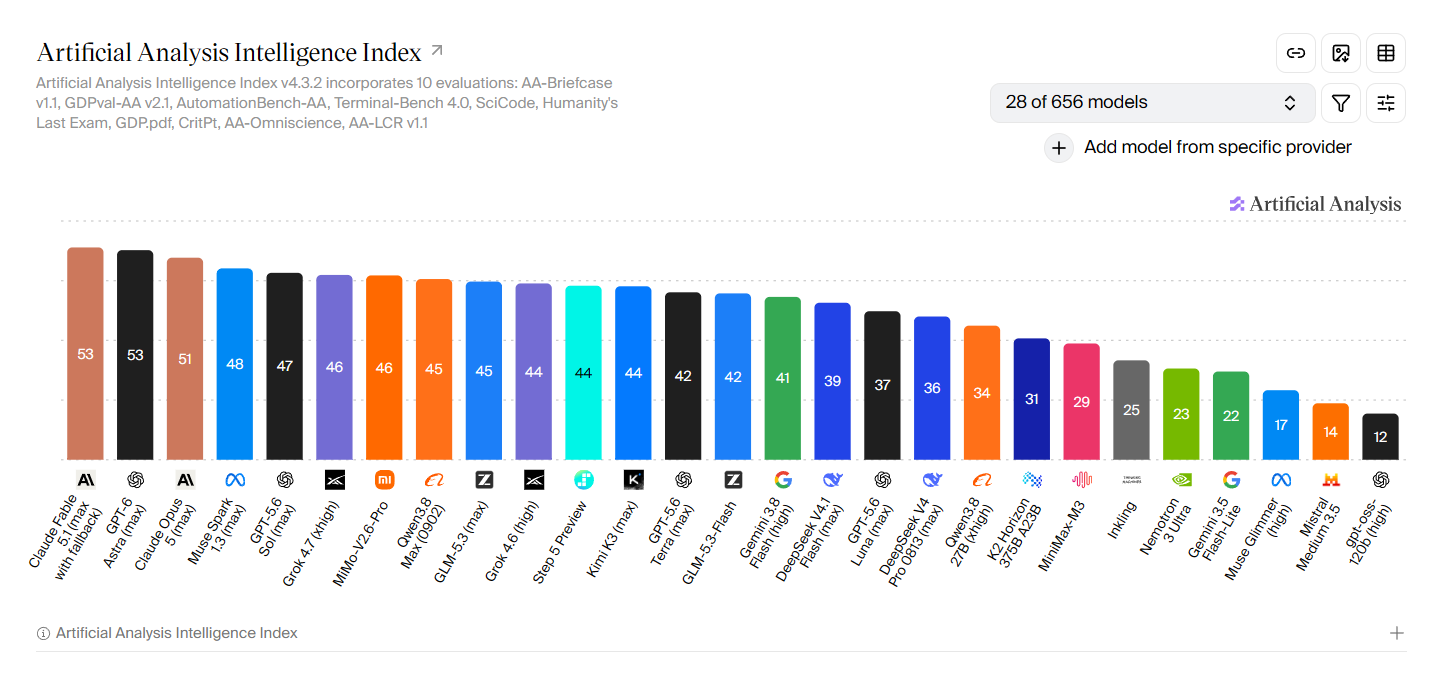
I checked the Artificial Analysis Intelligence Index on 22 September 2026. Under v4.3.2, GLM‑5.3 and Kimi K3 sit well ahead of Mistral Medium 3.5. The open-weight Qwen3.8 2.4T A95B does too. Exact model variants matter more than brand-level comparisons.
| Model and setting | Index, displayed rounding |
|---|---|
| Claude Fable 5.1 — max with fallback | 53 |
| GPT‑6 Astra — max | 53 |
| Grok 4.7 — xhigh | 46 |
| GLM‑5.3 — max | 45 |
| Kimi K3 — max | 44 |
| Qwen3.8 2.4T A95B | 40 |
| Mistral Medium 3.5 | 14 |
These are not intelligence percentages or universal quality measures. The index combines ten evaluations; reasoning settings and fallback models matter. Nor is this a benchmark of Mistral’s GLM endpoint. See the index methodology.
My interpretation is straightforward. For a business seeking an agent for difficult work, European origin alone cannot erase a substantial usefulness gap. When alternatives have available weights, it is reasonable to ask whether every capability needs to be retrained from scratch, or whether some investment is better spent on reliable operation and integration.
Available weights do not automatically make a project fully open source or easy to run on a personal computer. Licences, hardware requirements and usage conditions need checking individually. Chinese open-weight models are not a uniform category of unrestricted software.
Talent alone does not pay for the GPUs
The image that comes to mind is a boxer entering the ring with one hand tied behind their back. That does not mean Mistral is a poor contender. It means research talent is only part of the competition. Capital, compute, data, operations teams and electricity also determine what a lab can attempt.
In his 4 September interview with Stratechery, Greg Brockman described Astra as OpenAI’s first training run using more than 100,000 GPUs. That is an executive’s statement, not an independent audit of training expenditure. It nevertheless conveys the industrial scale involved.
The energy constraint is just as tangible. The IEA projects roughly 950 TWh of data-centre electricity consumption in 2030, versus 485 TWh in 2025. Those figures cover all data centres, not just LLM training. Buying accelerators does not solve the problem of supplying and operating them.
I would not turn this into a claim that France is inevitably disadvantaged on every energy metric. Costs depend on sites and contracts. Mistral itself has announced an ambition for up to 1 GW of capacity by 2030 in its European infrastructure programme. Planned capacity is not deployed capacity, but it is hardly a statement of withdrawal.
“Mistral can never catch up” is too definitive. “Matching every escalation by OpenAI, Anthropic and Grok is expensive and risky” is much more defensible. A leaderboard cannot tell us how much of the gap comes from financing, scientific choices or regulation.
The AI Act adds obligations, not a legal ceiling on intelligence
European requirements are not merely a future concern. Obligations for new general-purpose AI models have applied since 2 August 2025, with a separate transition for older models. The European Commission’s guidance includes a copyright compliance policy and a training-content summary. Open models are not exempt from those two obligations.
Providers outside the EU placing models on its market are also covered. Importing Chinese weights does not remove compliance questions. Nor does the AI Act impose a benchmark threshold beyond which a model becomes illegal. See the Commission’s GPAI questions and answers.
My criticism concerns the economics. Funding a compute race alongside demanding governance creates pressure. But a strong score does not establish that a Chinese lab infringed copyright. Nor does it show that Mistral would have to break the law to achieve comparable results. Nationality and benchmark performance are not evidence of either claim.
The real question is return on investment. Is repeatedly funding capabilities already available elsewhere the best use of capital when customers also need support, contracts and operational control? Respect for creators should remain a requirement, rather than becoming the bargaining chip of this competition.
Retaining value requires distinguishing three kinds of control
I see a pragmatic commercial move. Mistral can sell execution capacity and a trusted relationship even when it did not train the model. Enterprise customers look like the natural market to me, although independent developers may also value an alternative to American APIs or routing services such as OpenRouter.
| What I want to control | What I need to check |
|---|---|
| Data and processing | Actual region, retention, logs, subprocessors, support access and transfers. |
| Operations | Availability, quotas, latency, monitoring, support and contractual commitments. |
| The model | Licence, weight version, ability to change hosts and dependence on future releases. |
A French operator does not automatically mean inference in France. Mistral’s regional documentation says the global endpoint does not commit to a region. Regional inference is a separate option with a 10% surcharge and model availability to verify. It does not regionalise all service metadata. The evidence here cannot support a blanket “hosted in France” claim.
Likewise, choosing a European supplier does not automatically make an application GDPR compliant. The CNIL describes the security and contractual checks needed for cloud services. I would examine contracts and actual data flows before sending sensitive client documents. This is the same approach I discuss in enterprise AI strategy, governance and sovereignty.
There is still genuine value in choosing an operator without giving up the model best suited to the task. Partial sovereignty, accurately described, can be useful. A promise of total sovereignty that hides its dependencies is much less convincing.
The alternative also needs to make economic sense
On 22 September, the GLM‑5.3 card lists $1.40 per million input tokens, $0.14 for cached input and $4.40 for output. These are standard API rates, not Vibe subscription allowances.
Consider a simple calculation, excluding any applicable taxes and other charges. One million uncached input tokens plus 100,000 output tokens costs $1.84 at standard rates. Applying the 10% regional surcharge gives $2.024, subject to model availability on the chosen endpoint. Neither figure is a guaranteed price for an agent task.
Agents can reread context, retry and produce substantial reasoning. That is why I care more about the cost of a successful task than a token’s sticker price. I explored this in my account of Copilot’s unpredictable everyday costs. I expect pressure on actual budgets, but that does not imply every unit price will rise. Efficiency, competition and promotions can push the other way.
For me, the appeal of this offer is the combination of a French operator, reliable results, predictable costs and greater freedom to choose models.
What guardrails apply to GLM? The answer is still incomplete
Mistral says GLM‑5.3 is served without its modifications. That describes the model, not the entire service. The Mistral DPA provides for automated moderation and API abuse monitoring, with an exception stated for the latter when zero data retention is enabled. These clauses must be read alongside the applicable offer and contract.
Mistral also offers a moderation API. Its existence does not prove that every GLM request passes through it. The usage policy prohibits compromising third-party security and bypassing protections. Open weights do not mean a hosted service without rules.
For an authorised penetration test, I would want to know what the service actually permits. The sources reviewed do not describe GLM‑5.3-specific filtering in enough detail to establish that it matches Mistral’s own models, or that it is absent. I have not tested this endpoint for cybersecurity work. Supposedly lighter censorship is therefore not a measured capability in this article.
My questions would be specific. Which filters run before and after inference? What differs between Vibe and the API? How are false positives on authorised audits handled? What records are retained and for how long? Clear documentation here would have commercial value.
What if Mistral is already preparing for the efficiency race?
The debate gained another dimension with the departure of Jacob Coxon, formerly at OpenAI and Anthropic. In September, Dario Amodei published We Must Pace the Frontier, calling for slower capability advances to give safeguards and independent evaluation more time, rather than stopping research. Altman and Musk endorsed the call. That alone does not establish an implemented worldwide pause.
Their stated justification is safety, not a claim that models are already good enough. But I also question the economic incentives. When the strongest incumbents call for a slower race, it could give them time to recover investments, consolidate products and protect their lead. I see possible opportunism, not a proven motive. Sincere concerns about risk and commercial interests can coexist.
My intuition is that, for a large share of routine business needs, the question will increasingly shift from “which model is biggest?” to “which one completes this task correctly, at an acceptable cost and within the required time?” This does not imply a universal plateau. Difficult, lengthy or critical tasks may still benefit substantially from better capabilities. But a few extra benchmark points do not guarantee a return on investment for every customer.
The next competitive battle could therefore focus more on efficiency. Models would need to deliver useful results with less computation and unnecessary context, while reducing retries and allocating work more effectively. These levers need to be distinguished. Reducing billed tokens, generating them faster and consuming less energy are not interchangeable measurements. What I want to compare is the full cost of a successful task at equivalent quality.
Seen this way, Mistral may have recognised early that a durable business does not require winning every round of the capability race. Developing its own models, distributing open-weight alternatives and becoming a leading inference operator in Europe could reinforce each other. Customers also buy availability, integration, support and operational commitments. That industrial ambition deserves recognition.
I am describing a strategy for profitability, not established profitability. The evidence checked for this article does not establish either that Mistral makes a net profit or that OpenAI loses money on every request. Revenue, inference margins, research spending and overall earnings are different things. My hypothesis is that Mistral can pursue more rational growth by monetising model use, including other labs’ models, instead of making its entire value depend on first place.
Mistral is also building an enterprise toolbox
Frontier-model rankings tell only part of the story. The Mistral catalogue combines general-purpose models with tools for documents, audio, code, semantic search and moderation. To me, this breadth offers another interpretation of its strategy. Mistral is gradually building a toolbox whose components businesses can assemble around their needs.
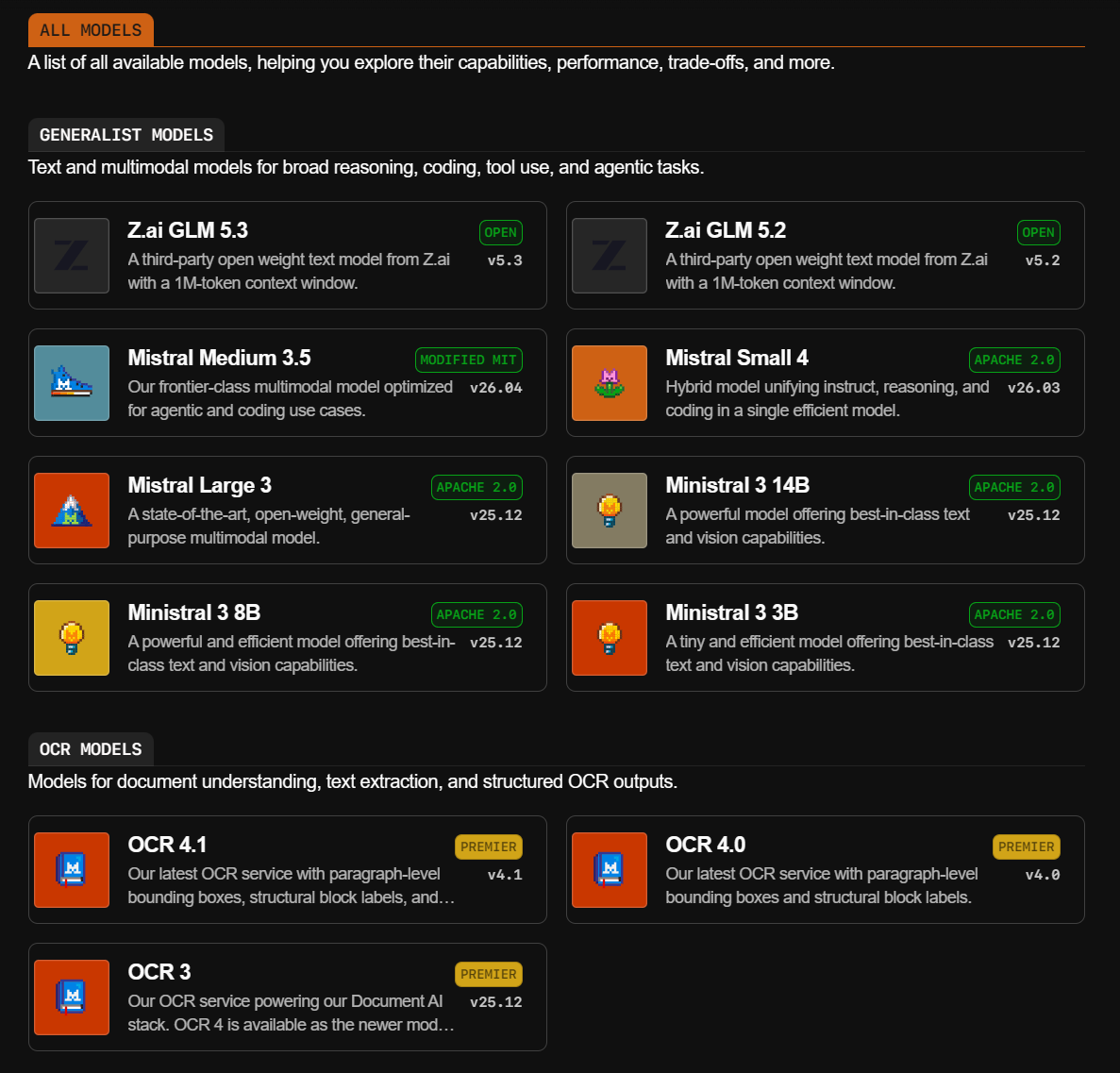
The Ministral 3 family includes 3B, 8B and 14B sizes. The 3B model targets local and resource-constrained deployments. This makes language and vision capabilities accessible without infrastructure comparable to that required by the largest models. Smaller variants can support hosting on relatively modest hardware, depending on quantisation, available memory, context length and concurrent users. It does not mean every model in the catalogue runs on any computer.
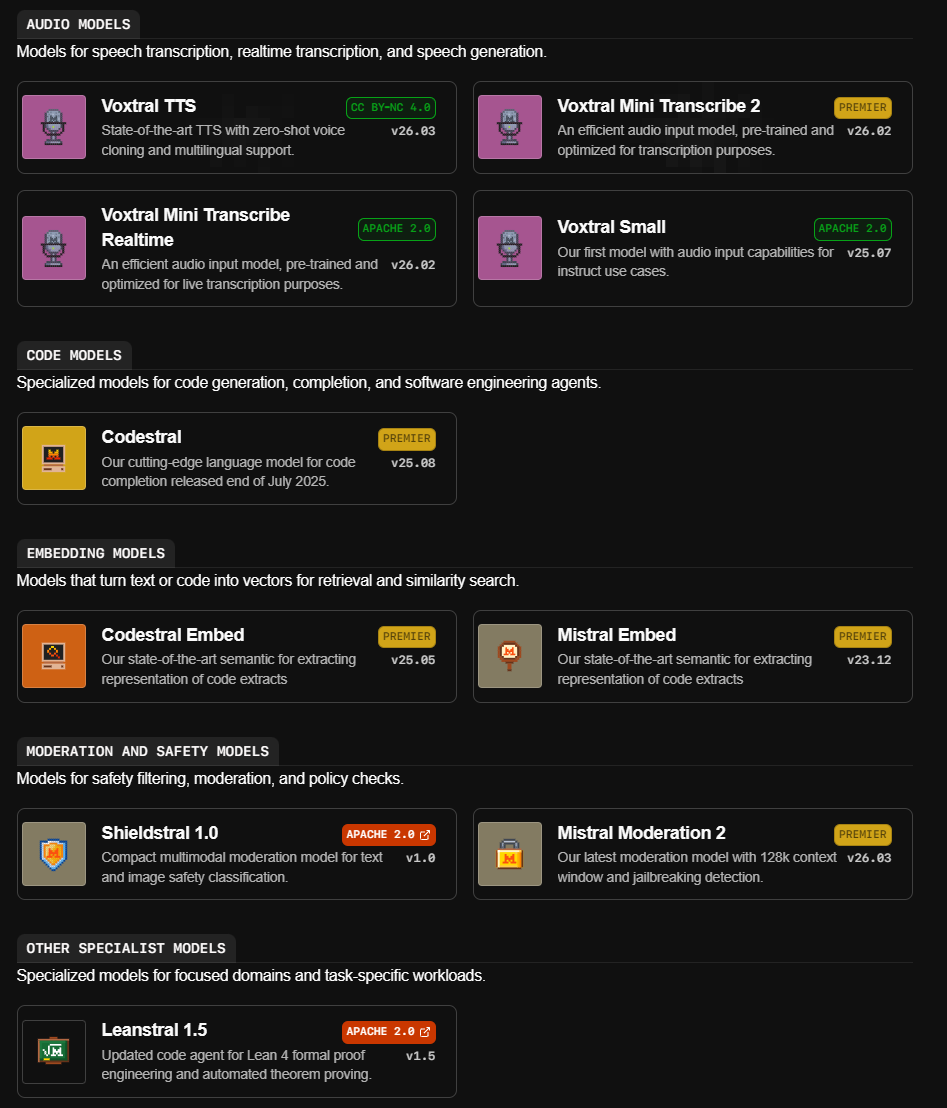
OCR extracts document content, Voxtral supports audio workloads, Codestral handles code completion and embeddings enable similarity search. Shieldstral adds a compact text and image moderation model under Apache 2.0. Businesses can therefore consider a workflow suited to their operations instead of sending every step to the most powerful model. That is another way to pursue efficiency.
The components still need to be selected individually. These screenshots mix open models and Premier offerings. Voxtral TTS weights use a CC BY-NC licence, so commercial usage rights need checking. A broad catalogue is not an entirely unrestricted, locally deployable and interchangeable suite.
The sovereignty benefits can be practical. Hosting suitable components in a controlled environment can help limit data transfers, pin versions and apply internal access and retention rules. This can make some regulatory requirements easier to implement, provided the whole system is documented and secured. Neither an open licence nor a moderation filter automatically establishes GDPR or AI Act compliance.
This is the positioning I find strategically interesting. Mistral can become a developer, distributor and operator of a growing set of tools. Enterprise customers gain options for their costs, hosting and governance. Value then extends beyond the highest benchmark score to the ability to build useful AI that remains manageable in everyday operations.
Acknowledging a gap can lead to a sound strategy
Yes, I see a form of admission. Offering customers a third-party model that outperforms your own in this index acknowledges that the answer will not always come from your lab. I prefer that honesty to a sovereignty promise that asks customers to sacrifice too much effectiveness.
It is not evidence that research has been abandoned. In my view, it is a way to fund another position in the market. Mistral can develop its models while operating others. The risk is dependence on licences and releases outside its control. The opportunity is to retain part of the customer relationship, expertise and revenue in Europe.
Personally, I find that option worth exploring. I would evaluate it on my own workloads, with a defined budget and data scope. I do not need Mistral to win every benchmark. I need an offer that is useful, transparent about its limits and strong enough to choose for reasons beyond patriotism.
Sources
Sources checked on 22 September 2026. Desk research and personal analysis; no benchmark of the Mistral API was conducted for this article.
- GLM‑5.3 in Vibe Code for Pro, Team and Enterprise users
- Mistral’s model card
- 11 August, starting with GLM‑5.2
- Artificial Analysis Intelligence Index
- index methodology
- 4 September interview with Stratechery
- IEA projects roughly 950 TWh of data-centre electricity consumption in 2030
- European Commission’s guidance
- Commission’s GPAI questions and answers
- Mistral’s regional documentation
- CNIL describes the security and contractual checks needed for cloud services
- Mistral DPA
- moderation API
- usage policy
- Jacob Coxon, formerly at OpenAI and Anthropic
- We Must Pace the Frontier
- Altman and Musk endorsed the call
- Mistral catalogue
- Ministral 3 family includes 3B, 8B and 14B sizes
- 3B model targets local and resource-constrained deployments
- Shieldstral adds a compact text and image moderation model under Apache 2.0
- Voxtral TTS weights use a CC BY-NC licence