What changes in the Pro plans
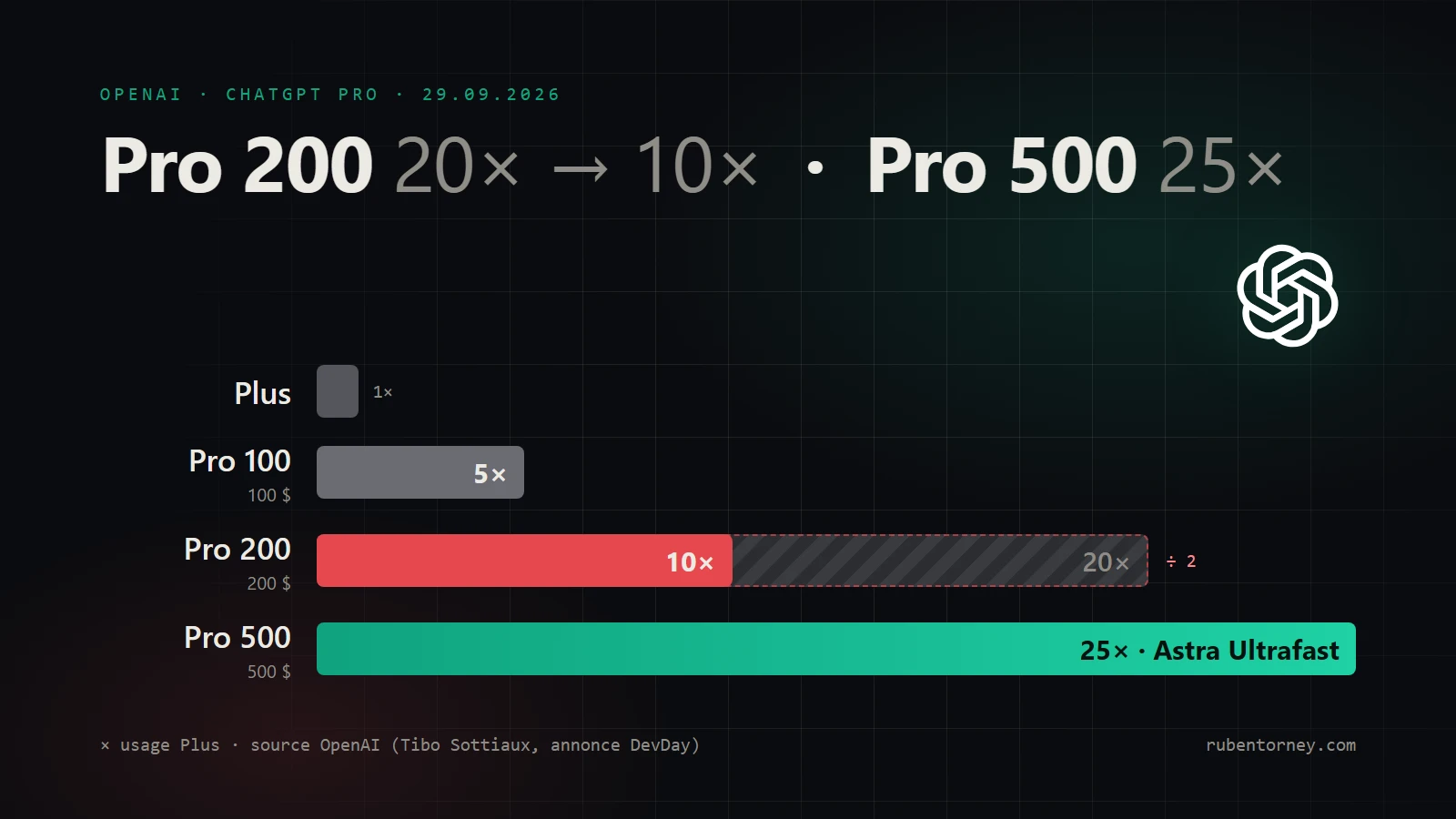
The announcement came from Tibo Sottiaux, who leads ChatGPT, Codex and API products at OpenAI, on DevDay 2026. Multipliers are expressed relative to the usage included in the Plus plan.
I’ll explain the new Pro 200 plan differently, before I start live tweeting from DevDay on things that are going out!
Today we are going to ship a number of things that increase what you can do across the Plus and Pro plans. A lot of compute is online for this increase. As we increase the floor, we are changing the relative difference between plans to be Plus = 1X, Pro 100 = 5X, Pro 200 = 10X, and we are reopening subscriptions for Pro 200 (we had paused it). If you have an existing plan you will keep the 20X multiplier for a bit and also receive a lot of additional credits because we know changes are hard even if it means that everyone will get more in the end.
A few hours earlier, in a longer post published the same day, he summed up the effect for Pro 200 subscribers in one blunt sentence. “If you do the math, it will net out at half the dollar in API spend compared to the old Pro $200 plan.” In other words, the same price now buys roughly half the usage, measured in API dollars.
| Plan | Monthly price | Included usage relative to Plus |
|---|---|---|
| Plus | reference plan | 1× |
| Pro 100 | $100 | 5× |
| Pro 200 | $200 | 10×, down from 20× before September 29 |
| Pro 500 (new) | $500 | 25×, with Astra Ultrafast |
The new Pro 500 offers 25 times Plus usage according to OpenAI’s DevDay announcement, and it is the only plan that unlocks Astra Ultrafast, a version of GPT-6 Astra that generates up to eight times faster in Codex. OpenAI’s help pages state that existing subscribers keep their previous allowance until October 29, 2026. Press coverage, including The Next Web, mentions a compensating credit of about $2,500 valid until the end of the year, and a GPT-6 Pro chat cap on Pro 200 that would drop from 200 to 100 messages a week. I did not find those last two figures on an official page.
OpenAI also highlights several trade-offs. The five-hour limit will not return on Pro plans, and only the weekly quota applies. GPT-6 Sol and its successor GPT-6.1 Sol cost $2 per million input tokens and $10 per million output tokens, half the promotional price of GPT-5.6. Conversations with dots, the new personal agents, do not count towards limits, but the tasks they launch in Codex or ChatGPT Work do. Their rollout currently excludes the European Economic Area, Switzerland and the UK.
A first warning with the September 10 freeze
This change did not come out of nowhere. On September 9, Tibo Sottiaux was already warning that demand for GPT-6 Astra was “really unprecedented”. The next day, OpenAI paused new subscriptions to Pro 200, explaining that these accounts put the most strain on its systems.
At the time, it could still pass for an emergency measure after a successful launch. Three weeks later, the reopening shows the constraint was not temporary. OpenAI opens the door again, but with half the usage for the same price, and sends heavy users towards a plan that costs two and a half times more.
Like GitHub Copilot, the end of the open bar
I have seen this scenario before. On June 1, I wrote that GitHub Copilot marked the end of the open bar, with a credit allowance replacing a plan that felt unlimited. Three months later, my look at Copilot’s everyday costs showed that a routine SQL analysis could burn more than $15 in credits.
OpenAI is heading down the same path, with one big difference. Pro 200 had become the go-to subscription for developers running Codex for hours every day, precisely because it cost far less than the API for heavy use. That gap between the plan price and the real cost of compute is what is shrinking now.
The reactions show it. Theo (@theo), a developer and creator with a large developer following, replied “Ooooof. Mad respect for the transparency here but this hurts a lot”. On OpenAI’s developer forum, a thread titled “Usage Limit Change Rug Pulling” accuses OpenAI of giving half the benefit for the same price.
My reading, GPUs are becoming the scarce resource
I read this pricing grid as an effort to slow down the use of compute capacity, and GPUs in particular. When a vendor freezes a plan, then reopens it with half the usage, it is telling us that every hour of agent work has a cost it no longer wants to absorb.
Pro 500 confirms it in its own way. It separates developers who can afford $500 a month to keep their former comfort from those who cannot. This sorting happens gradually, plan after plan, until subscriptions get close to pay-per-use.
This movement shows up more and more often, in two forms. Either quotas shrink, or users feel that models get worse over the weeks, what many call “nerfed” models. That second point remains a widespread perception in developer communities, not something I have measured. Both lead to the same place, a serious problem of model availability and compute capacity.
OpenAI’s argument is not absurd either. The new generation of models costs half as much per token and is meant to be more efficient, so according to OpenAI an allowance cut in half should not translate into lower productivity. Tibo Sottiaux goes further when he writes that “everyone will get more in the end”.
That remains to be proven. A lower price per token does not guarantee a lower cost for a finished task, because a model can use more tokens to reach the same result. Artificial Analysis measured exactly that on Claude Opus 5.5, cheaper per token than Opus 5 but with the same cost per task at maximum effort, as it generated 1.6 times as many tokens. And in my everyday work, a task rarely succeeds on the first attempt. You often have to rerun the agent, fix an output or give it more context, and every iteration draws on the quota.
So before concluding that nothing changes, you need to check your own usage for regressions. I recommend replaying a few representative tasks, counting how many iterations it takes to get a verified result and tracking how fast the weekly quota drains. If the efficiency of the new models truly makes up for the cut, good, but nothing guarantees it, and it will show on the bills and quotas over the coming weeks, not in an announcement.
Anthropic and OpenAI, two opposite trajectories
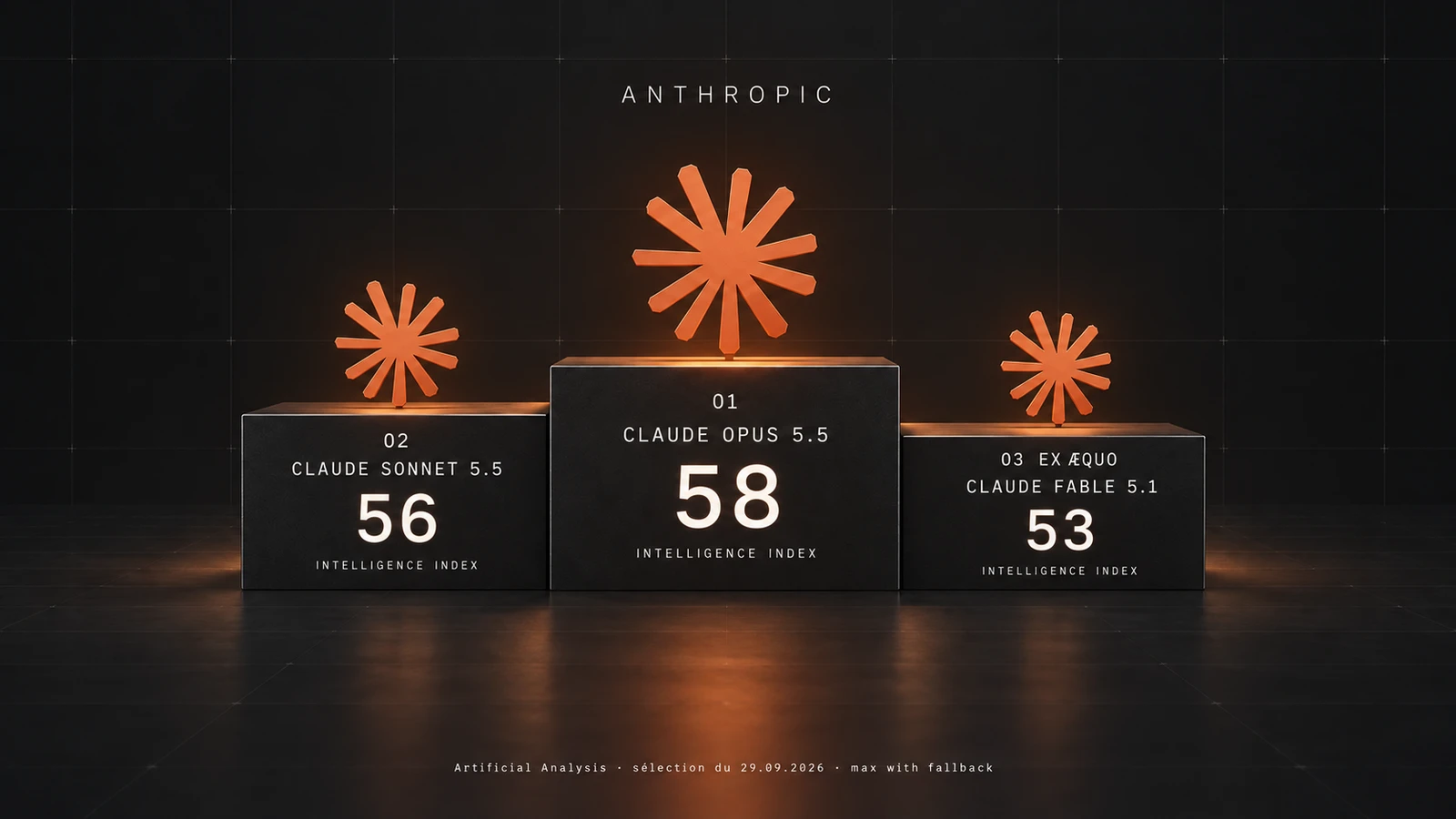
The contrast with Anthropic is striking. As I explained yesterday in my article on Claude Opus 5.5 and Anthropic’s IPO, Anthropic is preparing its stock market listing with models at the top of the rankings, higher five-hour limits on its plans and up to $250 in free credits for its cloud sessions. Its quotas remain fairly generous in my view.
OpenAI, for its part, is in no hurry. Sam Altman told Fortune on September 12 that the IPO would probably not happen in 2026, calling it an “ill-advised” moment given safety concerns. Without an imminent listing, OpenAI can accept a less attractive pricing policy and protect its compute, even if that upsets some of its heaviest users.
Getting ready for pay-per-use
The risk is concrete. A company that built its processes on a heavily subsidised plan can see its costs double overnight, or get blocked when the quota runs out. If you are not ready, you end up stuck with a business that no longer runs.
To give an order of magnitude, the two animations Claude agents produced for me yesterday would have cost $39.82 and $21.63 at API prices, for about two hours of work each. With pay-per-use, those are the amounts to plan for, task by task.
Here is what I recommend right now.
- Measure the cost of a finished, verified task, not just the price of a plan.
- Keep at least two usable model providers, so you do not depend on a single price list.
- Reserve the most expensive models for tasks that truly need them and route the rest to leaner models.
- Keep an open or local option for critical or sensitive workloads.
That last point ties into sovereignty, which I cover in my article on enterprise AI strategy. When compute becomes scarce and US vendors alone decide what a subscription includes, depending on a single provider becomes an operational risk. Mistral’s decision to host GLM-5.3 shows that the question is also being asked in Europe.
Sources and methodology
References checked on September 30, 2026. OpenAI’s announcements, press reporting and my own analysis are kept distinct in the text.
- Tibo Sottiaux’s posts on X, announcing the new grid and on usage in API dollars on September 29, and pausing Pro 200 on September 10.
- OpenAI’s help page on Pro plans and DevDay 2026 announcements.
- Introducing GPT-6 Sol and Luna and introducing dots.
- Artificial Analysis on Claude Opus 5.5 for the gap between price per token and cost per task.
- The Next Web for the transition credit and the GPT-6 Pro message cap, not confirmed on an official page.
- Fortune, September 12, 2026 for OpenAI’s IPO timeline.
Reading this as a brake on GPU usage, a sorting of developers and a shift towards pay-per-use is my own analysis. “Nerfed” models describe a user perception, not a measurement. The costs of my two animations come from the agents’ transcripts, at Anthropic’s public API pricing as of September 29, 2026.