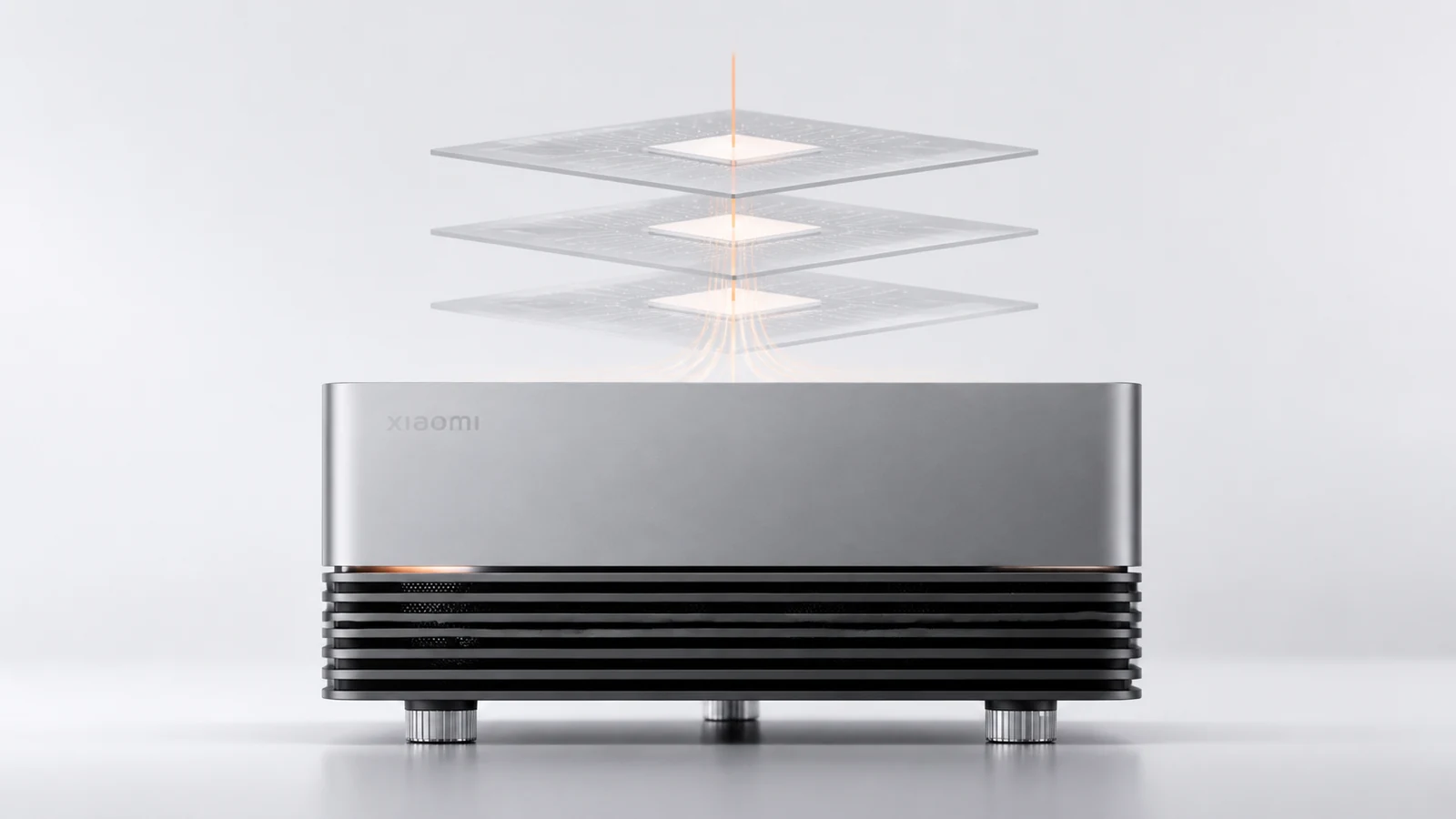
On August 24, 2026, Xiaomi showed a device I will be watching very closely. AI Cube is a prototype desktop AI terminal designed to run large models without sending every request to the cloud.
The promise goes beyond another mini PC. Xiaomi is not placing an off-the-shelf accelerator inside a polished enclosure. It is combining three in-house XRING chips, bringing them closer to its MiMo models and trying to control the whole stack from silicon to model. That integration could reshape the market currently led by NVIDIA DGX Spark and other GB10 systems.
On paper, AI Cube is a credible DGX Spark alternative. Its near-memory bandwidth and MiMo integration look highly attractive. Price, release date, runtime and real-world performance remain unknown, though. Today we are evaluating a prototype, not a machine you can buy.
What Xiaomi actually showed
The XRING event prototype combines the O3, O100 and D100 chips. The demonstration unit carries 80GB of unified memory, operates at a sustained 150W and locally runs what Xiaomi describes as a “120B + 3B” configuration. The company mentions switching between a fast and a slow system, most likely to route work between a responsive small model and a larger model.
The aluminum unibody includes 33,874 CNC-machined openings. That number is eye-catching, but the real story is inside. Xiaomi is distributing workloads across general-purpose compute, very high-bandwidth acceleration and a larger memory capacity.
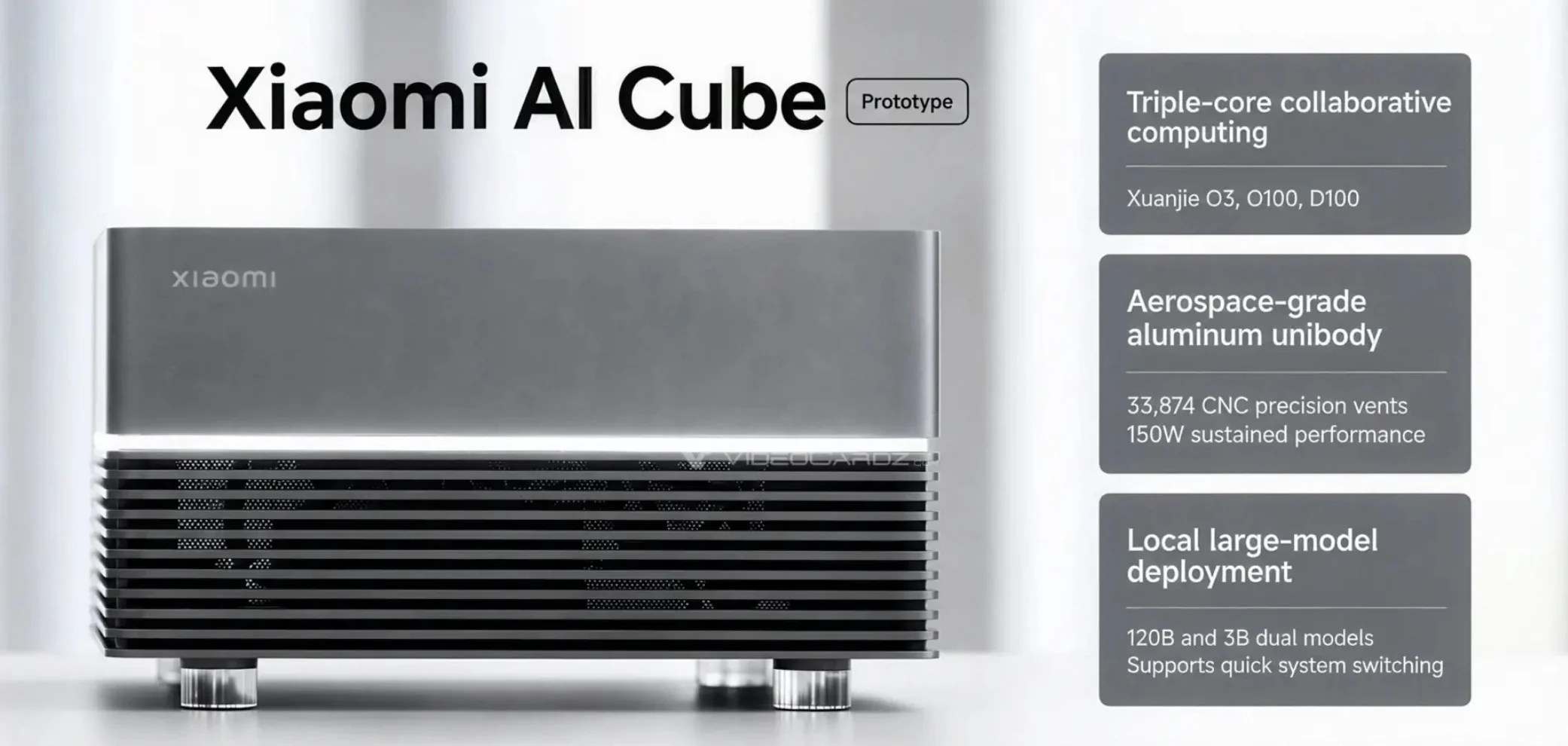
| Announced element | Xiaomi AI Cube prototype | What it means |
|---|---|---|
| Chips | XRING O3, O100 and D100 | Heterogeneous three-engine architecture |
| Prototype memory | 80GB unified | Less than today's DGX Spark |
| Demonstrated models | 120B + 3B | Models, precision and context not disclosed |
| Sustained power | 150W | In line with a compact AI workstation |
| Status | Prototype | No price or commercial launch announced |
Three chips, three roles
XRING O3 is the general-purpose SoC. Xiaomi lists a 10-core CPU, a 16-core G2-Ultra NX GPU and a 200 TOPS NPU. It acts as the conductor, handling the operating system, user input and lighter workloads.
O100 is the most original part. This 6nm accelerator stacks memory and compute at wafer level through 3D packaging. Xiaomi claims 28,672 data connections and 1.22TB/s of near-memory bandwidth. This matters for LLMs because token generation constantly moves weights between memory and compute units.
D100 comes from the automotive side. The 3nm chip combines a 20-core CPU, a 16-core NPU and support for up to 160GB of memory. Inside AI Cube, it appears to supply the capacity and sustained performance required by larger models.
The 1.22TB/s figure belongs to O100 and its near memory. It does not prove that all 80GB in the system run at that speed. We need the full memory topology and an end-to-end model benchmark before comparing it directly with DGX Spark's 273GB/s.
AI Cube, DGX Spark and Strix Halo
DGX Spark remains the easiest reference point. Its GB10 provides 128GB of unified memory at 273GB/s, up to 1 PFLOP FP4 and, crucially, a usable CUDA environment. We already know what works, which inference engines are available and how two units can be linked.
On AMD's side, the correct name is Strix Halo, or Ryzen AI Max+ 395. Systems based on it provide up to 128GB unified memory and 256GB/s. The hardware is not stuck in a dead end. ROCm now officially supports Ryzen AI Max APUs on both Linux and Windows, with PyTorch, Ollama, llama.cpp and LM Studio. A gap remains because many optimizations ship for CUDA first, and some recipes still require more adaptation on AMD.
| Machine | Memory | Published bandwidth | Ecosystem | Availability |
|---|---|---|---|---|
| Xiaomi AI Cube | 80GB in prototype D100 supports up to 160GB | 1.22TB/s on O100 near memory | XRING + MiMo, public runtime unknown | Prototype |
| NVIDIA DGX Spark | 128GB unified | 273GB/s | CUDA, TensorRT-LLM, PyTorch | Shipping |
| AMD Ryzen AI Halo | 128GB unified | 256GB/s | ROCm, PyTorch, Ollama, llama.cpp | Shipping |
AI Cube does not automatically win this comparison. It proposes a different architecture. If O100 can feed active experts at very high speed while D100 keeps a large part of the weights available, Xiaomi could reach excellent throughput without duplicating GB10's unified-memory design.
Software will decide the winner
Hardware is not enough. CUDA's lead is built from thousands of libraries, kernels, optimization profiles and well-understood behaviors. This is why an NVIDIA machine often produces good results quickly even when a competitor looks similar on a spec sheet.
AMD illustrates the issue well. Strix Halo is very capable and ROCm is moving fast, but developers still need to confirm supported versions, operators and quantizations. It is no longer the software desert some descriptions suggest. It is not yet the low-friction CUDA experience either.
Xiaomi can bypass some of that gap by optimizing a narrower stack. The company controls XRING chips, HyperOS, its runtimes and the MiMo family. Instead of supporting every model on every framework from day one, it can achieve very strong results on a smaller set of carefully selected Chinese architectures. That is less universal, but it can also be much more efficient.
MiMo, DeepSeek and the MoE leap
The MiMo connection makes sense. Xiaomi has already demonstrated an O3 + O100 mobile prototype running a MiMo model at 295 tokens per second. MiMo-V2-Flash uses a Mixture-of-Experts architecture with 309 billion total parameters and roughly 15 billion active per token. MiMo-V2.5 follows the same direction and targets agentic workloads directly.
Chinese models have closed much of the gap with the best US models across many coding, reasoning and agent tasks. MiMo, DeepSeek, Qwen and Kimi combine strong quality, open weights for selected models and efficient MoE designs. Hardware built around their needs can therefore become more than a budget alternative. It can become a leading platform.
MoE also changes how we think about size. DeepSeek V4 Flash has roughly 285 billion total parameters but activates only 13 billion per token. All weights still need to be stored, so memory capacity remains important. Throughput, however, depends heavily on how quickly active experts receive their data. This is exactly where O100's near-memory design could matter.
Community recipes already run DeepSeek V4 Flash on one DGX Spark with very aggressive quantization, while the more native path typically requires two systems. Precision, context and runtime trade-offs remain, but the direction is clear. Extremely capable agentic models are starting to fit on a desk.
What it changes for local agents
For a local agent, memory is not only about loading one large chatbot. It can keep several components active at once. A 120B model can handle difficult reasoning while a 3B model responds quickly, classifies requests or monitors events. A vision model, embedding engine and reranker can complete the stack.
- AI-assisted development. An agent can inspect a repository, write code and execute tools without sending the codebase to a third-party cloud.
- Private RAG. Documents, embeddings and answers remain on the machine.
- Specialized agents. Several roles can share one platform while using models of different sizes.
- Local multimodality. Screenshots, documents and images can stay on premises if the runtime supports them.
- Predictable cost. A regular workload becomes a hardware and electricity investment instead of a variable token bill.
For a setup such as Hermes Agent on a workstation, this kind of system could become a proper personal server. Agents remain available on the local network, keep their memory and use an open model strong enough to finish long-running tasks.
The unknowns that matter
The prototype is impressive, but many details remain unknown. We have no price, retail date, interface list or storage specification. Xiaomi has not published a benchmark comparable to DGX Spark, measured inference power consumption or a protocol that reproduces the 120B demo.
The software question matters even more. Which operating system would ship? The observed prototype used Android. Would developers get full Linux, documented drivers, an equivalent to vLLM or SGLang and straightforward support for Hugging Face weights? Without those answers, AI Cube could remain a strong vertical demo limited to models selected by Xiaomi.
Local also does not automatically mean sovereign. Keeping data at home significantly improves privacy. Sovereignty additionally requires control over drivers, updates, firmware, telemetry and model portability. A closed box running a local model does not provide the same control as a documented and open platform.
My verdict
I am genuinely interested in this machine. If Xiaomi ships something close to the prototype, prices it around DGX Spark and provides an open runtime with clean MiMo, DeepSeek and standard-engine support, the offer could be aggressive. Near-memory bandwidth promises much higher throughput on optimized models, while the advertised capacity is already enough for a serious local platform.
I would not sell my GPU based on a slide yet. DGX Spark shows less bandwidth on paper, but it exists, carries 128GB and benefits from CUDA. AI Cube still needs to prove that its three chips deliver a coherent developer experience.
The strategic signal is major nonetheless. Local AI is no longer only NVIDIA versus a handful of AMD mini PCs. Xiaomi is entering with its own chips, its own models and an end-to-end vision. If that vision becomes a product, I will seriously consider buying it for local inference.
Quick questions
What is the Xiaomi AI Cube?
The Xiaomi AI Cube is a prototype desktop AI terminal combining the XRING O3, O100 and D100 chips to run large models locally.
When will it be available and how much will it cost?
Xiaomi has announced neither a price nor a release date. The O100 and D100 chips are scheduled for commercial use in 2027, but that does not guarantee an AI Cube retail product.
Is it faster than DGX Spark?
There is not enough evidence yet. Xiaomi's 1.22TB/s applies to O100 near-memory bandwidth, while DGX Spark documents 273GB/s across 128GB unified memory. No comparable end-to-end benchmark is public.
Will it run MiMo or DeepSeek locally?
The prototype ran a 120B and 3B configuration, and Xiaomi is already tuning XRING hardware for MiMo. Exact compatibility, quantization and runtimes for MiMo or DeepSeek have not been published.
Sources
- VideoCardz, Xiaomi AI Cube and three XRING chips.
- IT Home, AI Cube prototype announcement at the XRING event.
- IT Home, 80GB memory, MiMo and local demonstrations.
- Beijing government portal, XRING commercial roadmap.
- NVIDIA, official DGX Spark specifications.
- AMD, Ryzen AI Halo Developer Platform specifications.
- AMD ROCm, LLM inference on Ryzen AI Max.
- Xiaomi MiMo, official MiMo-V2.5 model card.
- Xiaomi MiMo, MiMo-V2-Flash technical report.
- DeepSeek, official DeepSeek V4 model card.